
Stephen
Terry, Director


The
Cosmic Conflict
Commentary
for the March 1, 2025, Sabbath School Lesson
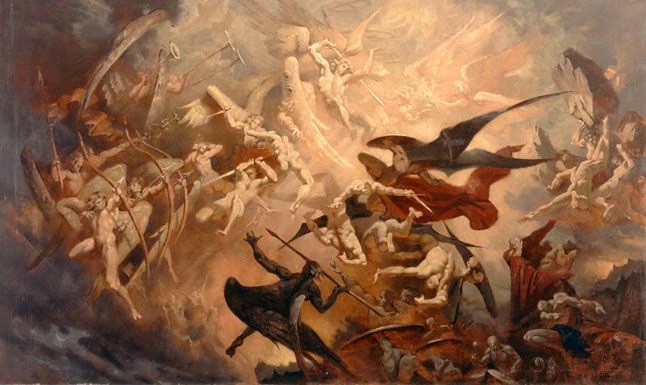 "Then war broke out in heaven. Michael
and his angels fought against the dragon, and the dragon and his angels fought
back. But he was not strong enough, and they lost their place in heaven. The
great dragon was hurled down---that ancient serpent called the devil, or Satan,
who leads the whole world astray. He was hurled to the earth, and his angels
with him." Revelation 12:7-9, NIV
"Then war broke out in heaven. Michael
and his angels fought against the dragon, and the dragon and his angels fought
back. But he was not strong enough, and they lost their place in heaven. The
great dragon was hurled down---that ancient serpent called the devil, or Satan,
who leads the whole world astray. He was hurled to the earth, and his angels
with him." Revelation 12:7-9, NIV
The story of Jesus' life here on Earth begins with His
incarnation and the miraculous events surrounding that birth. Then except for a
single Passover incident while visiting the temple in Jerusalem mentioned by
Luke,[i]
the scriptures are silent about what happened to Jesus over the three decades
when He grew from a child to a man. There are other sources that seek to unveil
this period, the most notable being the Gospel According to Thomas. However,
none of these sources found their way into our present biblical canon. While
there is not universal agreement even today on the canon of the Old Testament,
Christianity by and large has accepted the canon for the New Testament
established by the Roman Catholic Church in the late Fourth Century, C.E. The
Eastern Orthodox Church came into agreement with that canon by including the
book of Revelation in the following century.[ii]
This may be problematic for Protestants who claim they
adhere to the doctrine of sola scriptura,
the Bible as the sole authority for faith and practice. In response, our
Catholic friends might ask, "And who determined what was in that Bible?" Of
course, the answer to that is the Catholic Church, most notably at the Council
of Trent. They may go on logically to say that since the church determines what
is in the Bible, then the church is the ultimate authority even over the Bible.
Protestants on the other hand might rejoin that God preserved the inspired
scriptures despite the efforts of councils and prelates to undermine His will.
In any event, most traditions use the same New Testament canon, regardless of
how it came about.
What is significant about the New Testament is that it
ends its relative silence about Jesus when He is baptized and begins His
ministry. The accounts of the gospel writers resound with the three and a half
years of Jesus' teachings. This may be because that period coincides with the
time that the Disciples knew Him and walked with Him. The Nativity and Luke's
temple visit stories were likely recounted by Jesus or later by Mary, His
mother, after Jesus' death and resurrection. Interestingly though, although
John took in Mary at Jesus' request,[iii]
it was the Gospels of Matthew and Luke and not the Gospel of John that gave us
anything about Jesus before His ministry began, including the Nativity. If Mary
was the source of this information and she was living with John that seems
unusual. Perhaps Jesus placed a veil of silence over His past and Mary
continued to honor that.
Another possibility for the source could be Elizabeth who
figures prominently in Luke's Gospel for the Nativity and could also be the
source of the story of the Passover visit to Jerusalem. Extended families often
traveled together for festivals. Even today we have special holidays where
those in the extended family circle are made a part of
the celebration. This could explain John's silence about both the Nativity and
Jesus' childhood, although it does not necessarily explain Mark's. His Gospel,
deemed to be the earliest written, simply may have not had access to the
information contained in Matthew and Luke, which may argue strongly for someone
other than Jesus as the source of the information.
So where do we go with all of this? We can understand that
in looking at the Gospels, it is important to not let details obscure the
general concepts presented. More notably than anywhere else in the Bible other than
the Book of Revelation Jesus' teachings present a dualistic view of the
universe and therefore a parallel understanding to the perspective of modern
Christianity. The universe is divided over a struggle between good and evil,
and that struggle, which began in heaven, is now fought also on Earth.[iv]
Humans for their part are taking sides in this cosmic battle. Those who side
with Jesus Christ, do so voluntarily, while those who do not follow Christ are conscripts
of His adversary, the Devil.[v]
There is no neutral ground. Pretending the battle does not concern us or that
it does not exist will prove as futile as the proverbial ostrich hiding its
head in the sand. It is little different than modern conflicts where tens of
thousands of innocent people die during conflicts they tried to avoid.
This controversy is the ultimate source of every conflict
portrayed in literature and art. Every historical battle fought is a living
representation of what took place long ago in heaven. We may deny that such a
conflict exists, but conflict seems to have become definitive of who we are.
For all our desire for peace and an end to conflict, it eludes us, and we seem
unable to come to grips with why. The Gospels attempt to address that,
especially in the Sermon on the Mount recorded by Matthew.[vi]
Selfishness is what Jesus saw as the foundation of conflict. We want what we do
not have and are far too willing to diminish others to have
it. Put simply, we would rather see ourselves own an expensive newer car or a
large beautiful home in an upscale neighborhood, maybe even a huge place with
acreage in the country than to see the hungry fed, the oppressed set free, or
the naked clothed.[vii]
When we have more, we do all we can to secure it from those who have less instead
of building bigger tables that the poor may seat themselves and partake. Such
selfishness is completely at odds with the principle of giving shared by Jesus
who said that if we are sued for the shirt off our back, we should give our
coat as well.[viii]
Our nature is to grasp tightly what we consider ours and only releasing it when
our hands are "cold and dead."
We also can see in this the root of struggle in life. We
work hard so we can have things that we may not need but want. Then we work
continually to cover the maintenance involved. The house, the cars and the boat
all need insurance, maintenance, registration and updating. Instead of working
to have these things, we can get to the point where we are working for these
things. Like the lifeless idols that our ancestors placated with precious
offerings and food that could have helped the poor, we offer up the hours, days,
weeks, months, and years of our lives laboring to maintain these modern deaf
and dumb idols.
Sadly, as Job learned,[ix] no
matter how much we accumulate through those years of effort, it can all be
swept away in an instant. What profit is it to us then if we enroll in the
selfish side of this controversy, only to lose everything after many years? Do
we simply begin again, knowing there are not enough years left of our lives to
achieve our goal? At what point is it enough?
Even more importantly, what does our example say to
others? When we own that big, beautiful home on the hill, what does that tell
others? Isn't it a testimony that wealth should be the focus of life? And if
they have no legal means to achieve that wealth, does it place before them a
temptation to do evil to have it? Don't we see that played out in the poor
slums in our cities where drug dealing and the illusion of wealth it brings
with it are seen as answers to the grinding poverty in those neighborhoods?
When I was
twenty-one, I spent far too much money on a Porsche 911T. It took most of my
military paycheck each month to make the payments on the luxury sports car.
That Christmas, I went door-to-door with my church on
the annual Ingathering Campaign seeking donations for the poor. As we tallied
up the receipts each evening, I began to realize that I was spending more on
that car than we would raise for the entire campaign. The Holy Spirit was
convicting me over this, and I felt my face flush with shame. This, coupled
with the fact that the car created a never-ending temptation to flaunt the
rules of the road, brought me to trade the Porsche in for a much more sensible
and frugal vehicle. I would like to say that doing that solved all the poverty
in the world, but of course it did not. However, it did free up more of my
income so that I was able to contribute more to the solution and be less a part
of the problem.
We all need only to become aware that our blessings are
given to us to be a blessing to others who have not been so blessed. Putting
money into the coffers to build big, beautiful churches may only
institutionalize the same selfishness we have on an individual level, for it
does little to help the poor while helping us to feel prosperous and successful
as a denomination. We could all do with a little consideration of whose side we
are endorsing in the great controversy between good and evil by how we are
ordering our priorities.