
Stephen
Terry, Director


What
More Could I Have Done?
Commentary
for the March 15, 2025, Sabbath School Lesson
 "Very rarely will anyone die for a righteous
person, though for a good person someone might possibly dare to die. But God
demonstrates his own love for us in this: While we were still sinners, Christ
died for us." Romans 5:7-8, NIV
"Very rarely will anyone die for a righteous
person, though for a good person someone might possibly dare to die. But God
demonstrates his own love for us in this: While we were still sinners, Christ
died for us." Romans 5:7-8, NIV
When I consider the extreme
price paid by Jesus to restore the love that was thrown away in Eden by
humanity, I am reminded of the story "Were You Colder Than This?" written by
Ruth Seamand, a Methodist Missionary during the twentieth century who passed
away over a decade ago to await her resurrection at the return of Jesus. I
share this story here:
It
was Christmas Eve in Korea. An expectant mother walked through the snow to the
home of a missionary friend where she knew she could find help. A short way
down the road from the mission house was a deep gully spanned by a bridge. As
the young woman stumbled forward, birth pains overcame her. She realized she
could go no farther. She crawled under the bridge.
There
alone between the trestles she gave birth to a baby boy. She had nothing with
her except the heavy padded clothes she was wearing. One by one she removed the
pieces of her clothing and wrapped them around her tiny son -- around and
around, like a cumbersome cocoon. Then, finding a discarded piece of burlap,
she pulled it over herself, and lay exhausted beside her baby.
The
next morning the missionary drove across the bridge in her Jeep to take a
Christmas basket to a Korean family. On the way back, as she neared the bridge,
the Jeep sputtered and died, out of gas. Getting out of the Jeep she started to
walk across the bridge and heard a faint cry beneath her. She crawled under the
bridge to investigate. There she found the tiny baby, warm but hungry, and the
young mother frozen to death. The missionary took the baby home and cared for
him.
As
the boy grew, he often asked his adopted mother to tell him the story of how
she had found him. On Christmas Day, his 12th birthday, he asked the missionary
to take him to his mother's grave. Once there he asked her to wait a distance
away while he went to pray. The boy stood beside the grave with bowed head,
weeping. Then he began to disrobe. As the astonished missionary watched, the
boy took off his warm clothing, piece by piece, and laid it on his mother's
grave. Surely, he won't take off all his clothing, the missionary thought.
He'll freeze! But the boy stripped himself of everything, putting all his warm
clothing on the grave. He knelt naked and shivering in the snow.
As
the missionary went to him to help him dress again, she heard him cry out to
the mother he never knew: "Were you colder than this for me, my
mother?" And he wept bitterly. When Christ came, he stripped himself of
every royal garment and entered into our world of hatred and cold indifference.
Why did He do it? Because He saw centuries of broken lives needing a Savior.
And then He died of a broken heart. What broke it? The sin of human hearts. The
long history of men making slaves of other men. Centuries of cruelty.
Starvation and suffering. The worship of false gods in temples made with hands.
War, bloodshed, crime, and greed, those things broke the heart of Christ. But
so did we.
We
read this story, and we weep at the sacrifice the mother made to preserve the
life of her child. She was compelled by love to give
her life for the boy, even though she had no way of
knowing if the child would survive or what kind of person he would eventually
become. It is this kind of love that brought God to incarnate as a vulnerable,
baby human being. He could have come as a conquering warrior. In fact, that is
how the Jews expected the Messiah to come. Instead, he was just another child
born to a common family. He was not even known to exist by the wealthy and powerful
until the Magi appeared seeking him. Once aware, King Herod the Great deemed
him a threat and slaughtered all the male children under the age of two in Bethlehem.
Jesus had come to die to reveal the kind of love that such a sacrifice would
demonstrate, but it was not yet time, so he and his family, funded by the gifts
from the Magi, fled to Egypt, where they remained until Herod's death. Once
they returned to Nazareth, he remained subject to his parents for the remainder
of three decades before being baptized and proclaiming the Kingdom of God.
Jesus'
teachings and miracles are documented in the four
gospels. He is presented there as the essence of love
and compassion in contrast to the harsh legalism and injustice taught by the
religious leaders of the time. Sadly, little has changed since then. Those who
place compassion and love first in their understanding of God are shoved to the
side as though they were mentally disabled sinners incapable of understanding
that religion is all about exclusion, and sacrificial support is demanded of them
by religious leaders who are building power and wealth befitting their position
as evidence of how close they are to God. But it is those lost sheep who have
been cast out that God loves dearly. He knows their pain because he has been
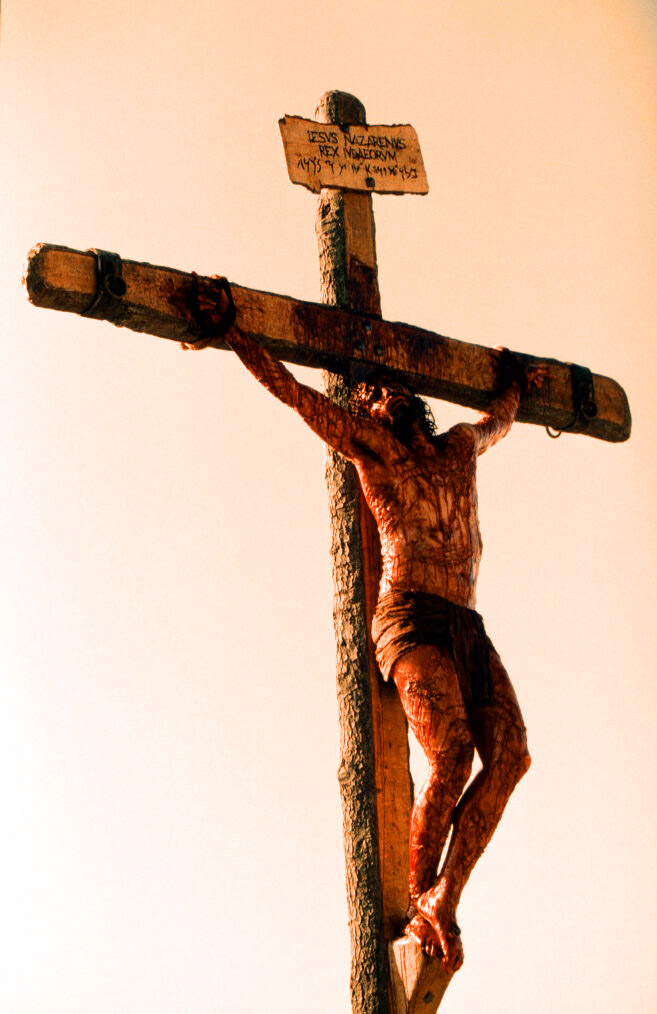
cast aside as well. Despite all the compassion he modeled, he was captured,
tortured, and nailed to a cross to die in agony. He had violated no civil
statute. His only crime was revealing religion then for the sham it was and
still is. It was not his desire that things would result in his death, but he
knew that hardened and intransigent hearts would allow no other outcome. His
death begs the question, what more could he have done than give up his life to
demonstrate God's love for humanity?
Today,
the faithful remain marginalized. Empathy and compassion are irrelevant to
those in power, both secularly and religiously. On both counts those who are
wealthy are held to be blessed by God, and those sinners who are not deserve
their lot and are far from God. Like the woman who anointed Jesus' feet, they
are felt by the religious to be great sinners with no right to approach God. (Luke
7:36-50) I have never forgotten the scene made at a prayer meeting at a
church I attended years ago when a young, male cross dresser showed up to the meeting.
The pastor confronted him and drove him away. Although he had attended church
since childhood, he was never seen there again, for the pastor threatened him
should he try to return. Lest we blame only the pastor, the church struggled to
maintain membership because they felt that being relevant to the parish where
they were planted was less important than simply
manning a bridgehead against sin lest it should somehow breach its walls. Viewing
those outside the church as beset by sin every bit as dangerous as leprosy,
they manned the ramparts and attempted to sterilize everything inside, not
realizing that the disease was already running rampant within.
The
failure of the church to model the empathy and compassion of Christ can be
traced to the root of all evil, the love of money. (1
Timothy 6:10) The world idolizes those who have heaps of it, and scorns
those who have little. Pastors and other religious leaders beg endlessly for
it. They complain that the work of God cannot go forward without it. The church
believes it is necessary to evangelize the world. In reality, much of the money raised is used to pay for more workers who
in turn ask for more money. Though they claim that God owns the cattle on a thousand
hills, (Psalm
50:9-12) he seems impotent to carry forward his work without huge
corporations, millions of dollars in salaries, and thousands of church leaders
issuing blessings as the rivers of money flow into church coffers. The church's
feelings on this are boldly displayed when they are more ready to forgive the
pastor of a parish with few or no baptisms than they are to forgive a
significant reduction in funds flowing into the denomination's accounts.
Often
the church cites the tithe support of the Aaronic Priesthood as an example to
be followed by all believers today. But that is an abominable lie. The Aaronic
Priesthood was ended by Christ, ushering in a universal Melchizedekian
Priesthood. (1
Peter 2:9 , Hebrews
5:7-10, & Hebrews
7:11) That priesthood is not only universal, it is eternal. (Psalm
110:4) Therefore those serving in that priesthood have the hope of eternal
life to fulfill their service. Those who choose to return to the methods of the
Aaronic/Levitical Priesthood are returning to the wilderness where they will
die as they did back then if they do not learn to trust God and serve him only,
not money, not powerful leaders, whether secular or religious but the teachings
and the life of Jesus. He is all in all. What more
could he have done?