
Stephen
Terry, Director


Confidence
Only in Christ
Commentary
for the February 7, 2026, Sabbath School Lesson
 "For
it is by grace you have been saved, through faith--and this is not from
yourselves, it is the gift of God." Ephesians 2:8
"For
it is by grace you have been saved, through faith--and this is not from
yourselves, it is the gift of God." Ephesians 2:8
Decades ago, I knew a child who
looked forward to birthdays and Christmases like all other children. He would
attend other children's birthday parties and during the holiday season, he
would see piles of presents under brightly shining Christmas trees when he visited
his friends' homes. There were presents from parents and grandparents, aunts
and uncles, cousins, siblings. From Thanksgiving to New Year's Eve, a spirit of
joy and family togetherness permeated the festivities. Grandma's special recipe
for squash rolls, Mom's rich cheesecakes, breaded and fried gluten steaks,
mashed potatoes with gravy, and roast turkey with stuffing, so many delights of
the season reminded everyone of the blessings they had received and the gifts
of God that had touched their lives all year. But try as he might to rejoice at
the bounty his friends and their families enjoyed, he could not deny the
differences.
The presents under his tree were
usually only from Mom and Dad, and since they were struggling financially, it
was usually a meager pile. The grandparents on one side struggled with
alcoholism which left little for presents for a grandchild. The grandparents on
the other side were religious conservatives and since they had decided Christmas
was a pagan holiday, they would not celebrate it. The grandson did not
understand the need to forego gifts to make God happy. It only seemed to him
that God was harsh and unloving, especially when he witnessed the love in other
families and their tender regard for one another, something that seemed absent
in a world of strict rules and an angry God. His parents knew that things were
dysfunctional in those extended families and did what little they could afford
to, but it could not hide the lack of love for others. Alcoholism and religious
extremism had affected not just the grandparents, but the aunts, uncles, and
cousins, never having experienced the love that should have been there, struggled
to model it themselves and remain more prone to wander down the paths of
judgmentalism, criticism, and narcissism that were modeled to them.
Decades ago, I attended some Alcoholics
Anonymous meetings with someone I was close to at the time and learned something
that surprised me. I had always assumed that to be an alcoholic, alcohol had to
be involved, but that is not true. A narcissistic personality that constantly
seeks out and forms co-dependent relationships with others but does not drink
is referred to as a dry alcoholic. This is why a person who stops drinking can
continue to exhibit dysfunctional personality traits even after years of
sobriety. It is why families of alcoholics can have similar personality traits
without ever drinking a drop. A person who is deeply religious can be a dry
alcoholic also exhibiting all the same personality traits. In practical terms,
the same refusal to give gifts or even love by the alcoholic who sees it as
threatening their means to purchase alcohol can be manifest in the person
addicted to religious extremism who sees a similar threat to the extremism that
they feel keeps alive their relationship to God. Typical to both is that they
manipulate and use others and struggle to understand love in the context of
interpersonal relationships. This affects their ability to form true friendships,
marital unions, and familial harmony. A child growing up in that world will be
shaped by it and can feel anger without realizing the source of their anger has
little to do with whatever is going on now.
It was never meant to be like
that. While dysfunctionalities have spread throughout humanity, things were
better once. The accounts in the opening chapters of Genesis reveal that to us.
We too often miss the message, unable to see the forest for the trees. We argue
over whether Creation should be considered science, history, or myth. But what
if it is really none of those even though the events seem to fit into one
category or another. What if it is more about that child caught in the
maelstrom of turbulent relationships it has no control over and the storm of emotions
and reactions that lie just beneath the surface waiting to be triggered? Considering
how far we have fallen and how people have been hurt by it, what if we can benefit
from a second look?
The apostle John tells us that "God
is love." (1
John 4:8), and Genesis tells us that humanity was made in God's image. (Genesis
1:27) What if instead of looking for scientific support for Creation, or
historical verification of Earth's chronology, we looked for love? Given those
two supporting verses, it is there of course. And as the small boy at the
beginning of this commentary witnessed, love is often seen as gifts given. We
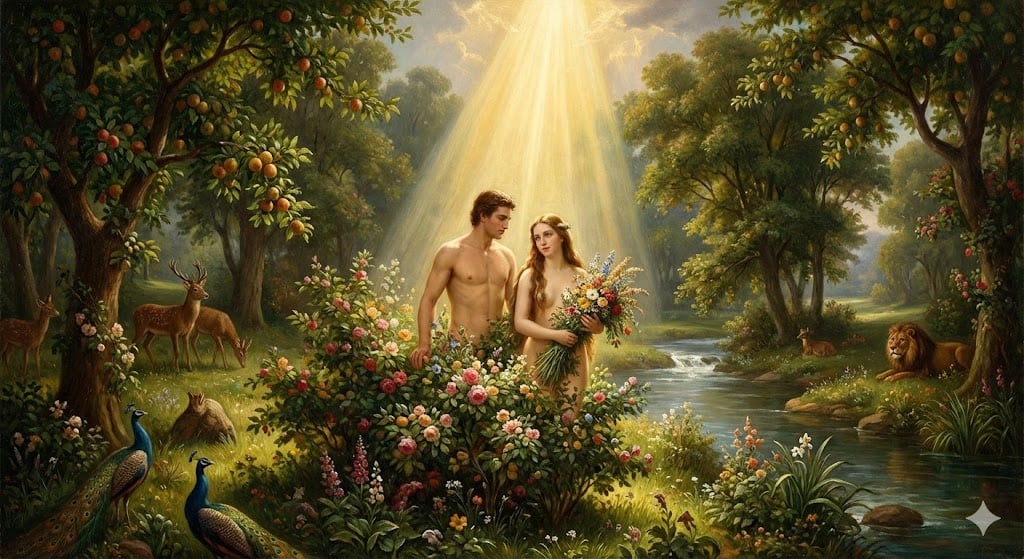
see for instance many gifts given at Creation. Sea life was given abundant water
to dwell in. The birds of the air were given the skies to soar through, and the
fauna on land were given meadows for grazing. In fact, there were so many gifts
given it can become challenging to list them all. The bee was gifted the pollen
and honey from myriad blossoms. Those same blossoms were gifted the bees to
fertilize plant reproduction. All the gifts must have made it a time of joy and
celebration. God even gave Creation the loving human beings, made in his image,
to benevolently reign over it all. In recognition of that compassionate stewardship,
God brought each animal to Adam that he might give them the gift of names. (Genesis
2:19-20) I would have loved to have
been there to hear those names and the reason for each one. He even gifted his
wife's name to her after she was created, and the Bible even tells us why he
chose the name he did. (Genesis
2:23) He calls her "Woman," the one who came out of man, but later calls
her "Life" in Hebrew, translated "Eve" in English (Genesis
3:20), since all of humanity's descendants would spring from her womb.
Even after all of that, God
still had gifts to give. On the seventh day of Creation, God gave one of his
greatest gifts. The reason we know it is a gift and not a reward is because it
was given right after humanity was created. There had been no opportunity for anyone
to earn a reward. The gift he gave was a day memorializing the relationship
between God and his Creation. It was a day of rest. After the cacophony of all
the animals coming forth at God's word, a time of stillness and peace, a time
of rest was given as a reminder that all God had gifted his creation was not because
of obligation to do so, but from love. Unfortunately, as our opening
illustration revealed, we have fallen far from that standard. We have taken the
gifts God has given and made them ugly and onerous. For instance, we have
transitioned from the lovely and gracious gift of the Sabbath rest day and made
it a heavy burden, warning one another if we do not observe it to the minutest
detail, God will smite us in response, and we may lose all hope of heaven. We
have turned the loving God that gave so many gifts from his heart-felt love
toward us and turned him into a vengeful, spiteful ogre eager to inflict pain
and suffering at every opportunity when he catches us in even minor
infractions. The irony is that since we see ourselves as being in his image, we
have taken on the distorted image we created for him and have become ogres
ourselves. We so easily become petty spies seeking to catch out one another that
we might drive from fellowship those who do not measure up.
For too many of us, our hearts
have turned to stone, and we give no more thought to snuffing out a human life
than we would to swatting a fly. Letting love die out like we have has left an
emptiness in the very pit of our being. We were created to love, and without it
we are devoid of purpose, so we seek to create a new purpose, the purpose of
subduing and dominating others, manipulating them through fear and taking all
they have to fill the void we feel. But in the end, when life runs its course,
the emptiness remains and all that we have stolen from those we have dominated
is little more than sand running through our fingers. Life was never about
possessions. It was also never about harshly dominating others. That kind of
domination is not driven by love. It is driven by fear of what others might do
to us if we do not dominate them to prevent it. Why do we feel this fear? It is
because we know what we have become and because we would do it to them, we believe
they would do it to us.
Jesus came not only to sacrifice
himself on the cross on our behalf. It was also to remind us that everything,
the foundation for all Creation, the reason for our existence, the reason for
Christ's crucifixion, and the very essence of Gods nature is summed up in only
one word, "Love."