
Stephen
Terry, Director


The
Preeminence of Christ
Commentary
for the February 21, 2026, Sabbath School Lesson
 "For in him all things were created:
things in heaven and on earth, visible and invisible, whether thrones or powers
or rulers or authorities; all things have been created through him and for him.
He is before all things, and in him all things hold together." Colossians
1:16-17
"For in him all things were created:
things in heaven and on earth, visible and invisible, whether thrones or powers
or rulers or authorities; all things have been created through him and for him.
He is before all things, and in him all things hold together." Colossians
1:16-17
This week's lesson is a
complicated one. This is not because it has not been addressed before. In fact,
it has been addressed continually for almost two thousand years. Its roots are
founded in the controversy over whether Jesus was the promised messiah, and if
so, what does that even mean? What is the nature of this messiah physically and
spiritually? What role does divinity play in the relationship between God and
humanity? Is Jesus' nature divine, human, or both?
The synoptic gospels deal mostly
with Jesus' biography as history and providing junctures between his life and
the writings of the ancient prophets. While glimpses of his nature may be seen
in those accounts, it is more often the other way round, as revelations of his
nature shed brighter light on those gospels. It is John who penetrated most
deeply into Jesus' nature even using the metaphor of light and its illumination
of the darkness to reveal Jesus' purpose and character. It is also John, in his
first epistle, who succinctly sums up that character in only three words-- "God
is love." (1
John 4:8) Despite this simple answer and John's light metaphor, the
controversy over Jesus' nature has produced far more heat than light in the
years since those first century experiences.
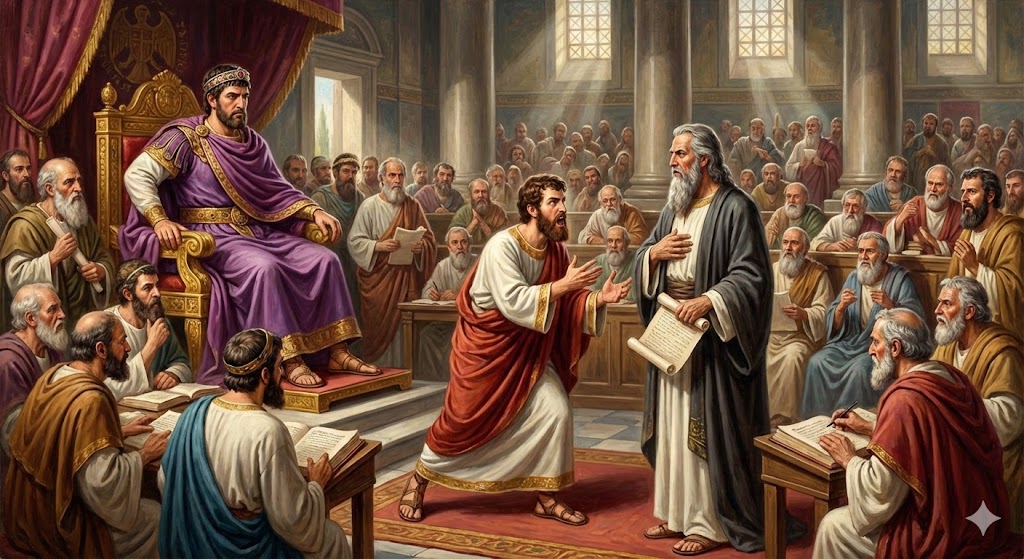
The arguing became so bitter that
Emperor Constantine I was called upon to intervene, and he presided over the
First Council of Nicaea in 325. Although hundreds of bishops attended the
council, the leaders of two factions in Christendom spearheaded arguments for
their cases before the emperor. Arius, a presbyter or elder from North Africa
in an area we now refer to as eastern Libya, argued that Jesus was a fully human
created being and not divine, while Athanasius, a theologian from Alexandria in
Egypt maintained that Jesus' nature consisted of underived divinity. After
hearing the arguments, Constantine ruled against Arius, confiscating his lands
and titles. Later, repentant for that ruling, he restored what he could to
Arius, realizing that the imperial throne had been used to settle scores by
Athanasius. While church historians like to point to Paul's journey to
Jerusalem to visit the apostles residing there as the first church council, it
was never debated by the entire church. It was only a discussion by Jews who
followed Jesus and whether they would recognize Gentiles on an equal footing as
God's chosen. A sect of Jewish Christians who came to be known as Ebionites
rejected that idea and demanded circumcision and other Mosaic legal
requirements be fulfilled for fellowship as Christians. Coincidentally, they
also believed like Arius that Jesus was human and not divine. Although there
are no records that trace the connection, this may have been the pot that
served up the stew that Arius was sharing. With this controversy stirring up so
much greater participation from across the empire, Nicaea seems a better
candidate for first church council.
Paul, ever the diplomat seeking
to build up what others threatened to tear down with their warring factions did
not help matters when he wrote of Jesus, "The Son is the image of the invisible
God, the firstborn over all creation." (Colossians 1:15) This passage continues
to be a touchstone for conflict with some translators giving us "of all
creation" and others giving us "over all creation." The key to translation
depends upon the theological bias of the translator. Those who continue to side
with Arius choosing "of" and those siding with Athanasius and the Nicaean Creed
voted by the council favoring "above." For centuries after Nicaea, Rome and
Byzantium went with the council's decision and rejected Arianism, while North
Africa sided with Arius. The Vandals who swept through Iberia and North Africa
adopted Arianism and became ardent enforcers of that dogma, deposing bishops
and destroying churches that refused to reject the Nicaean Creed. This continued
until Emperor Justinian I of Byzantium conquered them in 534. But conquering
through warfare rarely extirpates competing theologies. It only drives them
underground where they continue to grow. As Tertullian wrote in his "Apologeticus,"
"The blood of the martyrs is the seed of the church." He was referring to
martyrdom of Christians in general, but the same has proven true even for sects
within Christendom. The teachings of Arius did not die out and are still taught by the Jehovah's Witness denomination.
It is a defining attribute of
religion that once something has been declared truth
that it takes on a life of its own and becomes unassailable from within the
fellowship of believers that proclaimed it. While egos and politics are
certainly factors, the declaration of any dogma to be a foundational pillar of a
denomination makes it impossible to fine tune that "truth" beyond the moment it
was set in concrete. It mandates that any advance beyond the limits of existing
doctrine is heretical and anathema. Deemed an existential threat, such
explorations are excised as though malignant that the
existing doctrines be preserved in all their purity
and not be allowed to be contaminated
by the thinking of the naïve or the weak. While hundreds
of thousands have died in inquisitions, holy wars, and excommunications that
left individuals and families destitute of means of support, nothing was changed by these battles. Ancient
practices considered heretical are still observed
today. If that were the case, witchcraft and paganism, would have long
disappeared from the face of the earth, but both continue to find new
adherents.
Advances in theology also
continue despite the challenges they raise to orthodoxy. Those denominations
structured for expansion find themselves fitting more diversity under the big
tent fellowship they foster. Unitarian Universalists attempt to achieve this
and perhaps they do in some locations, but their local church spends a lot of
energy on self-righteously bashing Christianity for their intolerance while not
seeing the irony. The idea is inclusive, but the application, if done poorly,
can engender more bitterness than healing.
Our problem in arguing over the
nature of Christ seems to emanate from our limited perception of God. We are
like two-dimensional beings arguing over the nature of three-dimensional space
and the beings that inhabit it. To us, a line drawn on a sheet of paper would
be a physical barrier to movement. We would not possess the ability to move in
the third dimension that would allow us to simply step over it. Further, a
three-dimensional being stepping over that line would move in and out of our
two-dimensional world magically appearing and disappearing at will. We would
not have the tools to explain that. We might describe the ability as god-like.
We might extrapolate all sorts of god-like abilities based on our limited
observations. We might even go further than that and declare that those who challenge
such constructed explanations as being heretics. This criticism is made easier because they can no more
disprove our claims than we could prove them because they are
limited to the same set of tools we all possess.
Once we accept that we do not
have the tools to define God beyond the limited constructs we attempt, maybe we
can finally arrive at the point where we can stop pulling out by the roots
anyone that does not look like a believer that accepts our construct over those
of others. A key problem with such constructs is that they need defending, and
since God is not inclined to defend what we think he should be defending, we appoint
ourselves vicegerents to fill the need, not realizing that it is our construct
of God that we are defending and not God himself. He must weep to see us willing
to die for a construct instead of abandoning those constructs for reality. If
we were created in God's image (Genesis
1:27), and "God is love," (1
John 4:8) then that image is love. For us, that seems as difficult to
define as God. It means no one need die fighting over God's nature. Doing so is
to define us as ungodlike and therefore neither Christian nor destined for
heaven where failing to love would prevent us from finding root in an environment
permeated with love.
This life is a school. With
helps like the Bible and the Holy Spirit, we are given the opportunity to
develop a character that will mesh completely with the love of God. We will
find joy in companionship with him as Adam and Eve once did in Eden. But we
cannot develop that character by seeking to roast others because they do not
measure up to what we think they should be. As we grow in Christ, we discover
that we do not measure up in every respect either. That is where grace is made
possible by God's love even beyond our understanding. If we were treated as we
treat others, we would have no hope, no future. But at every instant, God
offers us the opportunity for repentance and change. We can live in bitterness
of spirit, or we can walk toward God and become more loving, more in his image
with each step. This is vital. Fighting with others over the nature of our
constructs is not.