
Stephen
Terry, Director


Shining
as Lights in the Night
Commentary
for the January 31, 2026, Sabbath School Lesson
 "Those
who are wise will shine like the brightness of the heavens, and those who lead
many to righteousness, like the stars for ever and ever." Daniel
12:3
"Those
who are wise will shine like the brightness of the heavens, and those who lead
many to righteousness, like the stars for ever and ever." Daniel
12:3
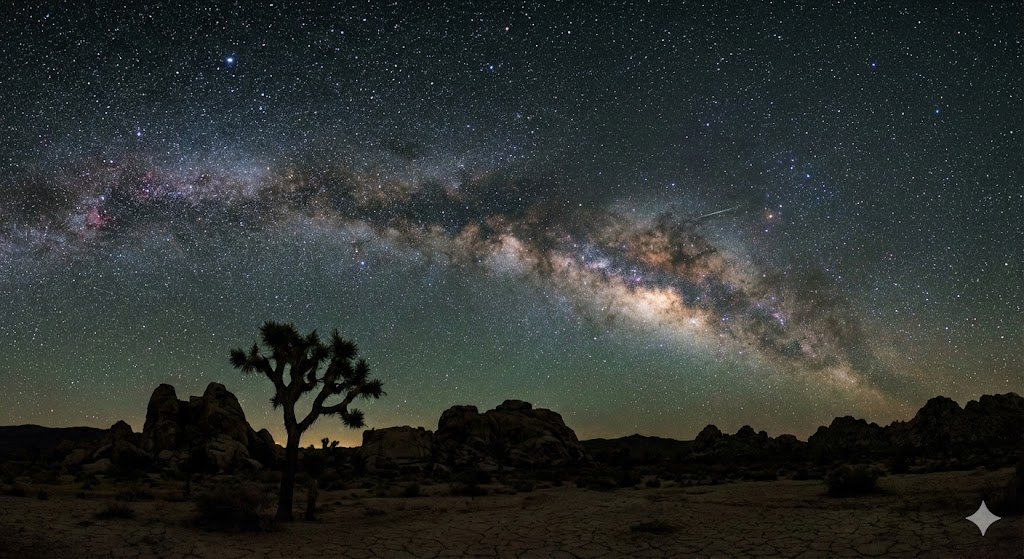
Depending upon one's visual
acuity, anywhere from three thousand to four thousand stars may be seen with
the naked eye in the night sky when the conditions are ideal, without overcast,
light pollution, and with a wide expanse for viewing. The vast, starry expanse
can seem breathtaking, even overwhelming. The thousands of points of light
shimmer as though beckoning for our notice. The Milky Way, the disk edge of our
own galaxy stretches across the starry background, making it seem as though
space is remarkably close. But that nearness is because of a foreshortened
perspective. It is like when we sit behind the umpire at a baseball game and
look out toward the pitcher's mound. The distance between the pitcher and the
batter looks much shorter than it is.
While all the stars that fill
the night sky seem reachable if we have the technology to travel in space, the
expanse they fill is almost a hundred billion light years across. Reaching even
the nearest stars would mean transiting distances of several light years. Each
light year is about six trillion miles in distance. If we could travel at the
speed that light travels, we would travel that six trillion miles, and in a
year, we would still find ourselves less than a quarter of the way to the
nearest of all those stars we see, Proxima Centauri. Despite the illusion created
by foreshortening, most of space is devoid of stars. Yet, during the night when
the sun does not overwhelm the view, billions of stars, blazing infernos like
our sun, send light out into the expanse across a broad spectrum of both
visible and invisible light. Because that spectrum is so broad and because eyes
vary in size, shape, and form across many species, what we see when we look at
the stars may vary significantly from what another species might see should
they be tempted to lift their heads toward the sky. Would they be as impressed
as we are?
What if there were no stars?
Apart from the fact that life as we know it would not exist, we would not be
able to distinguish the earth from the sky. Absent light, there would be
nothing to define shape or distance to our eyes. It would be like being in a darkened
box that was large enough we could not feel its dimensions. Could we remain
sane for long in such an environment? Since our sun is also a star, day and
night would cease, and darkness would be our entire experience. Would eyesight still
provide an advantage that could be selected for over generations, or would we
lose whatever eyesight we have as certain small fish and other creatures have
while living entirely in dark caverns below the earth's surface? Light and the
ability to use and interpret it are essential to our being as well as most life
on earth. The flora rely on it for photosynthesis, and the fauna rely on it for
essential nutrients such as vitamin D. This does not begin to account for the
problem that species thrive within certain temperature ranges moderated by the
sun, our distance from it, and the atmosphere.
In folklore, darkness has come
to be associated with danger and evil. Even though there may be no real basis
for fear, our neck hairs rise on end if we must transit a dark alley at night,
or if we pass by a cemetery at midnight that would not cause such a reaction at
noon on a sunny day. That metaphor for evil persists across genres whether it
is Darth Vader in "Star Wars" or old westerns where the bad guys all wore black
hats and the good ones wore white. This has had an unfortunate effect on relations
between different ethnic groups, with humanity consciously or subconsciously demonstrating
a preference for those with lighter skin tones and a prejudice against those
with darker ones. Even in cultures where everyone might be considered darker, similar
prejudices exist even though none could be considered white but only less dark.
This has led to strange assumptions in the religious world. Even in the Bible,
we see God and Jesus portrayed with light, brightness, and white garments. While
skin tones in the Levant are darker, many artists' depictions of Jesus have
portrayed him as white, Nordic, and with light colored hair, an assertion drawn
upon as justification for white colonialism and the need to subdue the lesser,
darker races and introduce them to the white messiah.
Although John was writing metaphorically,
nowhere is this focus on light versus dark clearer than in the first and third
chapters of his gospel. (John
1:9-13 & John 3:19-20) The world is dark and opposed to the light that
God has brought into the world through Jesus. It refuses to acknowledge that it
needs light, thereby also denying how dark everything is. But a property of
light is that it shines into the darkness revealing the truth about the
darkness. Those who deny that truth also reject the light that reveals their
own dissembling. In a world full of darkness, the truth they are bonded to is
that it is much easier to manipulate others through fear. Fear because who knows
what might be hiding in the darkness? Better to listen to our fears, cower, and
survive. But when that does not work as the light reveals nothing was hiding in
that darkness, the ability to make others fearful vanishes. Once having
experienced the light, it is hard to return to darkness, but possible. If we
choose to succumb to fear once again, we will be on our way back to letting
others manipulate us through that fear. How do we avoid that?
The world is full of enemies,
but if we do not fear them, they lose their power over us. We cannot simply
choose not to fear them. Our hearts have turned to stone through fear. We are
afraid to open our hearts to others because in the past it only resulted in
pain and betrayal. That fear keeps us from healing. But while we cannot heal
ourselves, God can and will if we come to him. He will give us hearts capable
of loving. Through the prophet Ezekiel, God tells us, "I will give you a new
heart and put a new spirit in you; I will remove from you your heart of stone
and give you a heart of flesh." (Ezekiel 36:26) If we have lived our entire
lives in fear, this sounds too good to be true. Besides, our fear has led us to
do so much we now regret. How can God ever fully trust us when we do not even
trust ourselves?
First, Paul tells us that
everyone has this issue because we all have sinned. (Romans
3:23) But that is not a barrier to change. John tells us, "If we confess
our sins, he is faithful and just and will forgive us our sins and purify us
from all unrighteousness." (1 John 1:9) This means that our recognition of our
sinfulness is part of the process of healing and a positive step away from
fear. When the Jews at Pentecost became aware of their sins, they were
distressed and asked Peter, "What shall we do?" And Peter replied, "Repent and
be baptized, every one of you, in the name of Jesus Christ for the forgiveness
of your sins. And you will receive the gift of the Holy Spirit. The promise is
for you and your children and for all who are far off--for all whom the Lord our
God will call." (Acts 2:37-39) Jesus himself said, "Very truly I tell you,
whoever hears my word and believes him who sent me has eternal life and will
not be judged but has crossed over from death to life." (John 5:24) The
greatest fear to plague humanity is the fear of death. Jesus told us not to
fear the one who can only kill the body but cannot do more. (Luke
12:4)
When God created humanity, he
created us in his image. What is that image? John tells us, "God is love." (1
John 4:8) He wants to recreate us in that image. That is why in his Sermon on
the Mount, Jesus told us to love our enemies as even God does. And we should be
perfect in loving as he is. (Matthew
5:43-48) John tells us, "Whoever lives in love lives in God, and God in
them." (1 John 4:16b) When God takes our stony heart and recreates it to be
capable of loving again, that is the secret to no longer living in fear. Fear
and love cannot coexist. One will drive the other out. As we allow God to perfect
love in our hearts, fear will no longer find a home there. (1
John 4:18)
The Prophet Isaiah says that God
one day "will swallow up death forever. The Sovereign Lord will wipe away the
tears from all faces; he will remove his people's disgrace from all the earth. The
Lord has spoken." (Isaiah 25:8) And our response on that day will be "Surely
this is our God; we trusted in him, and he saved us. This is the Lord, we
trusted in him; let us rejoice and be glad in his salvation." (Isaiah 25:9)
That is the power of love over fear. "And now these three remain: faith, hope,
and love. But the greatest of these is love." (1 Corinthians 13:13)