
Stephen
Terry, Director


Foundations
for Prophecy
Commentary
for the May 17, 2025, Sabbath School Lesson
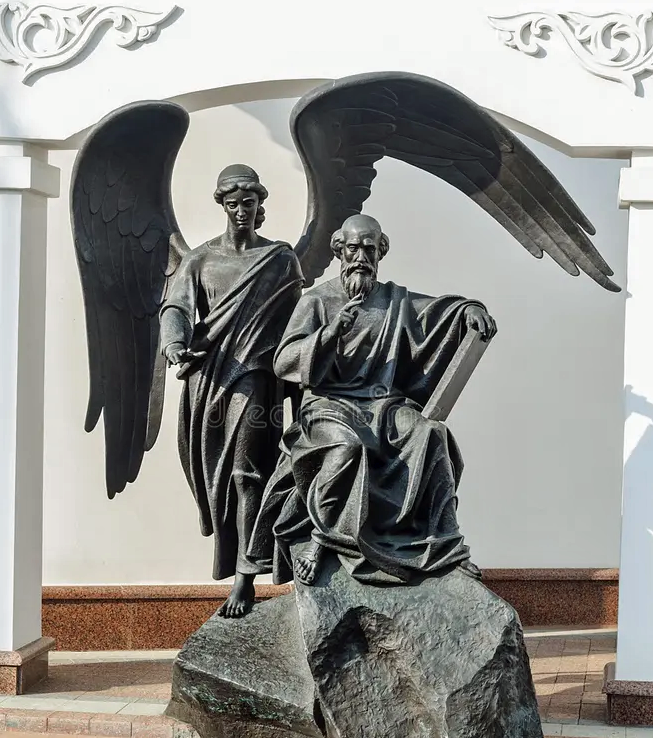 "I warn
everyone who hears the words of the prophecy of this scroll: If anyone adds
anything to them, God will add to that person the plagues described in this
scroll. And if anyone takes words away from this scroll of prophecy, God will
take away from that person any share in the tree of life and in the Holy City,
which are described in this scroll."
"I warn
everyone who hears the words of the prophecy of this scroll: If anyone adds
anything to them, God will add to that person the plagues described in this
scroll. And if anyone takes words away from this scroll of prophecy, God will
take away from that person any share in the tree of life and in the Holy City,
which are described in this scroll."
Revelation 22:18-19, NIV
Our
Sabbath School Lesson Quarterly goes a little off the rails this week. While it
claims to be setting a proper foundation for prophecy, it does so by asserting
that two cherubim were guarding the gate to Eden after humanity was expelled.
There is no biblical basis and none in "Patriarchs and Prophets" by Ellen White
for this assertion of exactly two cherubim. While it is true that words ending
in "-im" in Hebrew are plural as in cherubim, that ending does not specify two,
but simply more than one. I do not know if the lesson author or the editor was responsible
for this slip up, but no source for there being two cherubim is cited other
than to claim a dubious link between the two cherubim over the Ark of the
Covenant and those guarding Eden. Sometimes, if we do not know, we should
humbly admit it instead of concocting ideas that then call for ever more
strained defenses to shore up the rickety structure we are insisting is truth
as opposed to sticking to the script God has preserved.
Another
troubling slip is the assertion that the faces on the four-faced cherubim in Ezekiel
and Revelation are the symbols on the standards of the leading tribes on the
four sides of the wilderness tabernacle. The authors of a 2011 commentary are
cited as the source, but that commentary claims it is based on rabbinic
tradition, without any citing of the Talmud or Midrashim to back up that claim.
What passes for scholarship in our Sabbath School Quarterly has seriously gone
downhill. It is little wonder that in parts of Europe they prefer to publish
their own lesson quarterly. For those who might feel this is unimportant, if
John could write such strong words about those who add to or remove words from
Revelation, how much more so does it apply to those who rewrite Torah?
A
proper foundation for understanding prophecies is to stop building tenuous structures
based on suppositions or maybes. Or at least admit that is what they are before
someone leans too heavily against the walls of our house of straw and collapses
everything. Our denomination is already facing this over the idea of an
investigative judgment beginning in 1844. This is based on a supposed vision by
Hiram Edson while walking through a cornfield the day after the Great
Disappointment of October 1844. Despite Edson never claiming it was a vision
and never writing an article for the Review about it, even though he wrote
articles on other topics, a mythology has built up about the event that served
the purpose of a discredited denomination that had become a laughing stock to
their friends and neighbors. It allowed the little flock to say, "See, we were
right all along. We just had the event mixed up." Conveniently, since the event
has been switched to heavenly places not visible to human eyes, humanity cannot
gainsay what did or did not take place in 1844. What is known, however, is that
despite the "vision" supposed to have taken place the very next day, that
little flock of pre-Seventh Day Adventist believers,[i]
did not accept it for several years, continuing to believe that probation had "shut
the door" on those who did not believe that anything significant happened in
1844. To a degree, that thinking persists as ministers have been defrocked for
questioning the circumstances that gave rise to the Investigative Judgment doctrine.
Even today, only those not in denominational employment are able to question it
without financial repercussions. As was related to me by a ministerial
secretary who oversaw the pastoral staff for one of our larger conferences
several years ago, the church uses money to control freedom of thought, firing
those who step out of line.
The
Seventh-day Adventist Church considers itself the "remnant" of Revelation, chapter
12, keeping the commandments of God and having the testimony of Jesus. (Revelation
12:17) A remnant is defined by various dictionaries as "all that remains of
something." If that is the case, then the denomination claims to be all that
remains of God's people. However, most Adventists believe that God saves people
outside of Adventism which is a schizophrenic theology for how can the "remnant"
be defined as the denomination defines it without believing that the definition
of what constitutes a remnant would mean that all true believers will eventually
become Seventh-day Adventist until there are none of God's people outside that
narrow definition. As unlikely as this seems, it becomes even more so when we
consider the second part of the qualifications for being the "remnant." The
denomination defines the "testimony of Jesus" according to Revelation
19:10 were the testimony of Jesus is called the "spirit of prophecy." This
epithet, Spirit of Prophecy, is widely used as a euphemism for referring to
Ellen White, whom the denomination holds to have been a prophetess of God.
Whether one agrees with that determination is not the point, for absent a purge
of membership, there are many who struggle with that who are nonetheless on the
church books. The point that needs to be understood here is that defining the
second characteristic in this way means that, no matter where someone does or
does not fellowship, accepting Ellen White as divinely inspired is an essential
qualification to be in the remnant as defined by Adventism.
The
arbitrariness of this definition is an indictment of proof texting our way to
salvation. While this has become an iron clad determinant for many within the
denomination as to who is and who is not Adventist, the phrase testimony of Jesus
could just as easily be referring to all the recorded teachings of Jesus and the life he lived, something of which John the Revelator was well aware. John,
brother of James, had gone from being considered one of the "sons of thunder" (Mark
3:17) to calling himself in his gospel the disciple whom Jesus loved. (John
19:26) In his epistles, John wrote extensively about love and its role in
our relationship to God and the rest of humanity. He came to understand the
love of God more than any other disciple. This may have been why Martin Luther
had difficulty accepting Revelation as legitimate as it was harder to see love
with all the imagery of destruction and judgment.
As a
denomination, we have lost sight of the very things about Jesus that filled
John's heart with love for his teacher. Christianity, and Adventism is not an exception
to this despite their "remnant" claims, has devolved into a fortress mentality,
and like Horatio at the bridge, is determined to hold out against the enemy to
the death if necessary. When I think of the sheep who have been
driven from fellowship due to this mentality in my lifetime, it breaks
my heart. If the commandments of God resemble even remotely Jesus' teaching
about loving God and loving our neighbor, and if the testimony of Jesus is to
be loving, then we have gone seriously astray. In so many churches, and not
just Adventist churches, the church members cannot even consider the people who
live right next door to the church as friends to be loved. Instead, we drive
many miles from other neighborhoods to worship in neighborhoods where we know no
one. And once we have performed our weekly worship ritual, we bundle ourselves
back into our vehicles and drive back to our own neighborhoods, leaving the
residents around the church to wonder why our church is even there in their
neighborhood. This remote migration has the added, but sad, benefits that no
one around the church has any idea what the lives are like of those commuting
into the parish, and no one where we live has any idea what we do when we leave
weekly for that far off church. All the better to avoid accountability for the
faith we profess.
I
cannot help but wonder if we eschewed all the creeds we created to keep people
out and instead just loved one another, what would ensue? It is fear of the
other that keeps that from happening. There are so many that are using fear to
manipulate others, politically, religiously, and corporately, it can be hard to
see the invisible chains they are forging for us through appealing to our
fears. And when we succumb to those fears we become willing participants in
forging those chains for others as we recruit them to our fears. It is long
past the time when we should replace our fears with the love Jesus taught. When
we do, we will discover that fear and love cannot dwell together, and love is
the better choice. As the Apostle Paul wrote, "And now these three remain:
faith, hope, and love. But the greatest of these is love." 1 Corinthians 13:13