Stephen
Terry, Director


Images
of the End
Commentary
for the June 28, 2025, Sabbath School Lesson
 "For God so
loved the world that he gave his one and only Son, that whoever believes in him
shall not perish but have eternal life. For God did not send his Son into the
world to condemn the world, but to save the world through him."
"For God so
loved the world that he gave his one and only Son, that whoever believes in him
shall not perish but have eternal life. For God did not send his Son into the
world to condemn the world, but to save the world through him."
John 3:16-17, NIV
Jonas
Salk is famous for inventing a successful polio vaccine. He is noted for giving
the vaccine to the world without a restrictive patent that could have
potentially made him a very wealthy man. I knew none of this when in the first
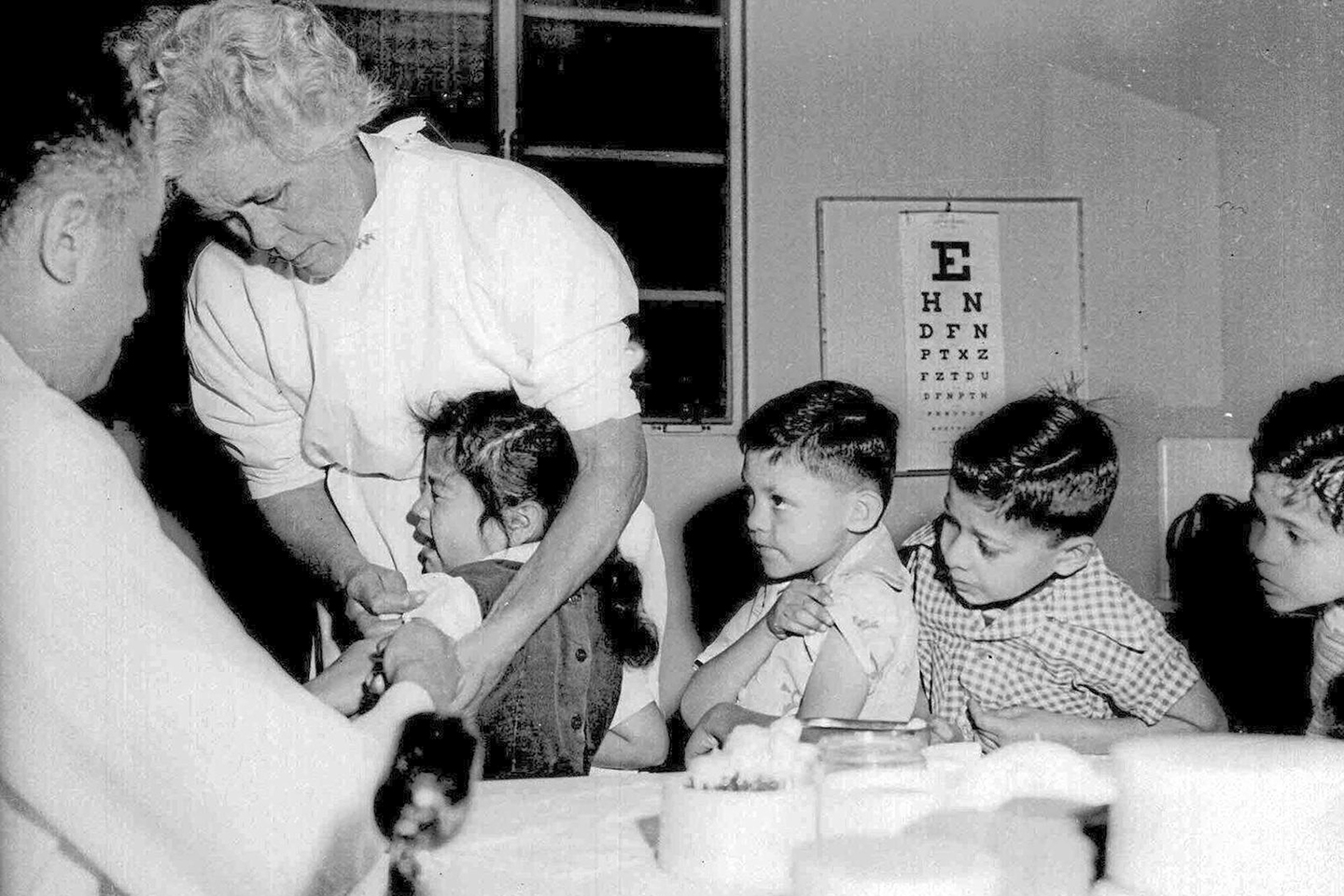
grade, I was lined up with dozens of other children to receive that memorable
jab in the arm. It was mandatory. Even our parents could not excuse us because
polio had become such a scourge in the United States. Children who contracted
it could be disabled for life, even ending up in an iron lung to maintain the
ability to keep breathing. The fear of those outcomes drove research into how
to combat the disease and once a successful vaccine was developed, mass inoculations
began. While some stout boys approached the person
with the needle with a stiff upper lip, there was also much
wailing and gnashing of teeth as we all waited our turn in long lines snaking
down the hallways of Frank Givens Elementary School.
Due
to improper preparation by some manufacturers of the vaccine, hundreds of
children were given polio instead of being given the expected immunity.[i]
Often due to religious reasons, a general hesitation to willingly seek
vaccination has been present in the United States all the way back to the
development of Smallpox vaccine. This accidental infection of schoolchildren fed
into those fears, and fear of vaccines has continued to be a major limiting
factor up to the present that came to a head during the recent Covid Pandemic.
But, as children, most of us only resisted because of the pain of being jabbed
with a sharp needle. Later elementary students in the 1960s were relieved to be
able to take oral vaccine instead. However, other vaccines meant that the
painful poke continued to be a nemesis of childhood.
Much
of the philosophical or religious opposition to vaccinations comes from adults,
not children. It raises the question of how much a person is willing to sacrifice
to save the lives of others. As a former Army medic, I know that it is standard
practice for combat medics to risk their lives to save the lives of their
fellows, moving through a hail of gunfire to reach a wounded comrade, patch him
up as much as possible, and move him to safety. Desmond Doss, a Seventh-day
Adventist who became a combat medic during World War II, was wounded four
times, received two bronze stars, and the medal of honor for saving the lives
of over fifty men on Okinawa. He became permanently disabled and was unable to
resume his civilian career after the war. This is a stark contrast to those who
would not so much as receive a vaccination that could save the lives of far
more than Doss had saved. Could it be that today we are more willing to
sacrifice our lives for things than for people? Or are we simply more afraid
than we have ever been? We live longer than previous generations and have more
options for physical activity and improved diets. Yet even though we know
beyond doubt that aging and death comes to all whether plant, animal, or human
being, we act as though death is not as much a part of life as birth.
How
strange that someone who had no need to face that greatest of all fears would
willingly submit to it. This was no vaccine that only had a remote chance of causing
death or disability. Jesus came and stood in line knowing that his jab would be
a death jab. But his love for humanity was such he could not do otherwise.
Jesus, who was actively involved in our creation and completely in control of
all things (Colossians
1:16), willingly submitted himself to that death as nails pierced his
wrists and his ankles on the cross and an agent of the government, a Roman
soldier, drove his lance into Christ's side to make sure the job was done. Paul
the Apostle wrote, "Very rarely will anyone die for a righteous person, though
for a good person someone might possibly dare to die. But God demonstrates his
own love for us in this: While we were still sinners, Christ died for us."
(Romans 5:7-8)
We
understand this to a degree. We may not sacrifice our lives for those we do not
know, even though they may be worthy of such a sacrifice, but many would do so
for their children or grandchildren. They are our charge based on procreation.
Scientifically, they propel our DNA into the future, and many
species have that ingrained, enabling the survival of that species. In a sense,
a similar argument might be made for Jesus. We are his charge based on
creation. We were created in the image of God. (Genesis
1:27) He was willing to give up his life to enable that image to be
propelled into the future eternally. But what is that image that is so important
that Jesus needed to die to ensure it would endure. The Apostle John tells us what
it is. "God is love." (1 John 4:8) This is the essence
of all life since the beginning.
It
does not take much observation to determine that humanity has mostly chosen a
different path. Fear, rather than love, has become the understood basis for
life. Jesus said this would be so, that fear and terror would be enough to
cause fainting or heart failure. (Luke
21:26) He said we would be living in a loveless society, but the rare
person who could continue to be loving despite all the fear and evil, would be
saved. (Matthew
24:12-13) It is hard to understand why people would choose fear over love,
but love includes a willingness to be vulnerable. Jesus demonstrated that
vulnerability in the extreme. Despite angel armies willing to save his life in
an instant (Matthew
26:53-54), he allowed himself to be painfully tortured. His flesh was
ripped from his body and then he was hung on a splintery cross where he was
jeered at and cursed by those he had come to set free. That is how willing he
was to be vulnerable to demonstrate his love. This vulnerability can be hard to
implement because we are constantly tempted to seize
control, especially when we allow fear to take over.
In
1967, the Summer of Love centered in Haight-Ashbury in San Francisco claimed to
be about ushering in a new age of love, but it was sustained
by hallucinogenic drugs, gratuitous sex represented as love, and dropping out
of society. This is not how love is nurtured. Love is not a social movement
that becomes just another way to exert control and manipulate others. Realizing
its unsustainability, those who had dropped out found themselves buying back into
the very society they had challenged and became known as the greedy Me Generation.
FOMO, or Fear of Missing Out, led them to double down on the accumulation of
wealth at a time when society was dialing back from the post-World War II
prosperity boom. Subsequent generations came to resent this material
prioritization especially from the so-called love generation. And prosperity
preachers are the worst of the lot. They also rose to prominence during the era
of greed, surfing the waves of wealth they cajole out of their susceptible
followers to live a lifestyle that Pilate and King Herod would have envied. Claiming
their wealth is their endorsement by God, they cause even legitimate ministers
to question their own faith.
Some hold
that we are living in the End Times. But so many that make that claim also want
to manipulate others through fear. Rather than lift up a loving God, who would
do anything to demonstrate that love, even death on a cross, who draws us with love
as the stoniness of our hearts cracks and resonating love pulses in our breasts
in response, they lift up a God who desires nothing more than revenge, torture,
and endless pain for his enemies. "Be afraid!" they say. "God is going to burn
you forever in hellfire, keeping you alive so he can enjoy your pain endlessly.
Do you have enemies? Join this vengeful God, and you can sit beside him and
watch their torment!" Little wonder that so many want nothing to do with God.
He has been the victim of so much character assassination that people shun him
or deny he exists. I would not want any part with such a God either. But this
is not the God I have experienced. I do not love God out of fear of what he
would do if I did not. But this creates life's biggest challenge. Once I have
experienced that love, how do I in turn love others as he has loved me. This
has transformed my life bit by bit into a challenge and an adventure, unfolding
petal by petal like a most exquisite rose. Yes, all roses die as do we all. But
no rose stifles its bloom because it fears death. It blooms because it was
created to bloom. We love for the same reason.