
Stephen
Terry, Director


Precursors
Commentary
for the June 21, 2025, Sabbath School Lesson
 "Above all,
you must understand that no prophecy of Scripture came about by the prophet's
own interpretation of things. For prophecy never had its origin in the human
will, but prophets, though human, spoke from God as they were carried along by
the Holy Spirit."
"Above all,
you must understand that no prophecy of Scripture came about by the prophet's
own interpretation of things. For prophecy never had its origin in the human
will, but prophets, though human, spoke from God as they were carried along by
the Holy Spirit."
2 Peter 1:20-21, NIV
Our
lesson this week is based on some of the major
prophecies of the Book of Daniel and their relationship to the book of
Revelation as posited in Uriah Smith's 19th century tome "Daniel and
the Revelation." Some of Smith's interpretations have
fallen out of favor such as identifying the Ottoman Empire as a major player in
End Time scenarios. That empire came to an end after World War I when the European
powers divided up the countries of southwest Asia as various protectorates, a
situation that has contributed to almost constant warfare as the lines of those
newly formed states were not based on stability but on European greed and
oligarchic grasping for the rich resources, especially oil, abundant in the
area. An elementary introduction to the betrayal of the Arab people can be seen in 1962's "Lawrence of Arabia" starring Peter O'Toole.
The empire had been tottering for some time, and their participation in the war
on the side of Germany allowed the European powers an open door to partition
the region, allotting specific portions to the victors, even those Arabs that had
been on the side of the Europeans against their brothers that favored Germany
had no say in where they ended up. Those Arabs had joined the fight hoping to
benefit from the end of Ottoman domination. When they found the Ottomans
replaced by rulers handpicked by the Europeans instead of by those who had
fought so hard for independence, the wound of that betrayal was deep and still
resonates in the Arab world today.
The
reason I bring all of this up is because our lesson author makes clear that the
Adventist position on the prophecies in Daniel and therefore Revelation, also, is
historicist. What is historicism? It "associates biblical prophecies with
actual historical events and identifies symbolic beings with historical persons
or societies."[i] This
is not necessarily a poor approach when it is coupled with a willingness to
revisit assumptive associations as they prove less durable over time considering
ever-changing political realities. But when specific interpretations
are endorsed by a prophet and that prophet is deemed
infallible in those endorsements, the position of a historicist is bound by
dogma to that prophet at risk of loss of career and livelihood. The
independence and impartiality of the apologetics that derive from that and
defended as historicism are no such animals. They derive instead from a need, more
obvious over time, to defend that prophet, even irrationally, lest the entire
house of cards collapse. Eventually, that collapse will come anyway, but the
apologetics are aimed at kicking the ball further down the field in hopes that
such a collapse does not occur in our lifetimes. The verification of this is seen
in the growing numbers of those who are no longer in denominational employ who
openly challenge those apologists.
I
will not address the problematic assumptions that the denomination's
historicists continue to make about Daniel's prophecies here in this limited
commentary. There simply is too much to cover, but those who have an interest
in further study can purchase my e-book "Daniel:
Stranger in a Strange Land." from Amazon. Here I will instead address issues
of the interaction between religious and political power that continue to shape
Christianity today, including our own Adventist denomination.
Jesus
faced the reality of religious institutions that had usurped power and control
that were more the realm of the secular government. This was not a natural
development. From the beginning, interaction with God was personal and direct.
Adam and Eve walked with God in Eden. When their son Abel was favored by God,
his brother, Cain, slew him in a jealous rage. But even then, God spoke
directly to Cain, and Cain was chastened by the interaction. Noah spoke with
God and followed his instructions to construct the ark for the deluge. Abraham
spoke to God to plead for Sodom and Gomorrah. In time fewer and fewer individuals
sought such a relationship. Those who still interacted directly with God became
known as prophets. But the idea of a prophet was different then from what we understand
today. Originally, prophets were solitary individuals, itinerant and not bound
to this world's goods and sources of power. When reading the writings of the
major and minor prophets of the Old Testament, we can discern an underlying
harmony in their testimony. Whether Obadiah, Hosea, Ezekiel, or Isaiah their
testimony is consistent with early prophets like Samuel, Elijah, and Elisha.
But our modern prophets are more inclined to the accumulation of wealth and
power as they start modern denominations. And instead of perpetuating the
harmony of the biblical prophets, they all claim to be inspired by God while
claiming the others in competition with them for followers are not. The Mormons
have Joseph Smith and Brigham Young. The Christian Scientists have Mary Baker
Eddy. The Seventh-day Adventists have Ellen G. White. The Jehovah's Witnesses
have Charles Taze Russell. Ironically, all of these arose in the 19th
century. Each claiming the mantel of the one, true faith. Each claims the
others are apostates, walking in darkness bereft of the true light revealed to
their founder.
When
Christ incarnated, he ushered in a new understanding of faith that was personal
and independent of secular control and the covetousness and greed that arise
from that secularism. The first centuries that followed were a period of light
and spiritual freedom not witnessed since the days of the patriarchs. When
Jesus offered that same freedom to the people, a freedom that would unfasten
the chains of religious and secular oppression, the religious leaders in league
with secular powers saw a threat to their control and the wealth they had been
able to extort from the people. It is the same threat the church felt when
Martin Luther challenged Johann Tetzel who was extorting money from the poor to
fill the coffers of the church in Rome. Tetzel was selling indulgences to any
living relatives that promised to overcome any sins that the deceased had
committed in life. In much the same way, churches
extort money from people by implying their relationship with God and therefore
their salvation is in question if they do not faithfully turn over a
significant amount of their assets to the denomination. Instead of individual
spiritual interaction with God, this advances the idea that the church is the
intermediary between God and each believer. This idea has served many denominations well over the centuries. Ironically, the
early church received funds, not to enrich the church, but to redistribute to
those in need. (Acts
2:44-45 & 4:32-35)
Because of the persecutions in Jerusalem, Gentiles were encouraged to send
offerings to that city to relieve the need of those suffering under that
oppression, not to build a kingdom on earth..
But
it did not take long for the church to realize this revenue stream could fund
the layers of church governance that began to grow and assume control of Christianity.
It also funded the explosive growth in Christian churches and monuments to
early saints that took place in the 4th century,
including the Archbasilica of Saint John Lateran and leading to the building of
the Hagia Sophia in the 6th century. This was
followed by the immense Gothic Cathedrals of Medieval Europe. The equivalent
today is the building of universities, hospitals, seminaries
and the buildings supporting a vast global denominational infrastructure.
Should the golden flow ever cease, all of that would collapse. This was the
fear two thousand years ago when Jesus presented his Sermon on the Mount. If
money stopped flowing to the temple, the priesthood would come
to an end. Despite their efforts to prevent that by killing Jesus, it
ended anyway when the temple was destroyed in 70 A.D., and it has never been
rebuilt. Rather than seeing that for what it was, a condemnation of the inanity
of promoting the idea that people could buy their way to salvation by keeping
those rivers of gold flowing, to this day there are those who promote the idea
of rebuilding the temple as a means to that end.
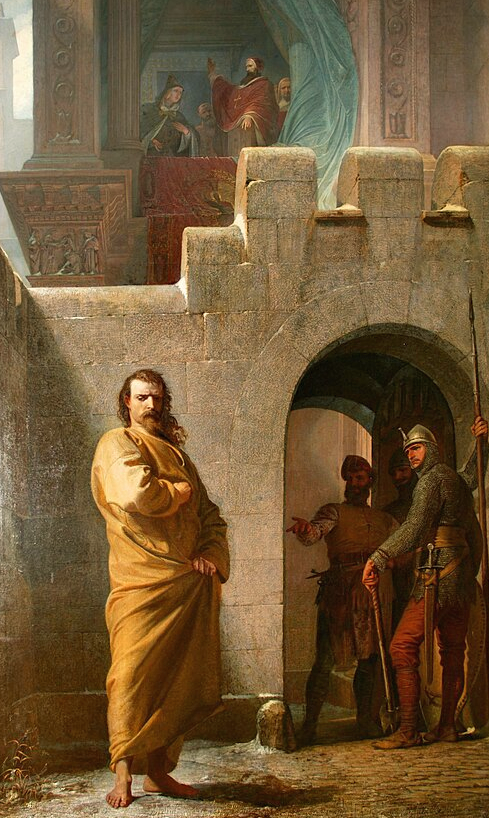
The illustration
accompanying this commentary is of Henry IV standing barefoot in January
outside the palace of Canossa where Pope Gregory VII was residing for the
winter. The two had disputed over who had the right to appoint bishops. Since
simony was widely practiced then as it too often is today,[ii]
whoever could sell the bishopric to the highest bidder stood to gain financially.
When Henry refused to budge, Gregory excommunicated him. Since everyone in
power has their detractors, Henry's opponents seized upon this opportunity to
break from his rule. Realizing the loss would be greater than the loss of funds
from appointing a bishopric, Henry and his family traveled over the Alps in
winter to arrive at Canossa. When he arrived, the Pope refused to see him.
Henry then stood barefoot outside the castle in the harsh Alpine winter until
Gregory would grant him an audience. After three days, the castle gates were opened,
and Henry was granted an audience. Penitent, he asked for forgiveness and the
excommunication was cancelled. Historically, this has been
seen as the high point of the power of the Christian church. However,
Henry's reinstatement did not stop the rebellion of some
his nobles who claimed to be loyal to Gregory, and Henry ended up marching to
Rome, deposing Gregory, and setting the antipope
Clement III on the papal throne.
Just
like when a wealthy man must watch out for those who would relieve him of that
wealth, a church that focuses on maintaining ever flowing streams of wealth
does not go unnoticed by others that work to divert those streams to their own
pockets. In Adventism, we have had many individuals
who have diverted those funds[iii]
through embezzlement schemes, phony investment schemes, and bold-faced efforts
at the diversion of offerings and tithes to independent ministries. It should
be no wonder then that those who already hold great wealth would not see ways
that the means of the church could be diverted to fund
their own pet projects. We see this in the politically orchestrated efforts to
control dogma, not just in Adventism but in every modern denomination. Those
who control dogma control the levers that keep the money flowing. This is why
the assumptions of the historicists cannot be questioned.
They are the underpinnings of dogma.
The
need for reformation of Christianity is as great today if not greater than it
was in Luther's day. If we cannot divorce ourselves from this obsession with
wealth, we have learned nothing of Christ and our lives are not in harmony with
his sermons. Here at Still Waters Ministry, we do not ask for donations, and we
do not accept them if offered. God has grown this ministry since 1997 to a
digital presence in over 120 countries and we have over 100,000 visitors a
year, some from countries that allow no other means of
gospel outreach. If the vast denominational enterprises saw their revenue
streams come to an end, they would immediately
collapse. God will never collapse. We recommend instead of using your means to
build empires on earth, even religious empires, help the needy directly and eliminate
the middleman. Despite promises, enriching the church cannot save you.