Stephen
Terry, Director

Understanding
Sacrifice
Commentary
for the May 10, 2025, Sabbath School Lesson
 "Come now, let us settle the matter," says the
Lord. "Though your sins are like scarlet, they shall be as white as snow; though
they are red as crimson, they shall be like wool."
"Come now, let us settle the matter," says the
Lord. "Though your sins are like scarlet, they shall be as white as snow; though
they are red as crimson, they shall be like wool."
Isaiah 1:18, NIV
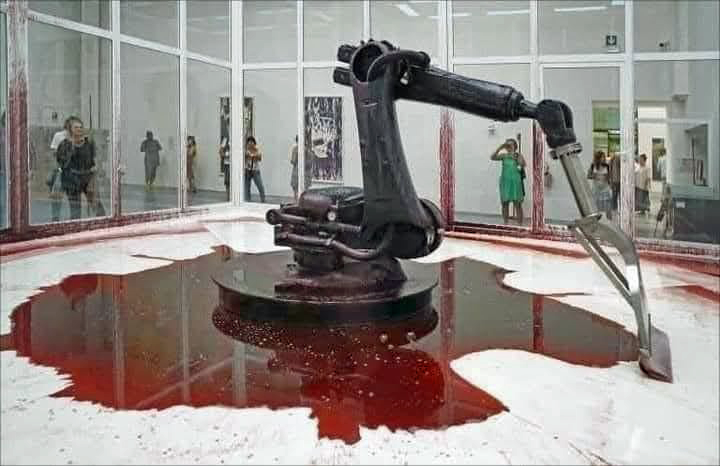
The photo
accompanying this week's commentary is an art project of Sun Yuan and Peng You
entitled "Can't Help Myself." This robotic arm was created
to clean up the hydraulic fluid leaking from it, put it back into place, and thereby
continue to function. The fluid was its life. With the essential lubricant, it
could keep running. Without it, it would cease to function. The robot was in a
constant race to preserve its life. It was programmed to dance and celebrate
when it succeeded in gathering up all the leaked fluid, but as the leak
increased over time there were fewer and fewer celebrations as the robot struggled
to contain the leaking fluid. This and the red color of the fluid that made it
seem human, leaking its blood and desperately trying to live, engendered sympathy
in those capable of feeling compassion for others, even lifeless mechanical
robotic arms. Eventually the leak grew to be unmanageable, and the robot "died"
in 2019.
This
has been offered as a metaphor for life in general where we load ourselves up
with tasks beyond our ability to complete only to eventually discover the folly
of that when we wind down in the final decline to our own deaths. But others
see an underlying evil in programming the robot to this end. It begs the
question, are we similarly programmed? Is life an exercise in futility? Will we
come to an ignominious end no matter what because we are programmed to do so?
Is the meaning of life simply struggle and death? How do we find meaning that
contradicts that depressing understanding? A child comes into this world so
full of hope and awe at the magic of life. A dewy blade of grass, a bird song,
a fluttering butterfly lifted on a summer breeze can all bring laughter and a
smile to the toddler. But even as children, we soon covet the supposed freedom of the big people around us. We attend
school to learn how to be big and along the way, work becomes more important
than life joy. That education teaches us that joy exists in the future and all
work is striving to reach it. But after a lifetime of work, broken and frail we
find that the joy we expected to be in the future was in the past when we
traded it for vain hope. In the end, like the robot arm, we gradually wind down
and die, overwhelmed by what we could not prevent. It was never meant to be
this way in the beginning. It does not have to be that way now. Society programs
us to constantly want more than we have. To paraphrase Robert Burns, we learn
to believe that a "man's reach should exceed his grasp or what is a heaven for."
But a belief in such platitudes has led many to step into a harness for life
driven by greed for more than they need, often at the expense of others
strapped into similar harnesses.
All
of this did not begin with a robotic arm, it is much older than that. Whether the
ancient account is metaphor or literal, the lesson is the same. Humanity was beguiled into believing the idyllic existence they
enjoyed was lacking and something more beckoned if they would only reach out
and take it. They did, and misery has been our lot since. We had a knowledge of
good and chose to add to it a knowledge of evil. It turned out that knowledge
was not an esoteric understanding but was deeply experiential. It is as though
we were children told not to touch a hot stove burner that could damage and
even kill us if burned severely enough. But someone comes along and says, "How
will you know how it really feels unless you reach out and touch it?" Howling
in pain, the only lesson we learn is that we should have heeded the initial
warning, but the damage has been done and cannot be undone in this life either
physically or mentally.
There
are those who think that they can simply return to a before state and achieve a
rejection of the values that entrap us. For instance, they will assume a
vegetarian diet, believing that living like Adam and Eve before the Fall is the
solution. They overlook that not only did God give permission to consume meat
after the flood but he commanded it as an integral part of the sacrificial
system on an industrial scale, beginning with the Paschal lamb on the night
preceding the Exodus and with every animal sacrifice at the wilderness
tabernacle and at the two temples built in Jerusalem by Solomon and Zerubbabel.
Hundreds of thousands of animals, if not millions, were slain and eaten in
those venues. Jesus, being an observant Jew, would have eaten the meat from the
sacrifices as well. The door to salvation through returning to an Edenic
lifestyle has closed. However, all that meat we have been eating does not
provide a return to Eden either. "It is impossible for the blood of bulls and
goats to take away sins." (Hebrews 10:4) Taking away sins means casting them away
as though they never existed. (Micah
7:19 & Jeremiah
50:20)
But
how can that be since there are always scars both mental and physical that keep
hurting our minds and our hearts? We cannot accomplish it. Only God can, and he
promises to do so. He tells us that the bloody sins that stain us will be wiped
clean. (Isaiah
1:18) Our scarred and hardened heart will become soft again. (Ezekiel
36:26) This is not an instantaneous process. It is the work of a lifetime.
It will be hard to turn our backs on the world telling us constantly to get
back in the harness and push for that material, but at the same time ephemeral,
hope that it will all be worth it one day. But a different voice calls us to be
free. It is Jesus who offers it. (John
8:36) What does that mean? His Sermon on the Mount gives us an idea,
especially in the context of striving for the goods this world offers. He
taught, " So do
not worry, saying, 'What shall we eat?' or 'What shall we drink?' or 'What
shall we wear?' For the pagans run after all these things, and your heavenly
Father knows that you need them. But seek first his kingdom and his
righteousness, and all these things will be given to you as well. Therefore, do
not worry about tomorrow, for tomorrow will worry about itself. Each day has
enough trouble of its own." (Matthew 7:31-34)
The
kingdoms of this world and God's kingdom are incompatible. The former would
keep us harnessed for life until we die in our traces in the vain hope that we
would one day ride upon the high places of the earth, secured by the wealth
accumulated from our labors. The latter tells us that we are already free to
ride upon those high places if we walk toward God instead of away from him. The
curtain between the inner and outer sanctuaries of the Jerusalem temple was
torn apart at Jesus' death on the cross. While some believe this was symbolic
of our ability to approach God directly, it is more than that. Torn from top to
bottom, it was torn by God, not man. (Matthew
27:51) It was God's desire to come through to us, as evidenced by his incarnation
in Jesus, which tore that curtain. The success of that breakthrough attempt was
demonstrated that weekend with an empty tomb.
All
the myriad animals sacrificed from Abel's sacrifice of a lamb at the gates of
Eden through the sacrificial offerings made in the land promised to Abraham and
the many sacrifices from the days of Moses to the time of Jesus could not open
that door. They only pointed to the one who could, the one who is both Shepherd
and Lamb. The sheep hear his voice because although Shepherd, he became one
with them so they follow him. (John
10:27) As long as they continue to follow him, no one can take them from
him. He gives them eternal life and no limit to what they may accomplish since their
works will not come to a final end in death. (John
10:28)
Jesus
will return to call them forth from death. Those who are alive at his return are changed from mortal to immortal and those who have died
in Christ rise to immortality as well. The last trumpet will sound, and the
graves will open. (1
Corinthians 15:51-56) No number of dead, sacrificed animals could
accomplish that. It was only accomplished through the death, resurrection, and
ascension of God incarnate in Jesus, the Good Shepherd. His sheep know him and
are drawn to him, and he will never abandon them. For them life is not striving
in futility, for that hope is genuine, not manufactured.