
Stephen
Terry, Director


Pride
Versus Humility
Commentary
for the April 18, 2026, Sabbath School Lesson
 "You, my brothers and sisters, were
called to be free. But do not use your freedom to indulge the flesh; rather,
serve one another humbly in love." Galatians 5:13
"You, my brothers and sisters, were
called to be free. But do not use your freedom to indulge the flesh; rather,
serve one another humbly in love." Galatians 5:13
In the 1960s, I gave my heart to
Christ at a youth meeting under the auspices of the Nazarene Church. I was not baptized
at that time as that was not a requirement to be a member. Nonetheless, I felt
the promptings of the Holy Spirit and desired to learn all I could of the Bible
that it might guide me along a faith-filled, spiritual path. Initially, this
was challenging. When I attended Sunday School and asked questions about what I
was reading in the Bible, I was rebuffed as a troublemaker for questioning the
church leaders about inconsistencies I was finding between the text and church
practice. One big one was why Peter told new believers to be baptized (Acts
2:38), but the church did not require it? Another was a prohibition by the
church against dancing with no scriptural support. In fact, King David danced
before the Ark of the Covenant. (2
Samuel 6:14) But the biggest conflict arose when I asked at the youth
meetings why Jesus observed the Fourth Commandment about the Sabbath, but we
did not? The youth leader told me to go and never come to the youth meetings
again, even though he was the one who led me to Christ with the Sinner's
Prayer.
Distraught at this, I continued
to attend the church each Sunday, and after the sermon one week as we were
leaving I asked the pastor if he could clear up my understanding about Sabbath
versus Sunday. He promised to do so in next Sunday's sermon. I eagerly looked
forward to hearing what he had to say. To my surprise, he said nothing about
it. I asked him about that afterwards, and he promised to address it in his
sermon the following Sunday. Miffed, I waited out the week and made sure to be
there for that sermon. Again, he said nothing about it. I confronted him more
directly about it after the service, and again he promised to address it the
following week. I realized then that he was only stringing me along, hoping I
would lose interest in the topic. But rather than lose interest in the topic, I
lost interest in that church. It was a troubling introduction to the fact that
religious leadership does not always travel a righteous path. Jesus warned his
disciples of this when he told them, "Be on your guard against the yeast of the
Pharisees and Sadducees." (Matthew 16:6) While the Holy Spirit guides us into
all truth (John
16:13), there is no such guarantee with the teachings of religious leaders.
Despite the example of Jesus, it took only three centuries for religious
leaders to outlaw worshipping on the Sabbath according to the example of Jesus by
the Council of Laodicea in 363-364 CE. That council passed sixty canons and
Canon 29 forbade the observance of the Sabbath rest enjoyed by Jesus and all
his disciples. Most of Christianity has continued to honor that ruling to the present
day. Ironically, the letter to the Church of Laodicea (Revelation
3:14-22) points out that while the church feels they are spiritually rich
and have need of nothing, they are in fact blind to their true state and need
the eye salve of the Holy Spirit to cure that blindness, and above all, Jesus
calls them to repentance. They need to start walking toward God instead of away
from him. Even Jesus stands without, knocking and unable to enter the closed
door of their hearts that they might find clarity of spiritual sight to discern
their true condition.
Surrounded by such a sea of
indifference, I was unsure how to proceed. I continued to study my Bible and
pray. It seemed the only source I could truly trust was to appeal to God
himself. One day, riding in the family car back from the grocery store, we
passed by a small, white, wood-frame building two blocks from our home. I happened
to ask my mother what it was as I had never seen anyone there. She replied that
it was a church. I countered, "How can that be? I have never seen anyone there
on Sunday?"
"They go on Saturday," she said
as though it was the most natural thing for a church to do.
This set the wheels turning in
my head, and I resolved to visit them next Saturday. As it turned out, that
Saturday was beautiful and sunny as though God himself was endorsing my
decision. I enjoyed walking those two blocks and was greeted at the door by an
elder who welcomed me to the Seventh-day Adventist Church. As I took my seat in
a hardwood pew, I noticed the signage up front, they showed the offering amount
for the previous two weeks. The Nazarene Church did the same but even though this
church was much smaller, the offering amounts were more than twice that of the
Nazarenes. I also noticed with the opening hymn that they sang with a
robustness I had never heard before, as though their faith was a powerful force
bursting to release its light upon the world.
After a short sermon by the
pastor, the elder who greeted me invited me to participate with them in the
Ordinance of Humility in the basement of the church. I had no idea what this
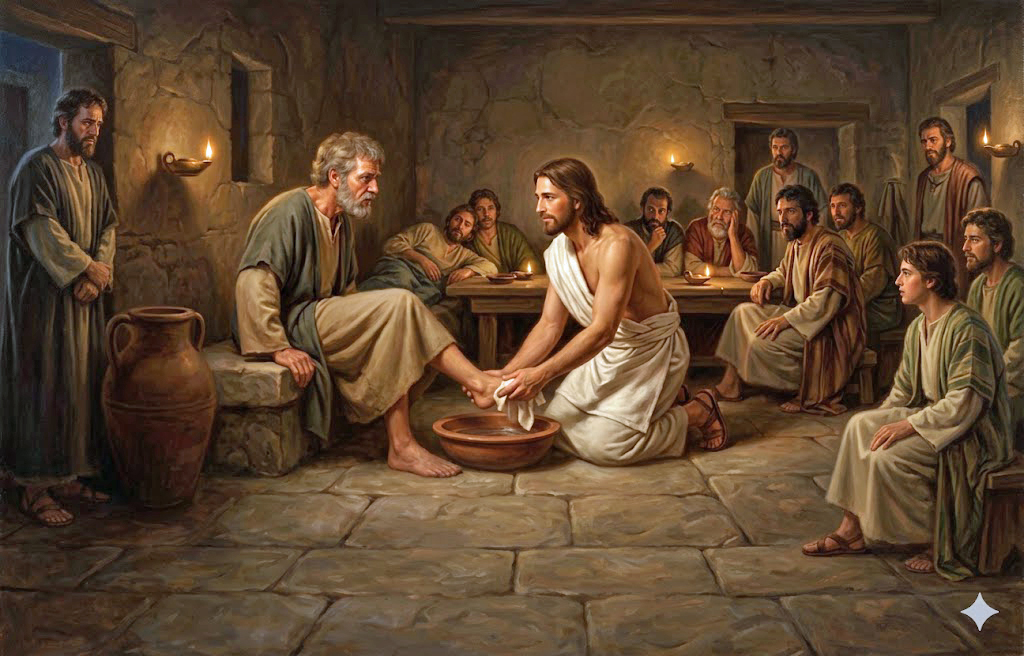
meant, but I accompanied him down the stairs and discovered it meant a foot
washing ceremony, washing one another's feet just as Jesus taught at the Last
Supper. (John
13:1-17) I participated and learned that this was to model humility and
service. I have participated many times since and even re-enacted the Last
Supper as Jesus, including the foot washing at a church in Spokane. While
pastoring in Kansas, I was also called upon to give a homily on foot washing
for a Good Friday service at the Lutheran Church in the town of Eureka since
the local ministerial council knew that Adventists practiced the ordinance. In
well over half a century since I first participated, the service has changed.
Initially, the men went to one room, and the women went to another to separately
wash one another's feet. Then later, instead of washing the feet of other
members or strangers, churches began having a third room where families could
wash the feet of others in their family. There also has grown to be a larger fourth
group that remains in the sanctuary during the foot washing, preferring only to
receive the unleavened bread and unfermented wine of communion. I understand to
a degree the thinking of that fourth group as my feet have not grown prettier
with age, but maybe that is where the humility comes in.
With the passage of years, the foot
washing can become merely another ritual in a litany of works designed to win
favor from God who already loves us so much that Jesus died in demonstration of
that love. We often approach God in that manner, even when we know we should
not. We may not ask it outright, but we may think, have I not done this or that
as if to assert that we have earned the right to heavenly bliss? But if we
could earn that right by our actions, what was the point of Christ bleeding out
on a rude cross, scorned by most of those present? We miss so much about God's
character and the nature of salvation with such an attitude. When we see heavenly
attainment as a checklist that must be completed before we are allowed in, what
happens if we do not understand the checklist or have the full list? We spend
our entire lives focused on finding all the requirements and trying to fulfill
them never understanding that heaven and all we consider requirements are gifts,
not burdens.
For example, many, many volumes
have been written, and debates have been fought out in the theological trenches
over whether Sabbath or Sunday is the true requirement for entrance to glory.
But if we see the Sabbath as a gift, given by God as a memorial of grace, and
Sunday as a gift given by the church as a memorial of the Resurrection, there can
be room for both. We tend to focus on the measurable minors while overlooking
the immeasurable grace of God. Perfectionism demands that like the Pharisees we
tithe even fine herbs into the coffers of the church. (Matthew
23:23) But those who try to practice such perfectionism are doomed to fail because
it relies on the law and the law can only condemn us as we ultimately fail to
observe it to the finest detail. As Paul wrote to the church at Rome, "no one
will be declared righteous in God's sight by the works of the law; rather,
through the law we become conscious of our sin." (Romans 3:20) The law was
intended as a path to humility, not a vehicle for a proud heart to proclaim our
righteousness compared to others, for we are "wretched, pitiful, poor, blind
and naked." (Revelation 3:17b) Let us therefore "walk humbly with our God." (Micah
6:8)