
Stephen
Terry, Director


Apostasy
and Intercession
Commentary
for the September 13, 2025, Sabbath School Lesson
 "The Lord saw how great the wickedness of the human
race had become on the earth, and that every inclination of the thoughts of the
human heart was only evil all the time." Genesis 6:5
"The Lord saw how great the wickedness of the human
race had become on the earth, and that every inclination of the thoughts of the
human heart was only evil all the time." Genesis 6:5
"As it was in the days of Noah, so it will be at
the coming of the Son of Man." Matthew 24:37
For
the over half a century that I have been a Seventh-day Adventist, I have been
aware that Adventists have claimed the United States is prophetically depicted
in Revelation,
Chapter 13. The lamb-like beast with two horns (Revelation
13:11) is said to be the United States with certain peculiar features that
seem to fit. Uriah Smith, in his book, "Daniel
and the Revelation," writing during a time when the persecutions of Protestants
in Europe were fresh in memory and Catholic immigrants, especially from Ireland
were seen as a threat to an America founded upon Protestant principles, saw the
United States as a champion of freedom of religion. He saw the fact that the
two-horned beast came out of the earth instead of the sea as one of the essential
identifiers. The previous beast in Revelation, arising from the sea, was said
to be arising from established, populated lands for Revelation gives this prophetic
meaning to waters, "Then the angel said to me, 'The waters you saw, where the
prostitute sits, are peoples, multitudes, nations and languages.'" (Revelation
17:15) Consequently, Smith felt that a beast arising from the earth would
represent an area relatively devoid of people. While Native Americans my dispute
his point, he saw this as an attribute of the new nation, the United States of
America.
Another
identifier was the two horns. Repeatedly in the prophesies of Daniel, horns
represent power, and often rapidly ascending power. They are associated with
the rise of Alexander in Greece, The Roman Empire, and the rise of another
power that displaced other horns as Roman power waned to usurp their power as
its own. The limitations of this commentary do not allow delving in depth with
these other prophecies. It suffices only to say that Uriah Smith saw the two
horns of the lamb-like beast as indicative of the beast's power. Since the
United States was founded with a new form of government based on a constitution
devised by the people, he saw the two horns as representing the civil and
religious liberties enshrined in that document. But despite that basis, the lamb-like
beast would become dragon like over time, repudiating those very principles
that made it unique. The United States that presented itself as the paragon of
liberty and equality would sacrifice those qualities on the pyre where raw
power is worshipped. Offering their patriotic children to Molech, the Sons of
Liberty were to perish in the burning hands of an idol to power, a sacrifice
that it never entered the mind of God to demand. (Jeremiah
32:35) What had been Ronald Reagan's "shining city on a hill" was to become
a charnel house of corruption and death to the world.
In
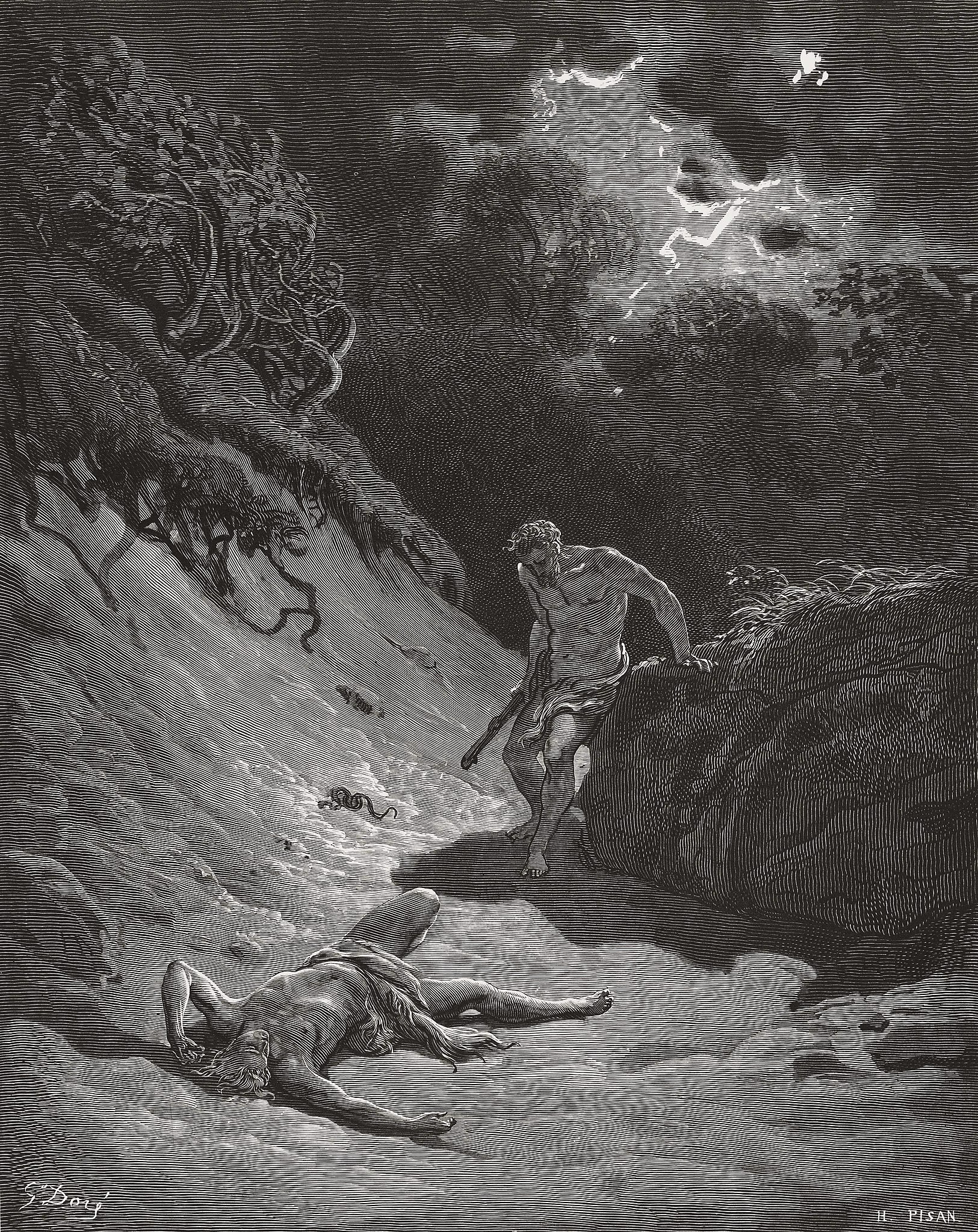
all fairness, this dark picture did not begin with the United States. Cain was
the first murderer when he slew his brother Abel who was more righteous than
he. While a righteous person lives, their lives are a rebuke to evil,
announcing to the world that we do not have to forsake righteousness in the
face of evil. Evil people therefore seek to end the lives of the righteous to
vainly silence their conscience where the Holy Spirit reminds them of their evil,
not to condemn them, but to lead them to repentance. As evil abounds, so does
murder, corruption, and every vileness that loves darkness more than light. As
with Cain, when humanity turns from God, evil is not far off. The heat of its
breath on our heels inflames the passions and leads to fear and death. The
beacon of light lit by the United States becomes ever fainter, and the
dragon-like roar ever louder as evil has its way. The Bible tells us that love
will be in danger of dying out as, like Cain, each seeks their own interest at
the expense of all others. The only answer to that is to remain in relationship
with God who will seek to restore in us the image we were created to bear--his image--the
image of love. (Genesis
1:27 & 1
John 4:8)
How is
this so? Fear is of the dark. Those who remember the "Star Wars" movies
remember that fear was the basis for recruiting others to the Dark Side of the
Force. In this, the movies got it right. So many see the evil around them and believe
that the only way to manage the fear is to be meaner, tougher, and more willing
to inflict damage on others as Cain did to Abel. From Rambo to Jack Reacher, we
have had this satanic homily preached at us continually for our entire lives. Little
wonder then that gun sales are at an all-time high and that murder stalks our
public places with insane fervor. Fear is so great that love seems to no longer
exist. But the light is still there. As Mr. Rogers used to say, ""Look for the
helpers." The only thing capable of driving back the darkness is light, and the
darkness cannot endure before even the smallest light of love.
Several
times since Cain murdered Abel this has been forgotten. It was forgotten before
the Noahic flood. It was forgotten during the four hundred years of Israel's
exile in Egypt. It was forgotten when the Jewish nation became eviler than
those around it and fell to Babylon. King Manasseh in Judah was said to have
filled Jerusalem with blood from one end to the other. (2
Kings 21:16) While we like to think that we are more evolved, smarter than
that, the Bible says otherwise. As in our opening verses, the evil that
abounded in Noah's day will abound again. But we cannot withdraw in the face of
that evil. Jesus told us we were not to hide our light, our love, under a
basket, but to shine that light of love openly. In doing so, we bear witness to
the true character of God. Humanity has mostly forgotten his character, and he
is represented as being wrathful and unloving. This perversely is an attempt to
justify our own wickedness. God created us in his loving image, and we have repaid
him by casting God in our own hateful image. Then who can blame us if we also
hate for we were "created in his image?"
This kind
of logic seems popular now as so much evil is justified like this, even by
those purported to be the children of God. Even in apostolic times during the
first century, such false and perverted "godliness" was rearing its ugly head.
Paul wrote to Timothy, "But mark this: There will be terrible times in the last
days. People will be lovers of themselves, lovers of money, boastful, proud,
abusive, disobedient to their parents, ungrateful, unholy, without love,
unforgiving, slanderous, without self-control, brutal, not lovers of the good, treacherous,
rash, conceited, lovers of pleasure rather than lovers of God--having a form of
godliness but denying its power. Have nothing to do with such people." (2
Timothy 3:1-5) We see such people on the streaming news channels wearing their little
gold crosses as though it is the only way to tell they are Christian. They are
unaware that the love of God shines out from the eyes which are gateways to the
heart and not from the glint of gold.
Paul also
wrote to the believers in Corinth, warning of such false Christians who were worming
their way into positions of authority in the church. He said of them "such
people are false apostles, deceitful workers, masquerading as apostles of
Christ. And no wonder, for Satan himself masquerades as an angel of light. It
is not surprising, then, if his servants also masquerade as servants of
righteousness. Their end will be what their actions deserve." (2 Corinthians
11:13-15) Since the end of such evil is already determined, the Apostle Peter's
question hits home, "Seeing then that all these things shall be dissolved, what
manner of persons ought ye to be in all holy conversation and godliness, looking
for and hasting unto the coming of the day of God." (2 Peter 3:11-12a, KJV)
The
Israelites let their fears run away with them in the wilderness while following
Moses to the land of Canaan, muttering and grumbling about their
fears constantly though God never ceased to provide for them. Jesus tried to
remind us that God is our sure support and we should trust him. He said, "do
not worry, saying, 'What shall we eat?' or 'What shall we drink?' or 'What
shall we wear?' For the pagans run after all these things, and your heavenly
Father knows that you need them. But seek first his kingdom and his
righteousness, and all these things will be given to you as well." (Matthew
6:31-33) As King David, the Psalmist, said, "I was young and now I am old, yet
I have never seen the righteous forsaken or their children begging bread." (Psalm
37:25) We place our hope in humanity for our sustenance, but Jesus told us to
trust in God. In that we find faith, otherwise we find fear that humanity will
fail us and rightly so, for their fear echoes our own and cannot deliver us
when they cannot deliver themselves. God alone has the desire and the ability.