
Stephen
Terry, Director


Passover
Commentary
for the August 2, 2025, Sabbath School Lesson
 "Then Moses
summoned all the elders of Israel and said to them, 'Go at once and select the
animals for your families and slaughter the Passover lamb. Take a bunch of hyssop,
dip it into the blood in the basin and put some of the blood on the top and on
both sides of the doorframe. None of you shall go out of the door of your house
until morning. When the Lord goes through the land to strike down the
Egyptians, he will see the blood on the top and sides of the doorframe and will
pass over that doorway, and he will not permit the destroyer to enter your
houses and strike you down.'" Exodus 12:21-23, NIV
"Then Moses
summoned all the elders of Israel and said to them, 'Go at once and select the
animals for your families and slaughter the Passover lamb. Take a bunch of hyssop,
dip it into the blood in the basin and put some of the blood on the top and on
both sides of the doorframe. None of you shall go out of the door of your house
until morning. When the Lord goes through the land to strike down the
Egyptians, he will see the blood on the top and sides of the doorframe and will
pass over that doorway, and he will not permit the destroyer to enter your
houses and strike you down.'" Exodus 12:21-23, NIV
I
attended my first communion service as a teenager in a small, white Seventh-day
Adventist Church in a little seafaring town on Sinclair Inlet on the western
side of Puget Sound. This was in the 1960s when the Vietnam War and the fight
for equal rights were both in full swing. As it was for decades, the church was
not only painted white, but the congregation was also entirely of the same hue.
This was not unusual because the public schools were similarly constituted.
Although I attended one of the largest high schools in the state, we only had
one student who was noticeably non-white. This is such a singular thing that I
have never forgotten his name to this day, sixty years later, even though I may
have trouble remembering the name of someone I recently met. Most of the "colored"
students attended West Central High School which was situated in an area where "red
lining" had allowed their families to purchase homes.
The
Seventh-day Adventist Church was not alone in its whiteness. Before I became
Seventh-day Adventist, I was Nazarene. The congregation there was also
completely white, as was the congregation of the Baptist Church where I
attended Vacation Bible School as a child. Like all other such "Christians," it
never occurred to me that segregation, whether enforced or de facto, was antithetical
to the teachings of Jesus. Maybe this was because all the Bible pictures I saw
in the children's classes at church had a white, Aryan Jesus that conditioned
me to accept whiteness as part and parcel to the gospel, and church membership,
which of course was believed to be a ticket to get-out-of-hell-free. When I
realize how much I have changed in my understanding during the ensuing decades,
I feel like the 1994 song, "Bless the Broken Road," describes my path over the
years. Despite the brokenness of the church and its people, that road has
still, step by step, brought me closer to understanding what is and is not
representative of God's character and when it is and is not reflected in his
professed followers. We were created to be in his image. (Genesis
1:27) Until we can sort through the brokenness to see that image clearly,
we can never fulfill our potential.
Part
of that brokenness is found in a rite the church has celebrated for two
thousand years, a rite that has roots that go back over a thousand years more.
I am referring to the communion or eucharist and the Passover ceremony that gave
birth to communion. The Israelites had lived in Egypt for four hundred years,
having moved there to escape a famine in Canaan. But what had originally been a
refuge became enslavement under new Pharaoh's who felt no obligation to honor a
four-hundred-year-old agreement. As their lot became more oppressive, God took
pity on his people and sent Moses and Aaron to liberate the Israelites. A
series of ten plagues devastated Egypt, and the people were allowed to go free.
The final plague was the death of all the first born in the land of Egypt. As
in our opening verse, those who would follow Moses out of Egypt were instructed to slay a paschal lamb and spread blood from
the lamb on the door posts and lintels of their homes. The first born of those
who did so would be spared by the destroyer who was bringing
death to the households of Egypt, from the home of the lowly field hand to the
palace of the Pharaoh. The anguish throughout the country must have been heart
wrenching.
We have
had our own plagues in modern times that have visited us for refusing to set
our slaves free. Over seven hundred thousand lost their lives in the American
Civil War over whether the federal government could dictate an end to slavery.
Through Reconstruction, Jim Crow, and the battle for Civil Rights, thousands
more have died as many modern, minor pharaohs have hardened their hearts toward
their fellows over who should be allowed to be equal in America. Ironically,
those same combatants do not see discrepancy when they partake of communion in their
segregated fellowships. At this present moment, even though there are more minorities
attending white churches and more whites attending minority churches, the
Seventh-day Adventist Church still maintains separate organizational structures
for Black people and whites. Yet, we have the gall to refer to ourselves as God's
chosen remnant. But this should not be surprising, for Ellen White felt that
whiteness was the epitome to be experienced in heaven. She wrote in 1901, "In
heaven there will be no color line; for all will be as white as Christ himself."[i]
While she had not taken such a position in previous writings, by 1901, she felt
she could make such a bold statement.
While
this and other idiosyncrasies define Seventh-day Adventism, we are not alone.
Communion derived from Passover has gone astray in the various denominations
from the Passover celebrated by Christ with his disciples. While Passover requires
the use of unleavened bread for the meal, reminiscent of the speed of leaving
Egyptian captivity that did not allow time for the bread to rise, several
modern denominations see no problem with using leavened bread, some even going
so far as to advocate grabbing a loaf of white bread from the grocery store as
an acceptable substitute. The metaphor that the yeast represents is lost,
especially with Christ equating leaven to false teaching. (Matthew
16:5-12) Still others, including the Seventh-day Adventists use unleavened
bread but also insist on grape juice instead of wine. While wine was not a
factor mentioned in the account of the original Passover of the Exodus, it has
been a part of the Jewish Passover Seder since Christ's time. It is today an
essential part of Passover. While a case may be made that yeast is a contributor
to the fermentation of wine, that was not clearly understood until Louis
Pasteur documented it. Previously, the fermentation process was thought to be a
natural "boiling" where the bubbles produced the wine. The action of yeast
would not have been understood as a reason not to imbibe during Passover. There
is an argument that the Greek word "oinos" is referring to unfermented wine
when it is used in respect to the wedding in Cana or the Last Supper. But Greek
usage does not commonly support that assertion with far more cites supporting
the idea of fermented wine than not, nor does Jewish cultural practice related
to Passover support the idea whether ancient or modern.
It
has also been interesting to see the evolution of Passover to communion with what
was originally a meal where some were accused of gorging themselves while
others went hungry. (1
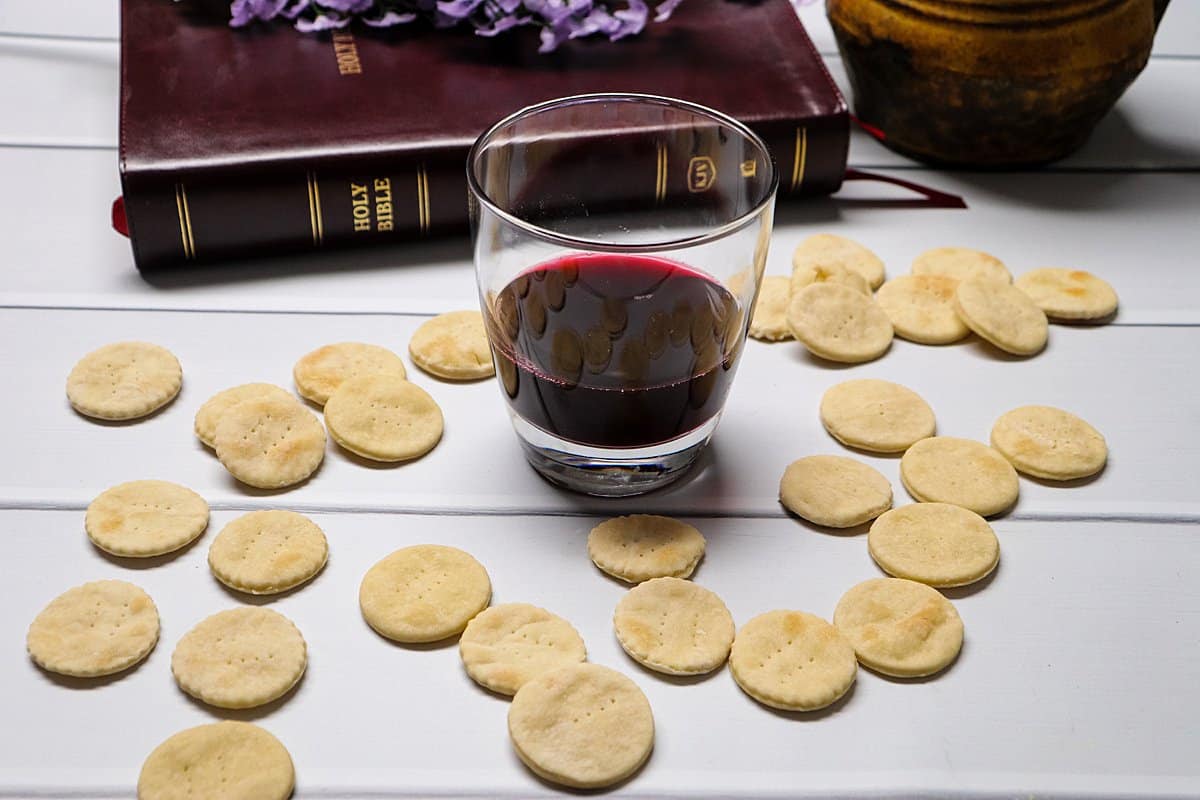
Corinthians 11:20-22) Now it is a miniscule glass of wine or grape juice
with little more than a crumb of unleavened bread. No one would mistake it for
an actual meal. It is laughable to think that it in any way constitutes the Passover
meal the night before fleeing Egypt.
This
brings up another idiosyncrasy of Seventh-day Adventists. Despite all the caviling
over wine versus grape juice as being authentic to the Last Supper, they, as
well as most modern Christians overlook the centrality of the paschal lamb to
the meal. The Jews have not forgotten this, but I have never seen a lamb chop
at a Christian communion service. The argument can be made that Jesus is
himself the lamb, so the lamb is symbolically present in communion in the bread
(body) and wine (blood). This is indeed a redefinition of Passover as Jesus
modeled. However, this does not preclude the consumption of lamb at the Last
Supper. That element of Passover had been essential for over a thousand years
at that point. It would have been so essential that like Isaac asked of Abraham
at Mount Moriah, the disciples would have asked "Where is the lamb?" But no
such question is found in the gospels. Not only had they lived under the lamb
as a Passover offering for their entire lives, but offerings at the temple and
the consumption of portions of the animals offered was so routine ever since
the wilderness tabernacle as to be unremarkable. Since Jesus' antitypical sacrifice
had not yet happened to replace the type of the actual lamb, it is doubtful
this portion of the Passover would have been omitted without comment. In practice
we see instead that Jesus' followers continued to offer animal sacrifices at
the temple even after the curtain had been torn in two denoting an end of that
system. Paul was going to the temple to offer sacrifices when he was arrested
years after Jesus' death, resurrection, and ascension. (Acts
21:26-27)
While
all these differences demonstrate the evolution from Passover through the Last
Supper to communion, it is important to remember that salvation is through
Christ and not through the celebration of minutely detailed magical rites. The
prophet Hosea, speaking for God said, "I desire mercy, not sacrifice, and
acknowledgment of God rather than burnt offerings. "(Hosea 6:6) and Isaiah
said, "If you do away with the yoke of oppression, with the pointing finger
and malicious talk, and if you spend yourselves in behalf of the hungry and
satisfy the needs of the oppressed, then your light will rise in the darkness,
and your night will become like the noonday. The Lord will guide you always; he
will satisfy your needs in a sun-scorched land and will strengthen your frame. You
will be like a well-watered garden, like a spring whose waters never fail."
(Isaiah 58:9b-11) Be the love that God created us to be.