
Stephen
Terry, Director


The
Tabernacle
Commentary
for the September 27, 2025, Sabbath School Lesson
 "They serve at
a sanctuary that is a copy and shadow of what is in heaven. This is why Moses
was warned when he was about to build the tabernacle: 'See to it that you make
everything according to the pattern shown you on the mountain.'" Hebrews 8:5
"They serve at
a sanctuary that is a copy and shadow of what is in heaven. This is why Moses
was warned when he was about to build the tabernacle: 'See to it that you make
everything according to the pattern shown you on the mountain.'" Hebrews 8:5
After
spending four hundred years in Egypt, the Israelites spent a tenth more of that
time wandering in the wilderness. While there, they formalized their practices.
Prior to the Egyptian captivity, they had simply gathered random stones to
create a rustic altar to offer animal sacrifices on. This practice dated all
the way back to Abel, the son of Adam and Eve, who was slain by his brother
Cain. The purpose of those sacrifices was unclear. They may have been to show
respect or reverence toward God. Were they for thanksgiving for blessings
received? Were they sacrifices of atonement? According to the Epistle to the
Hebrews, the latter may not have been the reason since it reads, "The law is
only a shadow of the good things that are coming--not the realities themselves.
For this reason, it can never, by the same sacrifices repeated endlessly year
after year, make perfect those who draw near to worship. Otherwise, would they
not have stopped being offered? For the worshipers would have been cleansed
once for all and would no longer have felt guilty for their sins. But those
sacrifices are an annual reminder of sins. It is impossible for the blood of
bulls and goats to take away sins." (Hebrews 10:1-4)
If we
see in these sacrifices a type pointing ahead to the coming Messiah who would
make atonement possible, that Messiah would one day come without judgment to
give life to those who faced death (John
3:16-17), revealing the loving character of God who wanted death for no
one. (2
Peter 3:9) It seems a bloody thing to slay all those animals over the
centuries to be a symbol of something they had no choice over. Initially, it
may have been more understandable, because it was common hospitality to welcome
guests with a celebratory meal. This could be a symbolic welcoming of God to
the homes of his people, just as Abraham welcomed heavenly visitors with a meal
shortly before the destruction of Sodom and Gomorrah. (Genesis
18-19) For pastoral people, such hospitality was second nature. Sodom and
Gomorrah, settled cities, were condemned because they did not continue this
tradition of hospitality to others. (Romans
12:13 & Ezekiel
16:49) However, later as the practice became institutionalized at the
wilderness tabernacle and later at the Jerusalem Temple the hospitality became
lost in the tens of thousands of sacrifices that turned the innocent animals
into little more than commodities to be haggled over as purchases to satisfy a
legal requirement demanded by the priesthood. The practice had become so
corrupted by the time of Jesus that foreigners who came to worship found their
coins to buy sacrifices for the altar were worthless and had to be exchanged for temple currency at exorbitant rates. The
priests benefited from a percentage of this exchange and revealed themselves to
be just as corrupt as Eli's two sons, Phinehas and Hophni, who plundered the
sacrifices to sate their own greediness. (1
Samuel 2:12-17) They threatened force against the worshipers and their
families if they did not comply. Eventually, death and evil came upon the
entire family for their corruption. We see evil committed by others in this
world, and we are tempted to submit out of fear, but God is well aware and,
though delayed by God, who would rather see the lost saved, justice is sure,
even if we do not see it played out ourselves.
When
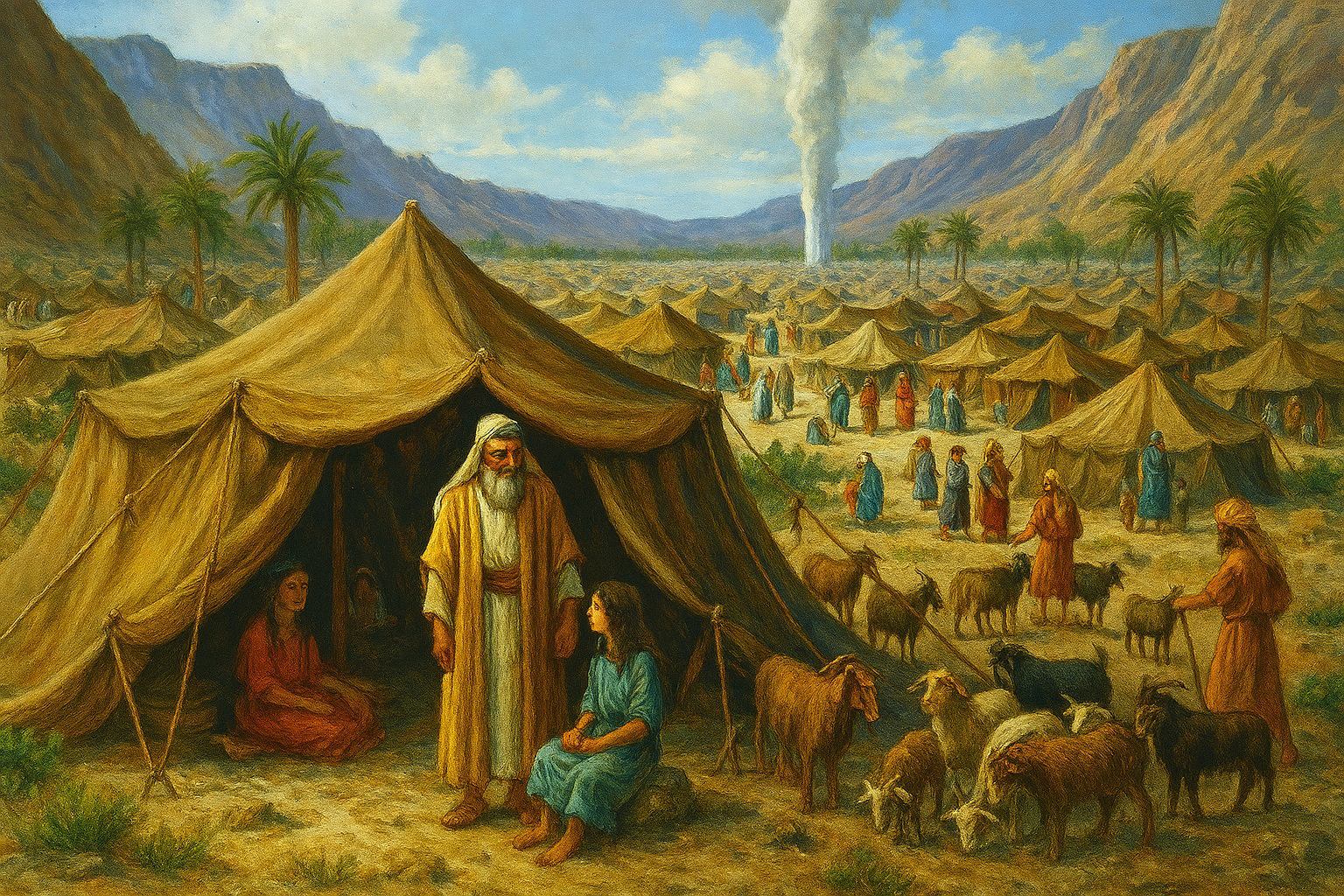
the wilderness tabernacle was dedicated, God's presence sanctified the tent.
And because God's presence accompanied them in this way, the camp itself was sanctified
and those items or people who became unclean, either permanently or
temporarily, had to be taken outside the camp until the unclean period was
over. Those people or things which came into contact with them while they were
unclean would also have to undergo a similar process. This was particularly
emphasized for Passover, celebrated in honor of their liberation from Egypt.
The household celebrating it would have to sweep the home to remove any leaven,
no matter how small in remembrance of the bread that did not
have time to rise during the flight from Egypt. Over time, the leaven
came to be associated with sin and ritual uncleanliness. While zealously
removing the leaven, because of the primitive knowledge of the time, they did
not realize that yeast permeates the very air we breathe so it is inescapable.
While unknown then, this is an even more fitting symbol as no one is free from
the impurity of sin. "For all have sinned and fall short of the glory of God."
(Romans 3:23) It can become easy to lose sight of the fact that it is not the
people who purify anything. It is God who purifies the camp and the people in
it. "All are justified freely by his grace through the redemption that came by
Christ Jesus." (Romans 3:24)
In
Egypt, an Israelite's worth was determined by the work he could accomplish for
his slave master. What he believed, what he thought were both unimportant
unless they interfered with his labor. In such a world, one comes to rely
solely on one's own strength to achieve whatever they might. Mercy, while
eagerly accepted when offered, seemed like an unlikely dream to those
accustomed only to the lash. Those raised only to the crack of the whip do not
learn how to show mercy and grace to others. How does one go from that to
freedom and compassion for others in a single generation? Despite prophets sent
to teach them, over a thousand years later they were still struggling to learn
even in Jesus' day. He rebuked them for their continuing hard heartedness. (Matthew
19:8) Sadly, the more we try to be compassionate, the more we fail. As I
have mentioned, it is not the person that purifies, it is God who does so. It
is the same with our hard hearts. We do not understand the need to trust God
completely to be able to surrender our hearts for softening. Because our
hearts, though made of stone, are so easily wounded because of past experiences,
we feel we need that hardness to prevent further damage.
We
are like a child with a doll or a teddy bear that another child has broken. We
vow never to let go of the toy again to keep others from damaging it further.
But the firm grasp that prevents further injury also prevents healing. God
cannot heal us if we cannot let go of the pain and trust him. The best person
to heal a broken toy is the toymaker. He knows just what is needed and how to
provide it. Likewise, the best person to heal a broken human being is the one
who made them. He knows exactly how far we have strayed from the original and
what it takes to get back there. Somehow we need to learn to trust again so
that can happen. That can be a lengthy process, but God is patient, and in his
patience with us, we can learn patience with others and patience with the
process we all are going through.
While
this week's lesson focused on the wilderness tabernacle and while others like to
ferret symbolism from the various elements of its construction, we would do
well to remember that once Messiah came, its relevance dissipated. The Apostles
continued to worship at the temple despite heightened persecution and even
martyrdom, but the moment the curtain was torn from top to bottom between the
sanctuary chambers, it passed into irrelevance. It was eventually destroyed in
70 CE., forcing the recognition that type had met antitype and a new era had
begun. We are then left to consider whether we are to continue to march around
Mount Sinai grumbling about our burdens or if we are ready to trust Jesus, who
died, resurrected, and ascended when he told us "I will come again and receive
you to myself." (John
14:1-3)
If we
rest in the arms of Jesus, trusting in his promise, we can say with Paul
addressing the Roman church, "Who shall separate us from the love of Christ?
Shall trouble or hardship or persecution or famine or nakedness or danger or
sword? As it is written: 'For your sake we face death all day long; we are
considered as sheep to be slaughtered.' No, in all these things we are more
than conquerors through him who loved us. For I am convinced that neither death
nor life, neither angels nor demons, neither the present nor the future, nor
any powers, neither height nor depth, nor anything else in all creation, will
be able to separate us from the love of God that is in Christ Jesus our Lord."
(Romans 8:35-39)