
Stephen
Terry, Director


Through
the Red Sea
Commentary
for the August 9, 2025, Sabbath School Lesson
 "The Lord will
fight for you; you need only to be still." Exodus 14:14, NIV
"The Lord will
fight for you; you need only to be still." Exodus 14:14, NIV
At
times, it can be hard to be still. When I consider the chronic illnesses that have
kept me company throughout my days, weeks, months, and years, I just want to feel
what it was like to be free of pain and fatigue. I am not alone in this. I have
met others who struggle with chronic health issues also. Among them have been those
who seemed to do everything right, eating healthily, exercising, and avoiding
the use of harmful substances like opioids and alcohol. It is a paradox that
people who live self-destructive lifestyles can seem to be better off than those
who are more careful. I know I am not alone in observing this. Others who struggle
with health issues have told me that they wonder about these things also. When
we portray God as just and compassionate, it seems unfair, especially among
those who love him, that they should continue to suffer. In the television
series, "The Chosen," this question comes up repeatedly. "Why did this person
have to die when you raised others to life?" is the question that haunts Jesus
and his followers as they travel about Galilee. In this series, one of the
disciples, Little James, is a cripple so this issue is
close to him, and in a private conversation with Jesus, he raises the question of
his own need for healing. He decides his love for Jesus means it does not
matter. But it is hard to watch him limping to Decapolis, Capernaum, and
Jerusalem, trying to find the strength to keep up with the others and in
obvious pain.
The
book of Job, ostensibly written by Moses also, tries to tackle this issue. Job is
the special target of Satan who takes everything he owns, destroys his family,
and afflicts Job with a painful chronic disease. While Job continues to love
God even if God should slay him, (Job
13:15) the book raises more questions than answers. Depending on one's
perspective about the story, Job is experiencing a Nietzschean strengthening by
enduring suffering almost to the point of death but nonetheless overcoming the
challenge. Or the point may instead be that faithfulness comes with pain and
suffering tremendously at the hands of an implacable foe. A third possibility,
and the most difficult to deal with is the idea that God would allow all sorts
of damage to his followers to prove a point. Whether we shattered a toe against
a chair leg in the dark of night or we have fought a lengthy battle against metastatic
cancer, these questions come to all of us who struggle with a relationship with
a being who can do all things but does not. We succor ourselves with the idea
that somehow it will all be worth it, and we move forward in faith, despite the
pain, just like Little James. The answer from God seems to be, "Not yet. Trust
me."
When
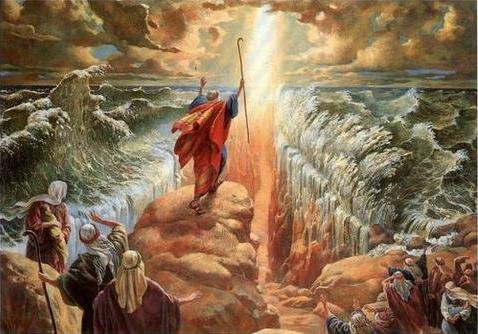
the Israelites fled Egypt, they found themselves with their backs to the Red
Sea and with the army of Pharaoh rushing down upon them to restore them to
slavery or to take their lives. The options seemed limited. Where was the God
who was to deliver them, the God who had done so many miracles of late? They especially
blamed Moses for their predicament. This was to become the tenor of their
relationship with Moses throughout the years to come wandering in Sinai. Moses
was over eighty at this juncture. He did not learn to have the faith he lived
by overnight. The Israelites had only recently fled from slavery. They had
largely forgotten God after four centuries in Egypt. Empires have risen and
fallen in less time. God chose Moses to lead them because he was able to model
for them what faith in God should be. Trapped against the Red Sea, they were
now in a situation where only a miracle could save them. They cried out in
anguish and fear. But Moses told them to have faith. God was in control, and
they only needed to be still. Looking for someone Like Moses to blame resolves
nothing.
The 23rd
Psalm is one of my favorites because it so describes the Christian Walk. "The
Lord is my Shepherd; I shall not want" tells us that the Shepherd is solicitous
to the needs of each member of the flock. "He makes me to lie down beside still
waters. He restores my soul." As Jesus said, "Come to me, all you who are weary
and burdened, and I will give you rest." (Matthew 11:28) He created us and
knows our need for rest and recovery. In the words of an engineer, he knows our
tolerances and what we can and cannot manage better than we know ourselves.
The Psalm
continues, "He leads us in the paths of righteousness for his name's sake." Those
who walk with God do so for his glory. Doing so will change their heart, (Ezekiel
36:26) and those who do will find righteousness, not only in God's
character but also in theirs as they change to emulate his image as it was in
the beginning. (Genesis
1:27)
The
next line is significant for the Israelites as well as for us in our struggles
and suffering. It reads, "Though I walk through the Valley of the Shadow of
Death, I will fear no evil, for you are with me." How did we end up there? Wasn't
God leading us up to this point? Could we logically conclude therefore that God
led us into that valley? When the Red Sea parted, did it create such a valley
for the Israelites? They had never experienced anything like it. Caught between
the army of Pharaoh bent on their destruction and the churning walls of water
on either side, they chose to obey Moses and follow him into that valley. They
suppressed their fear and walked across, and God was indeed with them in
crossing what became a valley of death for their pursuers.
"He
prepares a table before me in the presence of my enemies." Safely across, the Israelites
watched as God removed his restraining hands holding back the forces of Pharaoh,
and they chased after the children of Israel, but the wet sea bottom could not
support the heavy military chariots and the walls of water collapsed, inundating
Pharaoh's host. Israel was sustained in Pharaoh's presence after passing through
the baptism of the Red Sea, foreshadowing the antitypical baptism of repentance
to come when Jesus and John the Baptist proclaimed the Kingdom of God. Every
baptism harkens back to that Red Sea deliverance where the people moved forward
in faith and found salvation and set their feet on a higher path than they had
previously walked, a path that walked toward God and not away from him.
"He anoints
my head with oil. My cup runs over." These are types pointing forward to Christ
and the universal priesthood of his followers. They are symbols associated with
those chosen by God for a higher purpose than they have previously known, a purpose
founded on love and dedicated to compassion, empathy, righteousness, and
justice.
"Surely
your goodness and love will follow me all the days of my life, and I will dwell
in the house of the Lord forever." Robert Frost referred to God as the "hound
of heaven" who pursues us, not as a bloodhound chases escapees, but with
unremitting love and compassion until the point is reached where we turn around,
see God's character as it truly is, and ask ourselves, "Why am I fleeing this?"
Once we come to that realization, dwelling in the house of the Lord forever
becomes the most wonderful hope of all.
The Israelites
sacrificed a great deal during their forty years wandering Sinai. An entire
generation died, including Moses, without ever realizing the goal of setting
foot in the Promised Land. But the promise was real, and Joshua led the people
into Canaan, claiming the land according to the promise God made to Abraham. This
is a lesson for us as we struggle with chronic illness and pain. God will yet
see us through. As Jesus said, "Do not let your hearts be troubled. You believe
in God; believe also in me. My Father's house has many rooms; if that were not
so, would I have told you that I am going there to prepare a place for you? And
if I go and prepare a place for you, I will come back and take you to be with
me that you also may be where I am." (John 14:1-3)
At
times, when I am struggling with pain, my wife reminds me that Satan afflicted
Job because of his witness for God. She sees our present experience in the same
light. This ministry has been running for over 28 years now and has a digital
presence in over 120 countries. God alone has sustained it. We do not accept donations,
nor do we ask for them. If a little suffering is the price for God's blessing,
it is a small price to pay compared to dying on a rude cross outside Jerusalem
with jeering crowds. It is ironic that some might venture to die for their faith
but find it hard to suffer for it if that is their calling. That is the lesson
of Little James, the disabled disciple in "The Chosen."