
Stephen
Terry, Director


The
Message of the Cross
Commentary
for the July 11, 2026, Sabbath School Lesson
 "For the message of the cross is
foolishness to those who are perishing, but to us who are being saved it is the
power of God." 1 Corinthians 1:18
"For the message of the cross is
foolishness to those who are perishing, but to us who are being saved it is the
power of God." 1 Corinthians 1:18
As a typical American boy, I
grew up on a steady diet of cowboy westerns where the good guys wore white hats,
and the bad guys wore black. Good and evil were clearly defined. The good guys
never shot anyone in the back, and the bad guys nearly always did. The bad guys
seemed to frequently outnumber the good as well. Despite that the good guys
always seemed to prevail in the end where the final scene devolved from an argument
to a gunfight and right was determined by who was the better and the faster
gunfighter.
This was not limited to western
movies as trial by combat was often a feature of determining right from wrong whether
with medieval knights jousting in the lists or a wandering explorer challenging
a tribal chieftain's best warrior in more primitive cultures. The righteous
warrior lived and the black-hearted one always died. We were so programmed with
this by the time we reached puberty, when those hormones kicked in, we were
primed to explode into violence whenever the righteousness of our opinion was
questioned. Like many others, as a teenage boy, I had my fair share of trial-by-combat
fights in the school yard. Some I won. Some I lost. But I never questioned the
idea of fighting to prove I was right even when I lost. At the time, that seemed
as American to me as apple pie and hot dogs. Many continue to feel that way if
the popularity of the star characters Jack Reacher and John Wick are any
indication.
However, my teen years became a
nexus that sent me on a different path. Bible teachings at various churches I
attended introduced me to concepts like turning the other cheek (Matthew
5:39), and doing kindnesses to one's enemies and thereby heaping coals of
fire on their heads. (Proverbs
25:21-22) When I accepted Christ into my life, I tried to implement some of
these ideas into my life, but while I was trying to follow these teachings,
most of my compatriots had made no such commitment and still preferred to
settle things by combat. Stepping back and choosing a different path allowed me
to see how trivial the issues were and of course, how unnecessary
these fights were as well.
While this was affecting my
character development in the small town I grew up in, on a much larger stage,
the United States was engaged in a growing war in Vietnam. While some
questioned the sense of sending young men off to die in a conflict they did not
understand and had little stake in, in 1965, drafting men to fight in that war
began and by 1969 evolved into a national lottery system. Many of my classmates
graduated high school and were sent for further education in the rice paddies
and on the rivers of Vietnam. I graduated high school in 1969 and my number in
the lottery was low enough that I was due to be drafted. The choice facing me
was either be drafted and end up an 11-Bravo infantryman humping the jungles of
Asia or volunteer and enlist for a career of my choosing. I was good with
languages and had just completed a year of Russian in high school, so I enlisted
for further training to become a Russian translator-interpreter. While this made
sense to me at the time, God had different plans.
The first weekend of Basic Training
at Fort Bliss, Texas, we were all marched to the base chapel where the chaplain
told us of the need to "kill the commies for Christ." This was not the Christ I
had come to know. When I told those in charge of my training that I could not conscientiously
do that, we negotiated a compromise. They did not want to reclassify me as a
conscientious objector as that would bring into question the effectiveness of
their training program. Instead, they offered to send me for combat medic
training at Fort Sam Houston by San Antonio, Texas. They said a medic would not
be required to shoot anyone, but I would have to give up translator training as
translators had to be armed. This seemed like a reasonable compromise at the
time, so I agreed to the plan they offered.
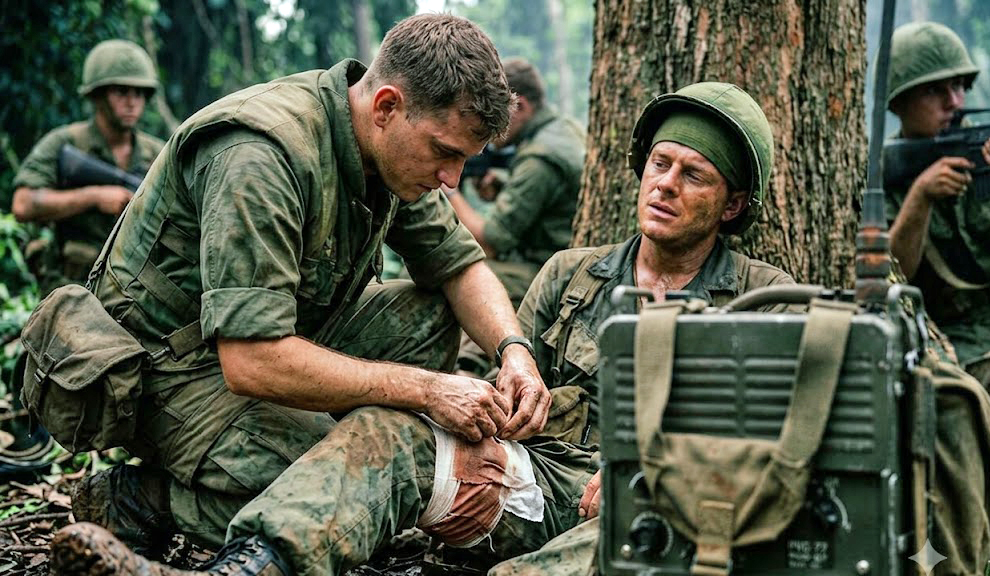
Eventually, I ended up in
Vietnam as a medic assigned to first, an evacuation hospital, second, a prisoner
of war camp caring for wounded North Vietnamese and Viet Cong, third to the
evac hospital emergency room, and finally to a mobile medical laboratory doing
drug testing of those returning stateside. In all this time, my unwillingness
to shoot the enemy was never questioned, and I was even promoted to Specialist
E-5. It was not a problem when I returned to the states either for the two
years I was assigned to provide medical support to an armored cavalry regiment.
But eventually the war ended,
and so did the draft. An enlisted conscientious objector, 1-A-O, is a special
status for draftees who cannot conscientiously carry a weapon. When the draft
ended, that classification no longer existed and even though I had never been
officially listed as such, they did not know what to do with a soldier who did
not carry a weapon. I was up for promotion to E-6 with an excellent service
record but was told they could not promote me because of my status. They did
not want to release me from service, and they did not want to recognize my
conscientious objection to warfare either. As a result, persecution ensued that
was unnecessary, and the Department of the Army stepped in to resolve the
impasse by discharging me honorably with my DD-214 discharge papers officially
listing me as a conscientious objector.
They made many attempts to try
to convert me to their point of view about killing others. One popular trope
was, "What if someone is trying to kill your family? Would you kill to protect them?"
Apart from this being a hypothetical situation based on fear and therefore
being manipulative rather than an honest effort to understand, I replied that I
did not believe God would allow that to happen. The reality is that for seventy-five
years, he never has. If we base our lives on fear and hypotheticals, we will
never discover the full potential available to us, not only as individuals but
as humanity and the amazing capabilities we are endowed with. Ironically, it is
those who are exploring that inherent capability that we all have for living in
harmony and unity caring for one another that are often
considered foolish. The modern pejorative is "woke."
Jesus was clear on what God
takes seriously, and compassion and empathy are high on the list. One of the
things I learned during my stint as a medic in a prisoner of war camp is that
despite political labels governments place on themselves and their people, we
are all capable of rising to far greater heights than simply killing those we disagree
with. Childhoods filled with many hundreds of hours of movies and play time
re-enactments of good guys killing bad guys gives us an internal voice that tells
us it is foolishness to see the humanity in our enemies and instead of killing
them, doing all we can to enable them to be with us for all eternity in
heavenly environs. But it is nonetheless the message of the cross. In the time
of Jesus' incarnation, Rome conquered Judea through force of arms. During the first
and second centuries, they murdered every Jew who stood in their way. Just like
today, fear was the point and the means of conquest. But Paul and Peter and
others like them turned the tables and conquered that great empire not with
fear but with the foolish love of God. When they refused to be afraid and
willingly offered themselves up to those who would slay them, their martyrdom
inspired others to do the same, and Rome lost all power over such people,
people who could not be manipulated through fear.
We are trained from childhood to
value our meager possessions above all things and to do all we must to preserve
them. No one ever tells us the truth that no matter how long we live, one day
our cold, dead hands will have to surrender what we have struggled so hard to keep.
We have compromised our morality to keep it all. We have compromised our
health. We have hurt those we should have loved. We have done all of this while
living only a few short decades with only a handful of peak years among them. When
we consider how quickly the sands of time flow through the hourglass, which is
more foolish? Is it the gift of eternal joy and life enabled by the cross of Christ
or is it the desperate clinging to a life of fear, knowing that at any moment all
we have given ourselves to amass can turn to dust as our mortality manifests. Can
we ever attain the wisdom of Solomon? "I denied myself nothing my eyes desired;
I refused my heart no pleasure. My heart took delight in all my labor, and this
was the reward for all my toil. Yet when I surveyed all that my hands had done
and what I had toiled to achieve, everything was meaningless, a chasing after
the wind; nothing was gained under the sun." (Ecclesiastes 2:10-11)