
Stephen
Terry, Director


A
Portrait of Love
Commentary
for the August 15, 2026, Sabbath School Lesson
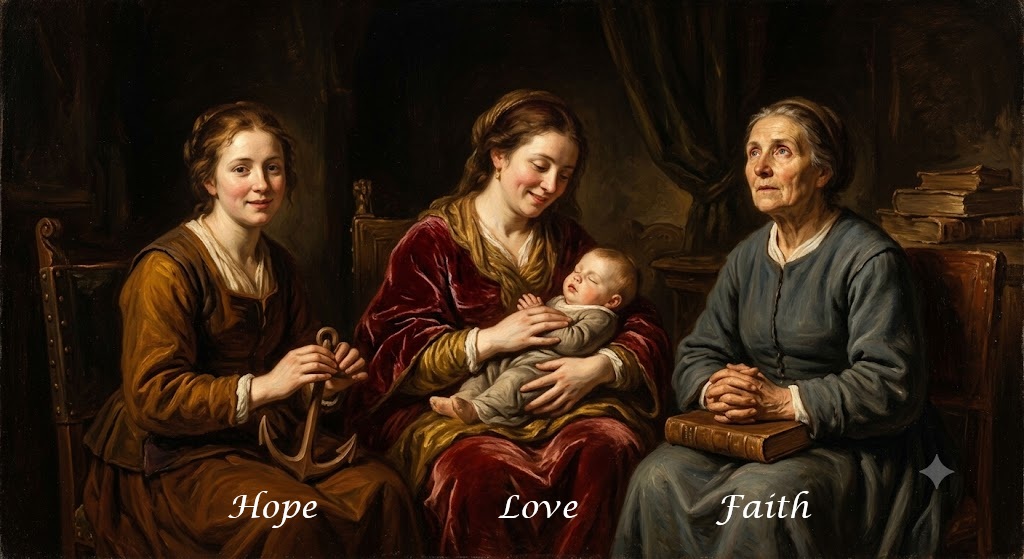 "And now these three remain: faith, hope
and love. But the greatest of these is love." 1 Corinthians 13:13
"And now these three remain: faith, hope
and love. But the greatest of these is love." 1 Corinthians 13:13
There is nothing like the run up
to an election to remind us how far we are from this ideal. It is like a mini
civil war. For those who are unfamiliar with the United States Civil War of the
1860s, it split communities, churches, families and even companions who attended
classes together at West Point severed their friendships with some joining the
Southern rebellion while others served the Federal forces to preserve the Union
only a little more than half a dozen decades old. Brothers fought one another from
opposing lines across corpse strewn battlefields. Over 600,000 died in the
bloody mayhem. Many returned home disabled to try to find healing within the
fractured family circle. Many others did not return home at all, leaving vacant
chairs at the family board to remind everyone of the insanity of war that would
rip families apart, war that would leave few hearts unbroken and few tears unshed.
Almost two centuries later, the
pain still tears at us. Manipulative politicians play on that pain to incite
fear of what those on the other side might be planning. Too many are both young
enough to naïvely believe them, or remote enough historically to have no idea
of the horrors of that conflict or what the war was about. Phrases like "state's
rights" and "Southern liberation from federal tyranny" are used to color the
rebellion as a simple but patriotic disagreement. But then as now, the conflict
was over who could appeal to the natural civil rights of humanity as declared in
the "Declaration of Independence," and who could not. We have struggled with
the answer to that question for two and a half centuries. In the process,
former slaves were granted freedom and women were given suffrage. The poor
children and the elderly were cared for with food, medical care, education, and
affordable housing without regard for race, gender, or religion. To be sure,
none of this occurred as a steady, straight-forward march to equality. It was
and still is resisted violently. Sometimes it seemed as though for every step
forward, it was necessary to take three steps backward. Once the Civil War
ended, it did not end the violence. Thousands have died in the intervening
years. The Washington Post[i] and
several civil rights organizations has alleged that
eight lynchings have occurred since the year 2000 in Mississippi alone. Those
who have been martyred in the struggle to be recognized as human and being
granted the rights of every human are like the souls under the altar in
Revelation. "They called out in a loud voice, 'How long, Sovereign Lord, holy
and true, until you judge the inhabitants of the earth and avenge our blood?'
Then each of them was given a white robe, and they were told to wait a little
longer, until the full number of their fellow servants, their brothers and
sisters, were killed just as they had been." (Revelation 6:10-11)
It begs the question as to why
so many, even among those who claim to be followers of Jesus, are so bent on
doing harm to others as though those others were subhuman and deserving of all
the pain that could be heaped upon them. Not only do they enjoy inflicting such
pain, but they think they are doing God's will in doing it. Jesus said as much,
"the time is coming when anyone who kills you will think they are offering a
service to God." (John 16:2) This kind of thinking put Jesus on the cross. It
was embraced by Jesuits burning Jews and other Christians at the stake. It was the
Crusaders wiping out the population of Jerusalem without regard to whether they
were Jews, Muslims, or Christians. Today it is evangelical Christians wearing
their little gold crosses on television and social media stoking fear that
non-white minorities are going to replace white culture and religion. Demagoguery
seems to be everywhere roiling the waters of discontent. The fear being stoked
will have its out. People will be hurt badly.
Foolish people love to quote "Spare
the rod and spoil the child," (Proverbs
13:24) because it equates love with inflicting pain, a masochist's fever
dream. By that reasoning, Cain killing his brother must have been an act of
love. The Bible does not appear to see it that way, however. If anything, there
is a basis for seeing a schizophrenic representation of love in the Bible. This
may be because so many different persons with conflicting views of God had their
writings all bound together in that tome. It is hard to reconcile Torah with
Jesus. In Torah, the world is destroyed by flooding, cities are burned to the
ground, and ethnic cleansing takes place in the Levant. Is this the same God
who Jesus tells us, wants us to love our enemies as he does? "You have heard
that it was said, 'Love your neighbor and hate your enemy.' But I tell you,
love your enemies and pray for those who persecute you, that you may be
children of your Father in heaven. He causes his sun to rise on the evil and
the good and sends rain on the righteous and the unrighteous." (Mattehw
5:43-45) How do we reconcile the two? Either God is schizophrenic or humanity
is representing his character as such. I am more inclined to go with the latter
explanation. It seems that throughout history, whenever his followers begin to
pump up the tough guy image for God, it is a sign that his followers are out to
hurt and even kill in his name. Not everyone participates, but the indifference
of most enables the bloodletting engaged in by those who would profit from the
misery of others.
Lest we wallow in that indifference,
we must understand what love is. Love is not inflicting pain on others. It is also
not manipulating them through fear that God will inflict pain on them. Harming
others is never part of the definition of love. It is mental illness to think
it is. Anyone who thinks they must hurt others to show love needs to seek help.
This is even more true if they use God as an excuse for inflicting such pain. Those
who think like that are wrong. As the apostle John wrote, "Whoever does not
love does not know God, because God is love." (1 John 4:8) Paul adds to this
that love is patient, kind, keeps no record of wrongs, always protects, always
trusts, always hopes. (1
Corinthians 13:4-7) Where is there room for genocidal rage in love?
Nowhere. It does not exist in the heart of God. It arose in the heart of the
fallen one who perpetuates the lie that pain is love, and even not a few of those
who wear clerical ordination as though God has blessed every action and thought
as if it were his divine will are among those who follow the evil one. "For
such people are false apostles, deceitful workers, masquerading as apostles of
Christ. And no wonder, for Satan himself masquerades as an angel of light. It
is not surprising, then, if his servants also masquerade as servants of
righteousness. Their end will be what their actions deserve." (2 Corinthians
11:13-15)
We should never allow such
individuals to incite fear in our hearts. They will do so by telling us that
God wants to harm us for our sins. Fearful people are easy to manipulate.
Constantly reminding them of what they need to fear is all that is necessary.
That and telling them they have the power to save them and claiming they know
how to appease that angry God who wants to destroy them. Years ago, I came across
some pentecostal street preachers at a local university. They were shouting at
the students that God wanted to put them in everlasting hellfire if they did
not repent. They wanted to make them afraid so they would join their church. I
tried to intervene and explain that God is not like that. He is love. They
surrounded me and shouted me down, but the momentum was gone and the students
woke up from the spell of fear being cast and moved on. The work of the evil
one is based on fear. Without it he becomes powerless. John said it like this, "There
is no fear in love. But perfect love drives out fear, because fear has to do
with punishment. The one who fears is not made perfect in love." (1 John 4:18)
We must cast aside fear and we can do so with the realization that God is love.
He wishes us no harm. How do we know this? "For God so loved the world that he
gave his one and only Son, that whoever believes in him shall not perish but
have eternal life. For God did not send his Son into the world to condemn the
world, but to save the world through him. Whoever believes in him is not
condemned..." (John 3:16-18) Paul had such complete faith in God's loving
character that he wrote, "For I am convinced that neither death nor life,
neither angels nor demons, neither the present nor the future, nor any powers, neither
height nor depth, nor anything else in all creation, will be able to separate
us from the love of God that is in Christ Jesus our Lord." (Romans 8:38-39) A
love like that is priceless.