
Stephen
Terry, Director


Sin
in the Church
Commentary
for the July 25, 2026, Sabbath School Lesson
 "All this I have told you so that you
will not fall away. They will put you out of the synagogue; in fact, the time
is coming when anyone who kills you will think they are offering a service to
God. They will do such things because they have not known the Father or me." John
16:1-3
"All this I have told you so that you
will not fall away. They will put you out of the synagogue; in fact, the time
is coming when anyone who kills you will think they are offering a service to
God. They will do such things because they have not known the Father or me." John
16:1-3
While Mahatma Gandhi left no
written record of such a statement he has been attested as saying "An eye
for an eye will only make the whole world blind." This would have been in
response to passages in the Pentateuch: (Exodus
21:23-25, Leviticus
24:19-21, & Deuteronomy
19:21) These passages sought to eradicate sin by inflicting on the sinners
the same harm they sought to inflict on others. Despite such measures, sin has
not been eradicated but rather has only increased causing more suffering. The
current state of the Levant is a case in point. No one remembers the first
wound inflicted but the continuing cycle of revenge killings has only grown in
size and scope, threatening entire civilizations and cultures and spreading to
distant lands never a part of the original conflict. The horrendous bloodshed
has even included innocents who could not possibly
know of the issues at play that ended their brief lives, lives that should have
been adorned with joy and play. The tears of those who remain become a watery bier floating those tiny
bodies to the cemetery where their presence will continually cry out for
justice. Thus, the cycle Gandhi warned of plays out and seems unstoppable.
King Solomon summed it up well. "This
is the evil in everything that happens under the sun: The same destiny
overtakes all. The hearts of people, moreover, are full of evil and there is
madness in their hearts while they live, and afterward they join the dead." (Ecclesiastes
9:3) Jesus sought to break that cycle. In the Sermon on the Mount, he taught, "You
have heard that it was said, 'Eye for eye, and tooth for tooth.' But I tell
you, do not resist an evil person. If anyone slaps you on the right cheek, turn
to them the other cheek also. You have heard that it was said, 'Love your
neighbor and hate your enemy.' But I tell you, love your enemies and pray for
those who persecute you, that you may be children of your Father in heaven. He
causes his sun to rise on the evil and the good and sends rain on the righteous
and the unrighteous." (Matthew 5:38-39, 43-45) Jesus did not want his followers
to succumb to the madness Solomon spoke of that seems to consume the earth,
leaving it awash in unspeakable horrors no one seems able to end.
Unfortunately, like millions of
Don Quixotes fixated on millions of threatening windmills, we see sin and evil
everywhere and lower our lances and spur our steeds to impale the threat before
it can spread. The zeal rarely abates, and should it begin to wane, gossips,
conspiracy theorists, and media pundits jump into the fray to breathe fire once
again into the cooling embers of conflict. Unlike Thomas Hardy's characters, it
is difficult to escape "far from the madding crowd" in our world as the
internet has shrunk it to the point where the frenzy reaches almost everywhere
to the detriment of us all.
In his first letter to the Corinthian
Church, even Paul falls prey to the madness of attempting to root out sin in
the church (1
Corinthians 5:1,5), something Jesus never did even with Judas the Betrayer.
In his second letter to that church, he repents his earlier attitude. "The
punishment inflicted on him by the majority is sufficient. Now instead, you
ought to forgive and comfort him, so that he will not be overwhelmed by
excessive sorrow. I urge you, therefore, to reaffirm your love for him." (2 Corinthians
2:6-8) Jesus warned of the dangers of trying to root sin out of the church. It
is like trying to pull weeds in a wheat field before harvest. While some weeds
may indeed be uprooted, some of the good wheat will be trampled before it ever
has a chance to mature and some will even be accidentally pulled up with the
weeds. (Matthew
13:26-40, 36-43) He tells his followers that this is a work reserved for
the angels and the harvest to take place at the end of days.
It can be frightening when those
who profess to follow God take this horrible work upon their shoulders. Not
only do they become murderers of others either figuratively or with actual body
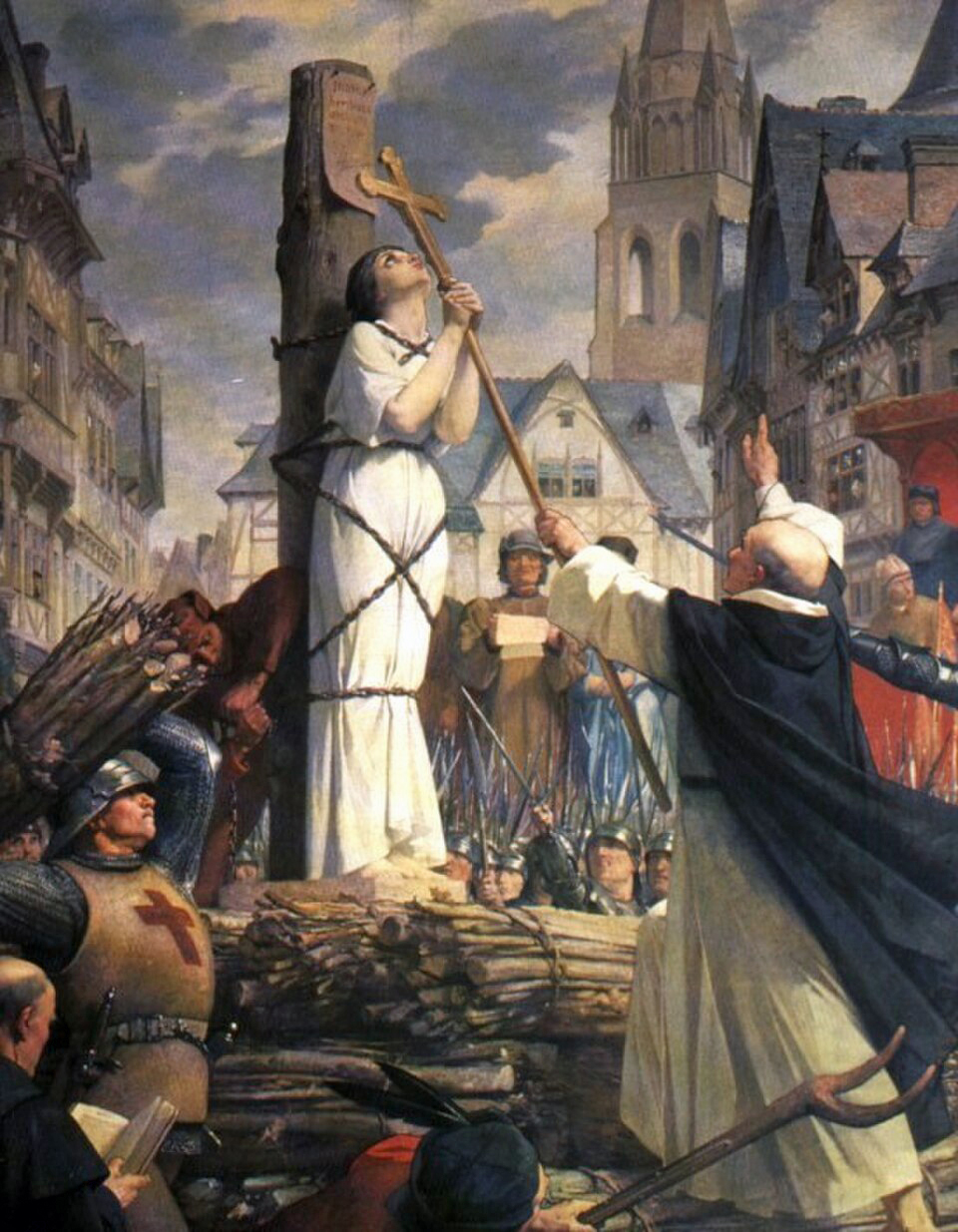
destruction, but they claim God's endorsement of their evil. A prime example is
illustrated in the picture accompanying this commentary of Joan of Arc being
burned at the stake painted by Jules-Eugene Leneuveu. Raised up like a latter-day
Gideon to liberate her country from foreign occupation, she was eventually
betrayed by the very people who followed her and believed in her calling by
God. They turned her over to the English who had suffered several defeats by
the French army she led. The British, in turn executed her for Satanic heresy,
believing they were doing God's will through her immolation. As the mythology
surrounding her death asserts, this was done despite her willingness to kiss
the cross of Christ as proof of her innocence.
The number of such martyrs is
legion when we consider the inquisitions foisted on the church by overzealous
prelates. It is ironic when we consider that the early Christians were often
subjected to such treatment by pagans in Roman arenas and those martyrs whose
blood also watered the ground in remote locations across the globe. Tertullian
recognized however that "The blood of the martyrs is the seed of the church."
While this sounds like he is lauding those who gave their lives for the gospel,
the same can be said for all martyrs and their causes. Martyrdom tends to
inflame and grow the opposition rather than defeat it. In terms of Jesus'
warning uprooting the weeds may not only uproot wheat as well, but it may also
cause some wheat to join the weeds in opposition to the gospel.
So, what are we to do about sin
in the church? Don't we, like Crusader Knights of old need to raise high the
banner of the cross and smite the heathen, thwarting their evil designs? After
all, Peter cut off the ear of the High Priest's servant while defending Jesus,
and Jesus himself indicated swords might be needed? (Luke
22:36,38) Strangely, Luke, the only gospel that has Jesus telling his disciples
to take up swords is written by the same author as Acts, yet nowhere anywhere
else in his two books does the author ever indicate that the early church
understood that they were to take up arms and offer resistance to the
persecution sweeping over them.
Jesus said to Pilate, "My
kingdom is not of this world. If it were, my servants would fight to prevent my
arrest by the Jewish leaders. But now my kingdom is from another place." (John
18:36) This does not sound like a rallying cry to battle the forces of evil and
sin in this world. Doing so would indicate that the cross was insufficient assurance
of victory. It would proclaim that Christ's kingdom is wholly dependent upon
our ability to conquer the forces of evil here and now. But if that is the case
what is the point of Revelation and an apocalyptic denouement? And in the assurance
of that denouement, why would Christians seek to establish something less in
the interim?
A Crusader mentality would have
us now, as in medieval times, going forth under the banner of the cross to do
battle with the heathen under the mistaken assumption that it would usher in
the Parousia. It did not happen during the Crusades of yore, and it will not
happen today. Nowhere does Jesus tell us that he needs us to establish a planetary
beachhead in anticipation of his militant conquest of planet Earth. In (Daniel
2), it is not humanity that brings an end to opposition to God, it is God
himself. In (Daniel
3), when humanity seeks to establish itself as reigning supreme, God
reveals again that it is his kingdom, his will that will prevail not mankind's.
For those who are in rebellion against God, this is not good news. It is the
handwriting on the wall in (Daniel
5), warning the rebellion will never succeed. But it is also not good news
for those who think they are doing God's will in persecuting others. Their
desire to harm others whether pagan or Christian is indicative that they are
not in harmony with God but are rather serving another. They worship and follow
powers they do not understand and despite the religious trappings they adorn themselves
with, they do not follow the light of Christ but one who would impersonate that
light. "For such people are false apostles, deceitful workers, masquerading as
apostles of Christ. And no wonder, for Satan himself masquerades as an angel of
light. It is not surprising, then, if his servants also masquerade as servants
of righteousness. Their end will be what their actions deserve." (2 Corinthians
11:13-15)
Some would manipulate us through
fear into opposing such individuals and angels, but the war is already won and
not by us. As Moses, speaking for God, said to the Israelites on the shore of
the Red Sea while the Egyptian army was pressing hard in pursuit, "The Lord
will fight for you; you need only to be still." (Exodus 14:14)