
Stephen
Terry, Director


Choose
This Day!
Commentary
for the December 27, 2025, Sabbath School Lesson
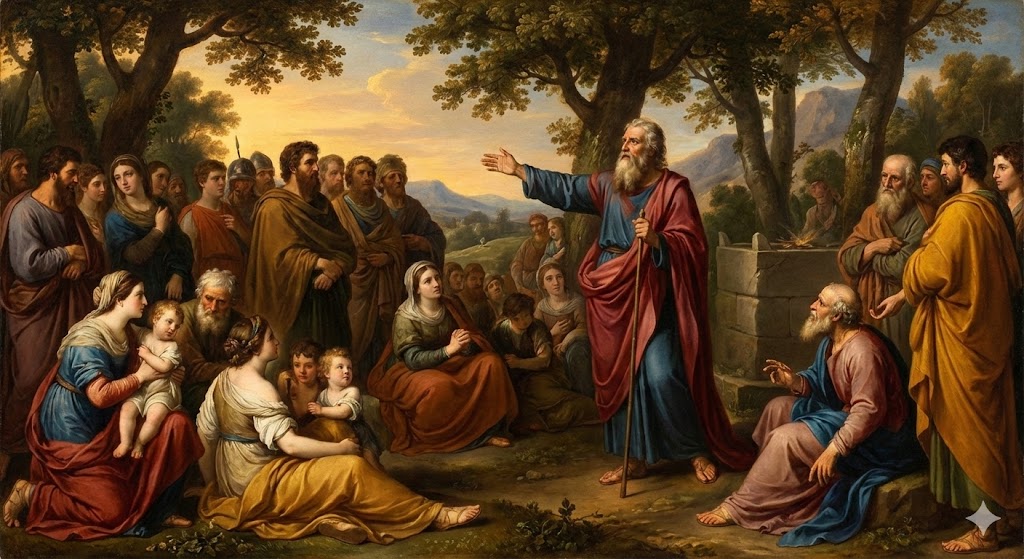 "But if
serving the Lord seems undesirable to you, then choose for yourselves this day
whom you will serve, whether the gods your ancestors served beyond the
Euphrates, or the gods of the Amorites, in whose land you are living. But as
for me and my household, we will serve the Lord." Joshua 24:15
"But if
serving the Lord seems undesirable to you, then choose for yourselves this day
whom you will serve, whether the gods your ancestors served beyond the
Euphrates, or the gods of the Amorites, in whose land you are living. But as
for me and my household, we will serve the Lord." Joshua 24:15
Each
morning, as I awake, our two Siamese cats, Simeon and Jasmine, greet me. It is
time for them to be fed, and their insistent demands for my attention reveals
they have not forgotten that others like them were worshipped by the Egyptians
as gods long before they had the misfortune to live with a commoner like me.
They order me to bring them sacrificial offerings or suffer the consequences.
Of course, as minor deities, the consequences are usually not mortal, but the
disfavor of even such lesser gods can be disquieting. They are not slow to
remind me that my wife will be invoked should I fail to respond. So, I rouse
myself and shuffle to the kitchen to begin the morning feeding regimen. Once
begun, the harmony of the universe is quickly restored, and I enjoy their favor
once again, at least until it is time for the evening sacrifices.
These
tongue-in-cheek daily rituals, although humorous, reveal a more profound lesson
that life is all about choices, and those choices can have a lasting effect not
only on the dispositions of two Siamese cats, but also on much else that transpires
as we journey through each day, ultimately weaving those days into the life
that transpires between our birth and our death. While I was attending Walla
Walla College's School of Theology in the 1970s, a fellow theology student challenged
me on that point. "Come on," he said, "it cannot really make a difference how
you tie your shoelaces or whether you walk around a building on the west side
as opposed to the east side! God would not use such trivialities in his
interactions with his people!" But I have read the Bible through from beginning
to end many times and have seen that he does concern himself with such minor
things. I have also seen it in my life over the years.
In
the concluding chapter of the book of Joshua, he calls the people together and
tells them to make right choices about their relationship with God for choices
matter. Then, as if to illustrate his point, the next book in the Bible,
Judges, gives repeated examples of the results of making bad choices and then
making good choices as the people struggle to find answers for the results of
those bad choices that now need correction. One example that shines out is the
story of Gideon, found in Judges
6-8. The Israelites had failed to deal with the dispossessed people of the
land and lived under threat from Midianite raiders. Instead of looking to God
for answers, they were worshipping the gods of those who had lived in Canaan
before them.One would think if those gods could not deliver those inhabitants
from the Israelite invasion how could they in turn protect the Israelites from
being invaded? Nonetheless, even Gideon's family had gone astray. But God saw
potential in Gideon and called him to become the deliverer of his people
against the Midianites.
Gideon
lacked faith in God but was bold enough to ask God for proof that he was more
than just his imagination in overdrive. God agreed to a test and Gideon
proposed how he would like to verify that he was speaking with God. He offered
to place a sheep fleeced on the threshing floor overnight, and if it were wet,
but the floor was dry, that would be a verification. God agreed, and when he
arose the next morning, he discovered the fleece to be wet, but the floor was
dry. Thinking it might have simply been a coincidence, Gideon proposed another
test with the opposite result. Once again, when he examined the fleece the next
morning, this time it was dry and the floor was wet. At that point, choosing to
follow God's guidance, Gideon went forward to win a significant victory against
the Midianites. But the point of this reference is that God was willing to use
something as simple and minor as dew on a lamb's fleece to guide Gideon along the
path of redemption, not only for Gideon and his family but for all of Israel.
Choices that we think are trivial may have significant impacts on us, our family,
our town, and even our nation. Those impacts can be difficult if not impossible
to ascertain when we make those decisions. Therefore, faith becomes essential.
To
have a relationship with God, we must believe that he exists. (Hebrews
11:6) Does that mean we need to be able to fully understand God before we
can enter that relationship? That may be impossible, but it does not prevent
the relationship. It may be like this. When I come home to a dark house, I flip
a switch, and I instantly have light to prevent stumbling about in the dark. I
reap the benefit of that light with my safety even though I may not understand
how electricity works or whether light is manifest as particles or waves, or
both. The light still works even if I know nothing about how or why. Now if I
come home with a friend from a place where they do not have electricity, he may
feel we need to kindle a flame and light a torch to find our way about the
house. He has no experience with light switches and acts as though the switch
does not exist. His solution may provide a more primitive answer to the problem
that works even if not as efficiently. But in replacing its function, it does
not negate the light switch. The switch continues to offer its services for
those who would put it to use.
Ironically,
both the one with the flame and the one with the switch may give thanks to God
for providing each as an answer to a problem. And if God is such a variable
answer that depends upon our choices for realization, then God is good all the
time and not malevolent. The Bible is a case study of the results of myriad choices.
When I buy a product, especially a potentially hazardous one, it usually comes
with a manual guiding me in how to make safe choices so that I will not harm
myself, others, or the product itself while utilizing it. The product's utility
makes it a proper choice to tackle certain tasks despite its potential for
harm. If I refuse to read the manual or read it and choose to ignore its
advice, it does not mean that the manufacturer is malevolent for making such a
device. And I would be foolish when faced with a similar problem to say, "I
will never use that product again because things went wrong when I used it before."
The wise course would be to be more attentive and careful when applying the
instructions the second time. Then with each successful interaction with the
manufacturer's product, I will not only grow more competent with the device, but
I will also develop a growing respect for the manufacturer, and I may purchase
other items from their product line based on faith in that relationship.
Joshua,
who assumed leadership of Israel after Moses' death, had that kind of relationship
with God. He had witnessed God's deliverance of Israel at the Red Sea when the
only thing the people needed to do was to be still and move forward in faith
toward their deliverance from the army of Pharaoh. He had seen repeatedly the results
when the people chose to walk away from God or to walk toward him as they
traveled through the wilderness for forty years. He also noted the suffering of
those who chose to follow God but had to suffer with the rest of Israel even
though they made the right choice and everyone else chose poorly. They knew
that the resulting suffering was not the result of God's plan or his
malevolence but simply the working out of poor choices. If I grab a scorpion
and am stung and suffer for it, it is not the fault of the one who made the scorpion.
It is because I chose to grab the scorpion, even if I did it in ignorance.
A common
flaw of humanity is to avoid responsibility and seek someone to blame. It is
the essence of the Fall in Eden. When God asked why they chose to eat the fruit
from the forbidden tree. Adam did not accept responsibility; he blamed Eve and
even blamed God for creating Eve. Eve in turn blamed the serpent, not accepting
her own responsibility for choosing to believe the serpent instead of God. And
this is where we are today. We either deny God exists because of the evil in
the world, or we blame God for allowing that evil. But just as it is a sign of
maturity within our family and our community to accept responsibility for our
choices, it is also a sign of spiritual maturity to do the same with our relationship
with God. We once enjoyed the warmth and closeness of that relationship in the
beginning. Joshua invites us to step up, be responsible, and choose that joy
once again.