
Stephen
Terry, Director


Giants
of Faith: Joshua and Caleb
Commentary
for the November 22, 2025, Sabbath School Lesson
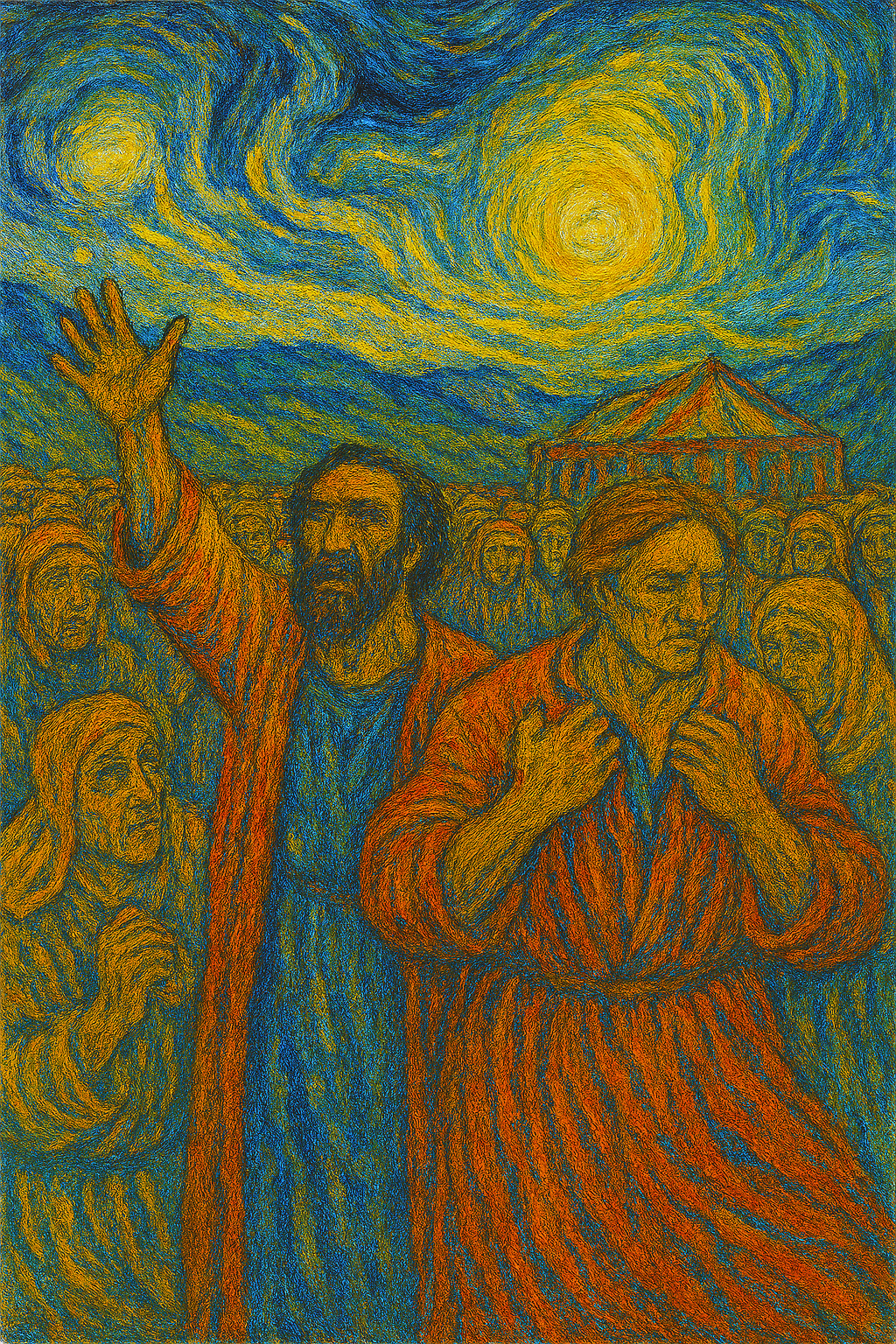 "The Lord said
to Moses, 'How long will these people treat me with contempt? How long will
they refuse to believe in me, in spite of all the signs I have performed among
them?'"
"The Lord said
to Moses, 'How long will these people treat me with contempt? How long will
they refuse to believe in me, in spite of all the signs I have performed among
them?'"
Numbers 14:11
One
of the great mysteries of faith is why some are willing to completely surrender
their lives to faith in God while others feel that only fools would sacrifice
so much. And the latter outnumber the former by orders of magnitude. Over six
hundred thousand souls eventually entered Canaan to possess it as the Lord
commanded. Of all those, only Caleb and Joshua had sufficient faith to have
gone up forty years previously and now had the opportunity to see that faith
rewarded. Even Moses, who led them from Egypt, and Aaron, the High Priest, were
not allowed to enter because at crucial moments their faith had faltered. When
challenged by the people when they told the people God wanted them to enter
Canaan, Moses and Aaron fell on their faces with humility before the people,
but Joshua and Caleb stood firm and urged the people to have faith in God to
deliver up their enemies. They were so bold in their profession of faith that
the people would have stoned them had God not intervened.
God's
intervention demonstrated that whether many or only two as with these brave
men, he has the power to save no matter how huge the throng in opposition. But
the people had lived in fear for centuries in Egypt where the Egyptians used
that fear to control the Israelites and keep them subservient. Evil always uses
fear and lies to rule over the people. And if they are successful in inciting
fear in our hearts, all manners of evil come spilling forth with little to no
restraint. But while fear raced through the crowd that day, it found no fertile
ground in the hearts of Joshua and Caleb.
We are taught fear from childhood. We are taught to be self-reliant,
that God only protects those who protect themselves. What are we to be
protected from? Anything that makes us fearful. A line often heard in movies
and television series is when a younger man asks a stolid and focused older man
if he is ever afraid of anything. The response is always, "Only a fool is never
afraid." The moral is that fear is normal. But is it? Or are we just being fed
a line to make us easier to manipulate?
I do
not think we were created to be fearful. We were created to be loving. God
created us in his image. (Genesis
1:27) God's character is love. (1
John 4:8) The love between God and humanity in the beginning was profound.
Adam, Eve, and God walked together in the Garden of Eden enraptured by that
love until the serpent brought fear of missing out for humanity to consider.
Once fear gained a foothold in human hearts, everything became tainted with it.
Even God, whom they loved so much, became something fearful to them, and
instead of looking forward to their time walking together in the garden, they
hid in fear from his presence. As Jesus wept over Lazarus' tomb, God must have wept
over Adam and Eve because of the sadness and fear that now came into the world.
Anyone who has ever loved and been betrayed by the one
they loved knows that pain in their heart. It is extremely hard to overcome the
fear that arises from that betrayal.
Fear
has become so universal that thousands of years after that original separation
between humanity and God, when God so loved the world that he sent Jesus (John
3:16-17), the first words out of the mouth of the angel announcing the
birth of Christ to shepherds in the field were "Do not be afraid." (Luke
2:10) Dealing with this human trait of fearfulness is why the ministry of Jesus
is so filled with kindness and compassion. One cannot win hearts by going around
telling everyone "Be afraid!" We feed a couple of feral cats that come to our
door each evening. Anyone who has done this knows that making such an animal
afraid of us will never win over their faith and trust. Does it then make sense
that characterizing God as a dangerous and fear inducing tyrant will be able to
return us to the relationship of Eden? How could we ever be at peace enough to
love him if we are fearful that his temper will flair and he will consume us? And
if we think about it, why would such a God resurrect anyone to enjoy paradise
in the earth made new? How could a life of fear ever be paradise? No, the
restoration coming is the love that existed in Eden in the beginning.
Love can
banish fear. (1
John 4:18) In the run up to Jesus' incarnation, it was thought the best way
to destroy evil was to eradicate it through physical destruction, but that only
transfers the evil from those who are thus destroyed into the hearts of those
doing the destroying. That is why the Crusades could never have produced a
kingdom of God on earth. Evil deeds create fear, and fear only creates more evil. This is what it has done since Cain slew his
brother Abel outside the gates of Eden. Thousands of years later, it was what
the people expected of the Messiah when he came. They wanted and expected him
to destroy the Roman Empire that dominated their lives.
Those
who never accepted Jesus as the Messiah, still expect whoever the actual
Messiah to come is to destroy everything at his coming. Even those who accepted
Jesus' incarnation think that way about the parousia. They call it a strange
act, out of character with God. A loving God is hard for even many who consider themselves Christians to accept. They do
not understand a God who loves sinners as though they and sanctimonious religious
leaders are equals. Jesus takes it a step beyond that, "I tell you that in the
same way there will be more rejoicing in heaven over one sinner who repents
than over ninety-nine righteous persons who do not need to repent." (Luke 15:7)
While some might gleefully rejoice at the punishment
of the wicked, God does not. "As surely as I live, declares the Sovereign Lord,
I take no pleasure in the death of the wicked, but rather that they turn from
their ways and live. Turn! Turn from your evil ways! Why will you die, people
of Israel?" (Ezekiel 33:11)
That turning
is repentance. It is a decision to stop walking away from God and start walking
toward him. But to do that, we must decide that God exists. "Anyone who comes
to him must believe that he exists and that he rewards those who earnestly seek
him." (Hebrews 11:6) This is what it means when we say we are saved by faith. It
makes no sense to walk toward someone whom we believe does not exist. Joshua,
and undoubtedly Caleb, understood this element of choice enlightened by faith
in our relationship with God and our trust in his leading. He spoke to those
who followed him into Canaan about it. Fear had become so ingrained in human
existence that he spoke to them in the context of that fear so they would
understand. "Now fear the Lord and serve him with all faithfulness. Throw away
the gods your ancestors worshiped beyond the Euphrates River and in Egypt and
serve the Lord. But if serving the Lord seems undesirable to you, then choose
for yourselves this day whom you will serve, whether the gods your ancestors
served beyond the Euphrates, or the gods of the Amorites, in whose land you are
living. But as for me and my household, we will serve the Lord." (Joshua 24:14-15)
The choice
remains for each of us. In 1979, Bob Dylan in his album "Slow Train Coming" had
a track titled "Gotta Serve Somebody." He maintained that any idea of real
choice is illusory. We may feel that we have autonomy regarding how we live our
lives. "But you're gonna have to serve somebody, yes indeed. You're gonna have
to serve somebody. Well, it may be the Devil, or it may be the Lord, but you're
gonna have to serve somebody." Those who think that their own autonomy is
established by how many they can co-opt into serving them are only deceiving
themselves for they also are serving the one they are enthralled to. Whether
the thralldom is with chains of gold or something else makes little difference.
As mentioned in an earlier commentary this quarter, Achan chose bonds of wealth,
and those bonds only brought needless death to him and his family. Bonds of
love secured by faith in God, who is love, would have served him better.
Wealth
is indifferent to us. Sacrificing our faith for it can leave us feeling as cold
as the grave. However, if we love someone who loves us, that cold can dissipate
to be replaced by the warmth of that love and the security we obtain when we
exchange our fears for love, especially love of God. God's love never ends.