
Stephen
Terry, Director


God
Is Faithful!
Commentary
for the December 20, 2025, Sabbath School Lesson
 "Love the Lord
your God with all your heart and with all your soul and with all your strength."
Deuteronomy 6:5
"Love the Lord
your God with all your heart and with all your soul and with all your strength."
Deuteronomy 6:5
We
live in a world today where right is wrong and wrong is right. Kindness is seen
as weakness, and vengeance and bullying are seen as traits of desirable
masculinity. These traits are glorified throughout our history. Major battles
between tribes, nations, and races of people punctuate every recounting of the
past as significant societal turning points. Often these battles are led by
individuals who, dying at the most, a few decades later, never see the full
result of their onslaught against others. Their descendants, not driven by the
same lust for power, see all that has been gained seep through their fingers no
matter how hard they try to keep what has been gathered. They discover that a
thousand wolves raid their borders as they have waited for the passing of the
conqueror to wreak vengeance and reclaim what was taken
by the victor a brief time before. If a new eader arises that can keep the
wolves at bay for a time, they continue to be a threat, biding their time and
probing for weaknesses.
Things
did not begin that way. The book of Genesis tells us that humanity was created
in God's image. (Genesis
1:27) That image was love. (1
John 4:8) In love, God, Adam, and Eve walked together in the Garden of
Eden. All was harmonious and wonderful until one day fear came to visit. The
serpent accused God of keeping secrets and Eve began to fear she was missing out
on something, to fear that God was not telling the truth. But God did not
create the lie. That was the serpent, otherwise known as Satan (Revelation
12:9) who invented the lie. (John
8:44) Satan used fear to separate humanity from God by claiming God's
intent to be nefarious. It worked then and still does today. How often have we
heard people say in response to the genocides of the Old Testament and the
Crusades and more modern religious terrorist mass murders that if God is like
that, they want nothing to do with him. Even the Bible seems to obscure and malign
God's character.
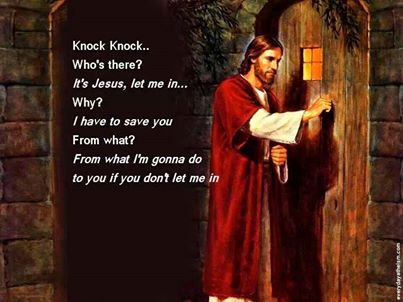
Preachers
in pulpits carry the same message. If you do not obey God, he is going to kill
you or torment you painfully while keeping you alive for all eternity so he can
enjoy the torment he is inflicting on the lost. It matters little whether the
torment is eternal or only momentary. God is going to get you if you refuse
him. This portrays our relationship with God more as a domestic violence
situation than a loving relationship. It makes it look as though God is so
desperate for us to validate his existence that he will perpetrate any crime,
even murder, to keep us from leaving. When we teach such things about God,
especially if we couple it with the idea that only the male in a relationship
can be in charge, there is little wonder why there is so much domestic violence
even among those who claim to be Christian. We take this distorted image of God
and make it the default for our own perspective on the world. Rather than love
our neighbor, we seek to dominate them even at church. There are those who would
pull any lever, stab any back, and think they are doing God's will in doing so,
never realizing that the tools they are using to manipulate, dominate, and even
destroy others were forged in hell not heaven.
In
view of all of this, God is tremendously patient compared to those who claim to
be his followers. Imagine how quickly their tempers would flare into an inferno
if the average Christian were to be even slightly offended at something said to
them. And once that fire is ignited, it often burns for generations with the
tale of the offense being passed on from parents to children, to grandchildren.
We can even see the results of these generational feuds today in the very lands
Jesus walked when he was here two thousand years ago. We claim to be waiting
for Jesus' return to right every wrong and restore the peace of Eden, but what
if our failure to let him restore his image in us is the reason he has not
returned? What if it is not because we have not taken Jesus to every nation,
tongue, and people, but because we have not lived the self-sacrificing patience
and love of God in our lives? The Apostle Peter was challenged over Jesus' delay
in returning, and he responded. "The Lord is not slow in keeping his promise,
as some understand slowness. Instead, he is patient with you, not wanting
anyone to perish, but everyone to come to repentance." (2 Peter 3:9)
But because
of the hardness of our hearts, we have chosen to live in fear of others and
fear of God and ignore the teaching that we are to live with love for God, and
love for our neighbor. The harshness and death that results from that kind of
thinking is seen throughout the Bible. One of the reasons the Bible is so
inspired is because it hides nothing of the evil we are capable of when we live
in fear. God knows our hearts, but so do we, and if we are honest with
ourselves, we behave stupidly and sometimes viciously because of fear. Often
that fear is never realized, but we entertain it and feed it until it overwhelms
us anyway. And we project that onto others, because fear is driving us to treat
others with suspicion and unkindness, we see them as having similar
motivations. But it does not end there. We even project our flawed characters
onto God. Because we are so prone to such projections as part of our nature, it
is reasonable to expect similar projection by the Bible writers. The fear birthed
in Eden has become so much a part of our nature that when Jesus was born and an
angel appeared to shepherds in the fields to announce his birth, that angel's first words to the shepherds were "Don't be afraid!"
It
was fitting that the shepherds were invited to go see the baby Jesus. The tender
care of a shepherd for his sheep is a model for our care for one another as
well as God's care for us. That thought brings great comfort to me today just
as it did to King David centuries before the birth of Jesus. In what we call
today the 23rd Psalm, he wrote, "The Lord is my shepherd. I shall
not want. He leads me beside the still waters. He restores my soul. He leads me
in the path of righteousness for his name's sake. Yes, though I walk through
the valley of the shadow of death, you are with me. Your rod and your staff comfort
me. You prepare a table before me in the presence of my enemies. You anoint my
head with oil. My cup runs over. Surely your goodness and mercy will follow me
all the days of my life, and I will dwell in the house of the Lord forever."
It is
ironic that Americans sometimes refer to the United States as a Christian
nation. But if we look at ourselves more closely we would see that much of what
we call Christian is just like what Christ called whitewash on a tomb. (Matthew
23:27) We have a higher percentage
of our population in prison than any other similar nation in the world, and we
typically put them there to forget about them. Our cities are filled with the
homeless in a land with enough empty homes to house everyone, but not many can
afford to buy them or even to rent them. Our people struggle with horrendous
medical debt and because so many cannot afford insurance our hospital emergency
rooms are choked with the uninsured with nowhere else to go. It reminds me of
Charles Dicken's "A Christmas Carol," when the wealthy Ebenezer Scrooge is
asked for a donation to help the homeless and less fortunate. He asks, "Are
there no prisons? Are they still operating? Those who are badly off must go
there."
"Many
would rather die!" came the reply.
"If
they would rather die," said Scrooge, "they had better do it, and decrease the
surplus population."
Today
people simply want the poor out of sight, seeing them as a blight on our
cities. Projecting their own hard-heartedness and greed onto the poor, they
live in fear that the poor will take from them whatever they do not give
voluntarily. Ironically, it is often the case that the poor find more sympathy
and support from those who have the least to share. The wealthy, not content
with ignoring the needs of others themselves, when they see others helping the
needy, to quiet the Holy Spirit's convicting voice, tell themselves and others
that those who give are just enabling bad behavior, as though if those helping
hands were gone tomorrow, there would no longer be needy people among us.
It is
time, people, including us as Christians, stopped misrepresenting God's
character, both in how we act toward others and how we characterize God's
actions toward those we consider the "lost." His heart yearns to walk together
in love with them and us as he once walked with Adam and Eve in Eden. He vows
that day will come again, but if we harden our hearts toward others, heaven will
not seem heavenly to us. But God is love. He will not force us to live where we
will not be happy, or where we cannot stand others who live there. That is
love.