
Stephen
Terry, Director


Memorials
of Grace
Commentary
for the October 18, 2025, Sabbath School Lesson
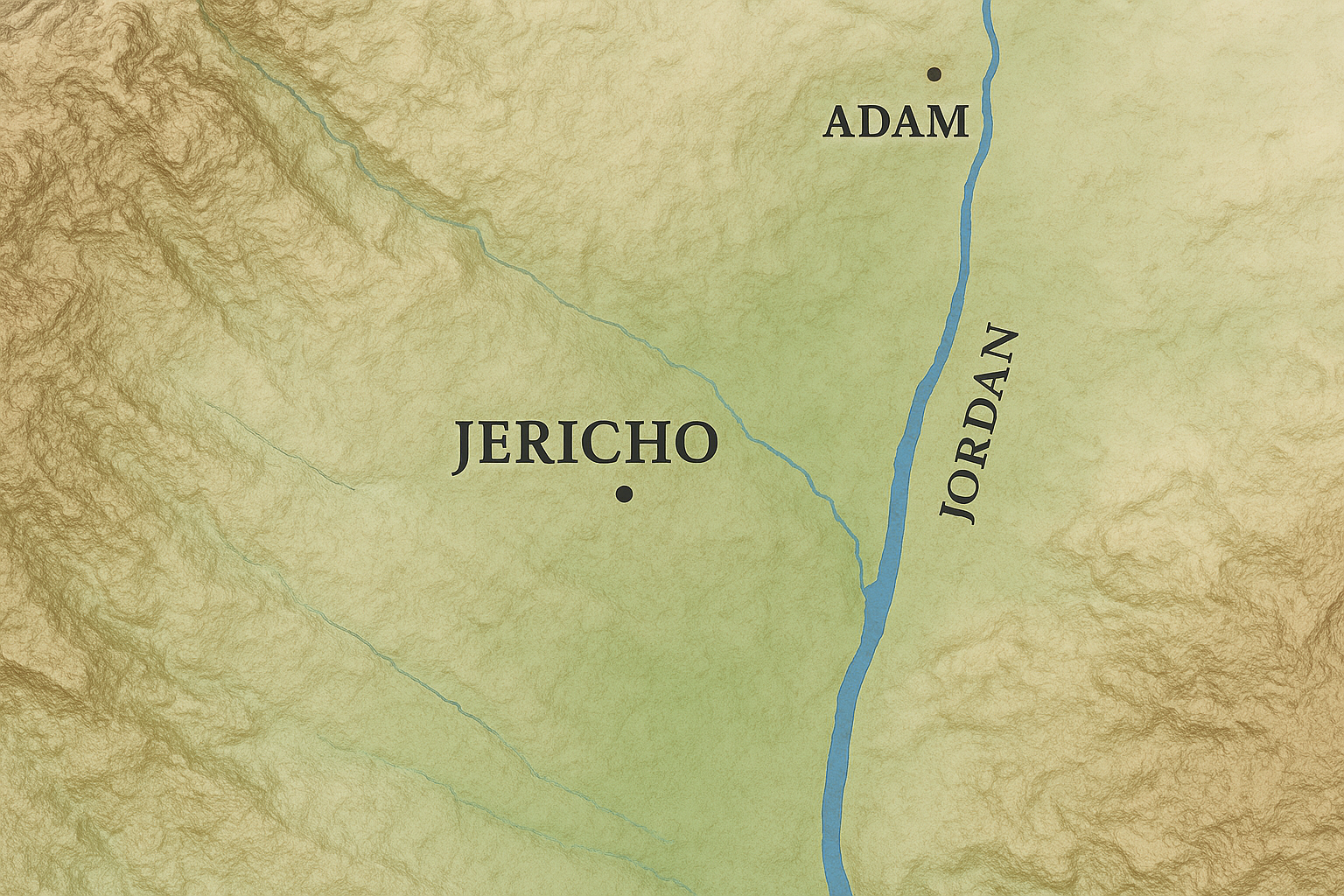 "The water
from upstream stopped flowing. It piled up in a heap a great distance away, at
a town called Adam in the vicinity of Zarethan, while the water flowing down to
the Sea of the Arabah (that is, the Dead Sea) was completely cut off. So, the
people crossed over opposite Jericho. The priests who carried the ark of the
covenant of the Lord stopped in the middle of the Jordan and stood on dry
ground, while all Israel passed by until the whole nation had completed the
crossing on dry ground." Joshua 3:16-17
"The water
from upstream stopped flowing. It piled up in a heap a great distance away, at
a town called Adam in the vicinity of Zarethan, while the water flowing down to
the Sea of the Arabah (that is, the Dead Sea) was completely cut off. So, the
people crossed over opposite Jericho. The priests who carried the ark of the
covenant of the Lord stopped in the middle of the Jordan and stood on dry
ground, while all Israel passed by until the whole nation had completed the
crossing on dry ground." Joshua 3:16-17
This
scene by Jericho was repeated many years later when Elijah parted the waters of
the Jordan River by Jericho before crossing over to be taken up to heaven in a
fiery chariot. He struck the river with his mantle or cloak to part the stream
and when he was gone, Elisha picked up the garment and did the same to pass
back across the Jordan. This is where we get the phrase about "passing the
mantle" of leadership from one generation to another. This was also the case
with Moses and Joshua. Moses parted the sea and that act confirmed his
leadership of the people when they were leaving slavery in Egypt behind. His
successor, Joshua, was identically confirmed when the Jordan was dried up to
allow all the people to cross over to the plain of Jericho.
The
latter miracle was no less spectacular because the river was
blocked at least twenty miles upstream from Jericho where the blockage
was likely unseen from the Jericho area. It has been
speculated that the cliffs next to the river collapsed blocking the water's
flow to allow all the people to cross. This is because in 1927 a similar
obstruction occurred. Whether the blockage was due to geologic instability or
from the power of the Ark of the Covenant standing in the midst of the river,
the timing was propitious and left little doubt who was in command of Israel.
The instability of the region cannot be denied because of the towns and wonders
that were toppled long ago by seismic activity. Even the conquest of Jericho
seems to have been accomplished by the shaking of foundations and the toppling
of walls. And just as there was no going back to Egypt once the sea closed over
Pharaoh's army, there was no retreat from Jericho, once the Jordan closed
behind Joshua and the Israelite tribes. One might say that except for the forty
intervening years, Joshua was re-enacting the scenes that played out for that
earlier generation. Just as each of the twelve tribes sent a man to spy out the
land of Canaan for Moses, Joshua sent two spies to Jericho, symbolic of the two
spies who earlier gave a good report and encouraged their forefathers to go up
and possess the land. The spies that visited Jericho also brought back a good
and encouraging report. All four spies, Caleb and Joshua from before and the
pair sent now entered the land and invoked God's promise to the patriarch
Abraham, not as originally planned without so much loss of life, and with much
stumbling along the way, but God remained faithful despite the waywardness of
the people.
This is
the way with humanity. We seem to wander like sheep, thinking we can find
greener pastures somewhere else. We prefer hiding in the bushes in our
nakedness instead of walking with God in paradise. Our definition of heaven is
to have milk and honey, and never-ending treasure pour into our hands without significant
effort on our part. We simply open our hands and there it is. While God's loving
grace will often bestow good things for his people, it is a mistake to presume
that no matter what, we can claim those treasures as surely as if we deserved
them because of our own great brilliance. The mistake in believing that is
testified to by the bodies of those who died during those forty years of
wandering, victims of their own distrust of God and the grace he so freely
bestows. When God created Adam and Eve, it was not with the idea they could
simply lay about under the trees of the Garden of Eden and have food drop into
their mouths without effort. They were placed in the Garden to tend and keep
it. (Genesis
2:15) Humanity has a responsibility to care for the earth not only to
selfishly provide for our own needs but to provide for all needs. However, some have caught a disease, the disease of insatiable greed.
As a result, most have nowhere near enough while very few sit on boundless
hordes of wealth and resources, dreaming of ways to prevent anyone, no matter
how needy, ever benefiting from having even the direst needs met by what that
wealth could provide. Without access to those resources, we have become a
society of beggars with constant appeals for money from charities that would
not even need to exist were there not such hoarding of resources.
Jesus
spoke repeatedly about such evil.
'The Parable of the Rich Man and Lazarus" (Luke
16:19-31) condemned the indifferent hoarding of wealth, and the expectation
that the wealthy could hope for any blessings later even though they denied
blessings to the needy or failed to show respect or kindness to those they
considered beneath them while they lived. We see such wealthy people on the
news lately wearing their little gold crosses and pretending they are saints
while grinding the needy beneath their heels. Then they have the effrontery to
claim that because we are in a "new covenant," they will be saved by grace no
matter how much evil they perpetrate in this life. Their hearts are stone, and
they are unwilling to humble themselves that God might give them caring hearts
of flesh. (Ezekiel
36:26)
But
it is not just the New Covenanters who have such hard hearts. Jesus was
approached by a wealthy young man who asked what he needed to do to be saved. (Matthew
19:16-26) Despite his wealth and his careful observance of the commandments,
he felt he was still lacking what was needed. Jesus
walked him through the law, and he claimed to be observant of all. But then
Jesus, while praising him for his obedience, pointed out to him his need to use
his wealth to be a blessing to others. He turned away from Jesus for his wealth
had become more important to him than treating others with the same love he
would like to receive. Jesus pointed out that it is easier for a camel to go
through the eye of a needle than for a rich person to enter God's kingdom.
Some, who worship wealth and power, have tried to corrupt Jesus' words by
insinuating that there was a gate in Jerusalem called the "Eye of the Needle"
that Jesus was referring to and not to an actual needle. But there has never
been such a gate. The Greek makes clear that it is an actual needle, and the
disciples understood it as such for they replied that then it would be
impossible for the rich to be saved. These two points
constitute the two witnesses the Bible requires to verify the truth, so we
should not be deceived by the false camel through the gate idea. Not only will
we be stripped of all our wealth when we die, but if
we have not learned the truth of this teaching, we will also fail to "pass through
the eye of the needle" ourselves.
How
should we then live in response to the needs of others? We experimented last
year and set aside a sum of money and donated to several
charities that we felt represented worthy causes. Almost all of them used the
money we sent not to help the needy but to send us piles of mailings wanting
more money. They also sold our name and address to other charities who
inundated us with even more mailings demanding money for their needs. For the
past year we have received as many as a dozen requests from charities per day
in the mail. The cost of all those mailings far exceeded the donations we gave.
We examined biblical giving and discovered where we went wrong. In the words of
Jesus, "So when you give to the needy, do not announce it with trumpets, as the
hypocrites do in the synagogues and on the streets, to be honored by others.
Truly I tell you, they have received their reward in full. But when you give to
the needy, do not let your left hand know what your right hand is doing, so
that your giving may be in secret. Then your Father, who sees what is done in
secret, will reward you." (Matthew 6:2-4) I shared this with a conference
treasurer and told him that I would be giving anonymously in the future. He
told me that I would be sinning to do so. I took this as evidence of how far
the church has strayed from the teachings of Jesus.
Decades
ago, after graduating from college and entering the pastoral ministry, my first
wife was diagnosed with multiple sclerosis. I needed to leave the pastoral
ministry to care for her and help with raising my son. A degree in theology
does not provide significant income opportunities, and things got so bad that
when I did find short term jobs, I would have to bring home toilet paper from
the office so we could have some at home. I fell
months behind on rent but trusted God that he would not forsake us in our need.
Then one day, I was told by our landlord that a woman from my church had paid
hundreds of dollars to bring our rent current. He did not know her name as she
chose to give anonymously. That gift allowed us to get a leg up and start to
turn things around. I am sure she did not lose her blessing for her kindness. I
now try to follow her example and give anonymously so I do not lose my blessing
either.
People
tend to give money to churches and charities because it is easy, and those
organizations stand as a buffer between us in our world and those experiencing
real world poverty. But I feel it would do each of us a world of good to get to
know the needs of others directly and seek to meet those needs, not to get tax
write offs, not to have others think we are saintly givers, but simply because
it is the right thing to do. It sure seemed right when someone else did it for
me.