
Stephen
Terry, Director


Recipe
for Success
Commentary
for the October 4, 2025, Sabbath School Lesson
 "There is a
time for everything, and a season for every activity under the heavens: a time
to be born and a time to die, a time to plant and a time to uproot, a time to
kill and a time to heal, a time to tear down and a time to build...a time to
tear and a time to mend, a time to be silent and a time to speak, a time to
love and a time to hate, a time for war and a time for peace." Ecclesiastes
3:1-3, 7-8
"There is a
time for everything, and a season for every activity under the heavens: a time
to be born and a time to die, a time to plant and a time to uproot, a time to
kill and a time to heal, a time to tear down and a time to build...a time to
tear and a time to mend, a time to be silent and a time to speak, a time to
love and a time to hate, a time for war and a time for peace." Ecclesiastes
3:1-3, 7-8
After
four centuries of captivity in Egypt, the period of the Patriarchs had passed. Self-effacing
and unprovocative, they had striven to live at peace with the Hittites and
others who occupied the land of Canaan before the Egyptian captivity. When they
emigrated to Egypt they did so as humble foreigners seeking a peaceful
existence where there was enough food and pasture for them and their flocks to
survive during a time of famine. Because Joseph had obtained a position of
influence in Egypt, Pharaoh welcomed them with open arms as the relatives of a
favored advisor. However, with the passage of time, old friendships were
forgotten and new political realities led to bondage for the Israelites.
Humble, patriarchal leaders could no longer rely on the good graces of those
who held power in Egypt. It was time for a new type of leader, a warrior
prophet unafraid to speak truth to power.
Moses
understood things had changed, and in his forties, he tried to forge a new
model. Slaying an Egyptian taskmaster seemed the logical first step, but it led
only to him fleeing into exile in Midian where he married into the family of a
priest, Jethro. For four more decades, he learned from his father-in-law
lessons he could not learn in Pharaoh's court. He learned there is a power greater
than the sword, so without a sword, he returned to Egypt and with authority
that only God can give, he demanded the freedom of the Israelites. He had
become a new creature. He was not the warrior trained to battle in the Egyptian
barracks he once was. His weapons were the words God gave him and miraculous
revelations of divine power that arose when he spoke those words of
confrontation to Pharaoh. The new creature he had become was a prophet of God,
giving utterance to the truths God would have him speak.
It is
important that we understand what a prophet is. It is not a perfect person.
Moses failed in that and lost the opportunity to enter Canaan with the rest of
the Israelites. The Bible tells us that all are sinners. We all fail at times. (Romans
3:23 & 1
John 1:8) This means that Moses' failure that kept him from entering Canaan
did not negate his prophetic calling. God's grace covers these flaws when we
acknowledge our failings and appeal to his compassion based on his willingness to
forgive our shortcomings. The Apostle Paul expressed it like this, "Therefore,
in order to keep me from becoming conceited, I was given a thorn in my flesh, a
messenger of Satan, to torment me. Three times I pleaded with the Lord to take
it away from me. But he said to me, 'My grace is sufficient for you, for my
power is made perfect in weakness.'" (2 Corinthians 12:7-9, Cf. Exodus
33:19)
The
point is that the grace of God is what makes a prophet. One cannot decide to be
a prophet and run about claiming to be such. It is God who calls, God who
creates, and God who enables the prophet with miraculous displays of
endorsement. Elijah did not create the Mount Carmel experience though God found
him and created in him the prophetic character that became a conduit allowing
God to speak to humanity. Moses did not choose to become a prophet. Instead,
when confronted by God at the burning bush, he tried various arguments to not
become God's prophetic voice. But God enables whom he will to fulfill the
calling despite their weaknesses and flaws. For the magnificent work God
intended, only a prophet would do. There would eventually be places for priests
and kings but something greater was needed for the transition from slavery to the
conquest of Canaan.
Even
though Moses could not carry his prophetic calling through to completion, a
prophet still needed to lead the people and be God's voice to them as they
moved forward into that promised land. The metaphorical prophetic mantle then
fell to Joshua, just as Elijah's fell to Elisha. This was no nepotism of priests
and kings. It was God calling whom he chose and enabling them for the role without
regard to blood lines or kinship. Joshua was not of Moses' lineage, nor was
Elisha of Elijah's. These prophets arose out of nowhere to inspire and lead the
people while speaking truth to power and being the guardians of justice for the
Israelite host. Though Jesus prophesied, no prophet was in the lineage of the
Messiah. Nonetheless their words and their martyrdoms presaged the bold and
salvific ministry of Christ. A prophet is someone who, absent from messianic
genealogies, does not, in that sense, exist, yet nonetheless does, and power
shudders before that miracle. And in a world where almost all strive for power,
wealth, and control, those who eschew all of that are walking miracles, enigmas
of grace, compassion, and deliverance though, like Christ, the type to their antitype,
their blood watered the ground. That blood has cried out indicting power and
demanding justice as Abel's blood cried out to God after Cain slew him.
The
people, driven by fear, run aimlessly back and forth blown by the winds of
strife. They are like sheep without a shepherd, cowering as the storm rages
around them, trembling for fear of the lightning and thunder. But the prophet
calls to the sheep and the voice they recognize for it speaks with the soothing
words of the one who can calm storms and deliver his flock to safety. The
prophet has evidently walked with Jesus, and the sheep feel secure.
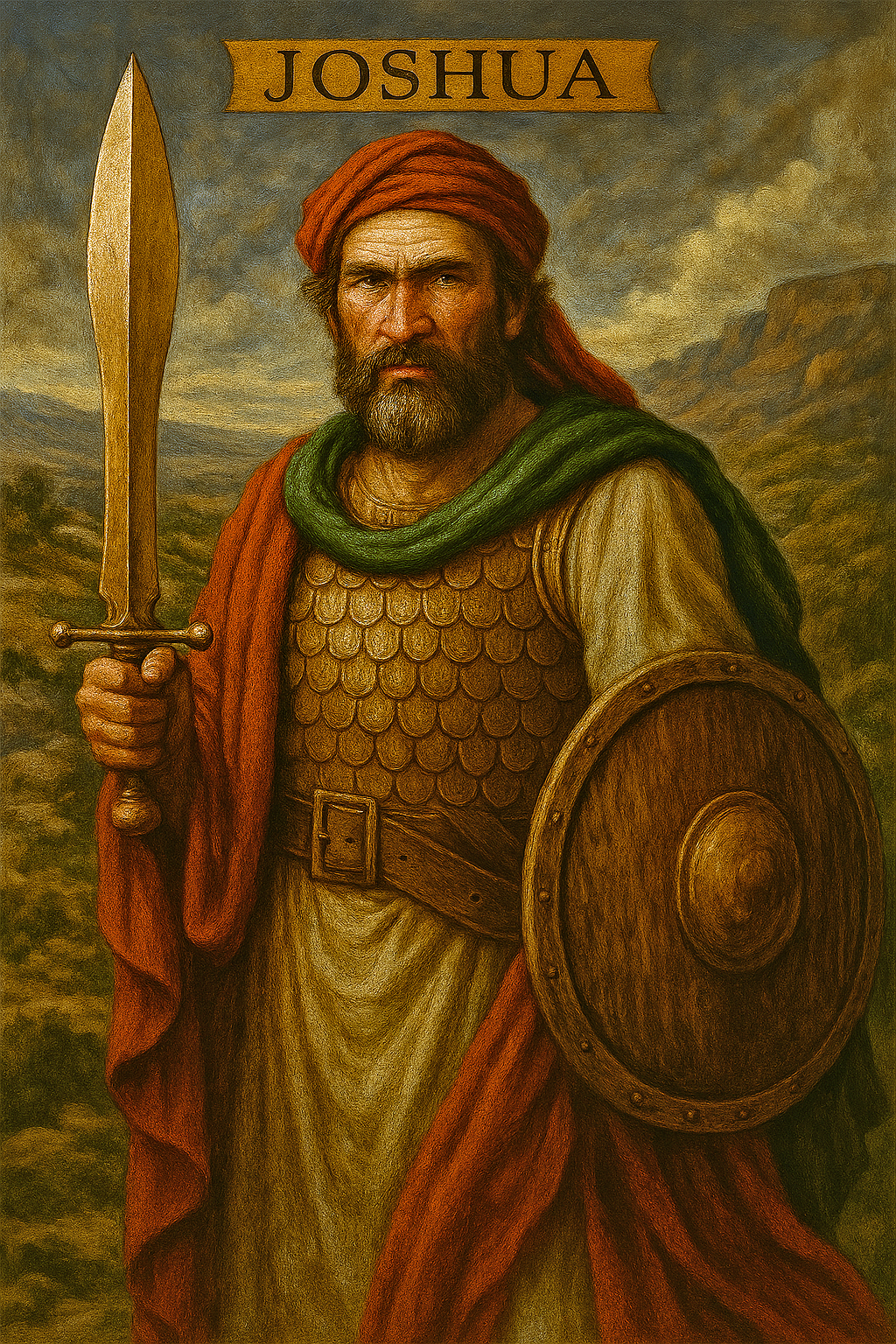
Joshua,
Moses' successor had that aura of prophetic character that revealed he also was
one who walked with God. He closely attended Moses in his ministrations,
councils, and judgments, taking on the wisdom of Moses that would eventually
allow him to step into the prophetic office and lead the people into Canaan and
conquest. Joshua did not become this prophetic leader overnight or on a whim.
He was one of the twelve spies who entered Canaan and brought back a good
report of what God had prepared for them. He and Caleb stood against the other
ten who were filled with fear and refused to go up and possess the land. Even
though their spirit of courage and faith in God was the right path, the others
wanted to stone them for speaking against the majority.
Sometimes
all a prophet can do when the people ignore prophetic counsel is to stand aside
and let the people, even though they are wrong headed, approach God, or in this
case reproach God and blame him for their fear and failure. In this case, they
brought upon themselves four more decades of wandering in the wilderness until
all but Caleb and Joshua had died, and they could enter Canaan and take
possession. For his faithfulness, Joshua, as a warrior prophet, led the people
into battle to drive out the inhabitants. Today, we look at all that bloodshed
and balk at the idea of so much death and destruction for a religious war of
conquest. But that is not what was ever intended by God. Had the people been
faithful when the spies came back, all the fighting would have been
unnecessary. God's plan was to drive the inhabitants of the land out with
hornets, not warfare. (Exodus
23:27-29) It was because of the hardness of the people's hearts driven by
fear without faith in God to overcome those fears that so many had to die in
battle.
Fears
are just as powerful today. Those fears cause people to look to a strong leader
they feel can overcome whatever fears exist. Innately, we understand the shepherding
role of the prophet, but our fears reveal we are not used to being shepherded.
This may be because those who should have fulfilled that role in our past
failed us and betrayed us to the storm with no rock to cling to. In such
desperate circumstances, we can feel nothing but fear like the disciples felt in
a storm-tossed boat on Galilee. But when we cry out to God, the waters
miraculously calm, and we are grateful for the peace, even though he rebukes us
for our lack of faith.
The
prophetic period from Moses to the Judges is a reminder that God does not
abandon us so much as we abandon him. Even so, he remains close. Whenever we
pray to him, we discover how near he is. (Deuteronomy
4:7) When we fail to take advantage of that closeness, it is as though we
purchased a cellphone and left it in the box it came in, never charging the
battery, never initializing it for service. Instead, we either write letters to
those we wish to communicate with or go see them. When we do, our friends who extensively
use cell phones wonder why we did not just call. It is the same with prayer.