
Stephen
Terry, Director


Surprised
by Grace
Commentary
for the October 11, 2025, Sabbath School Lesson
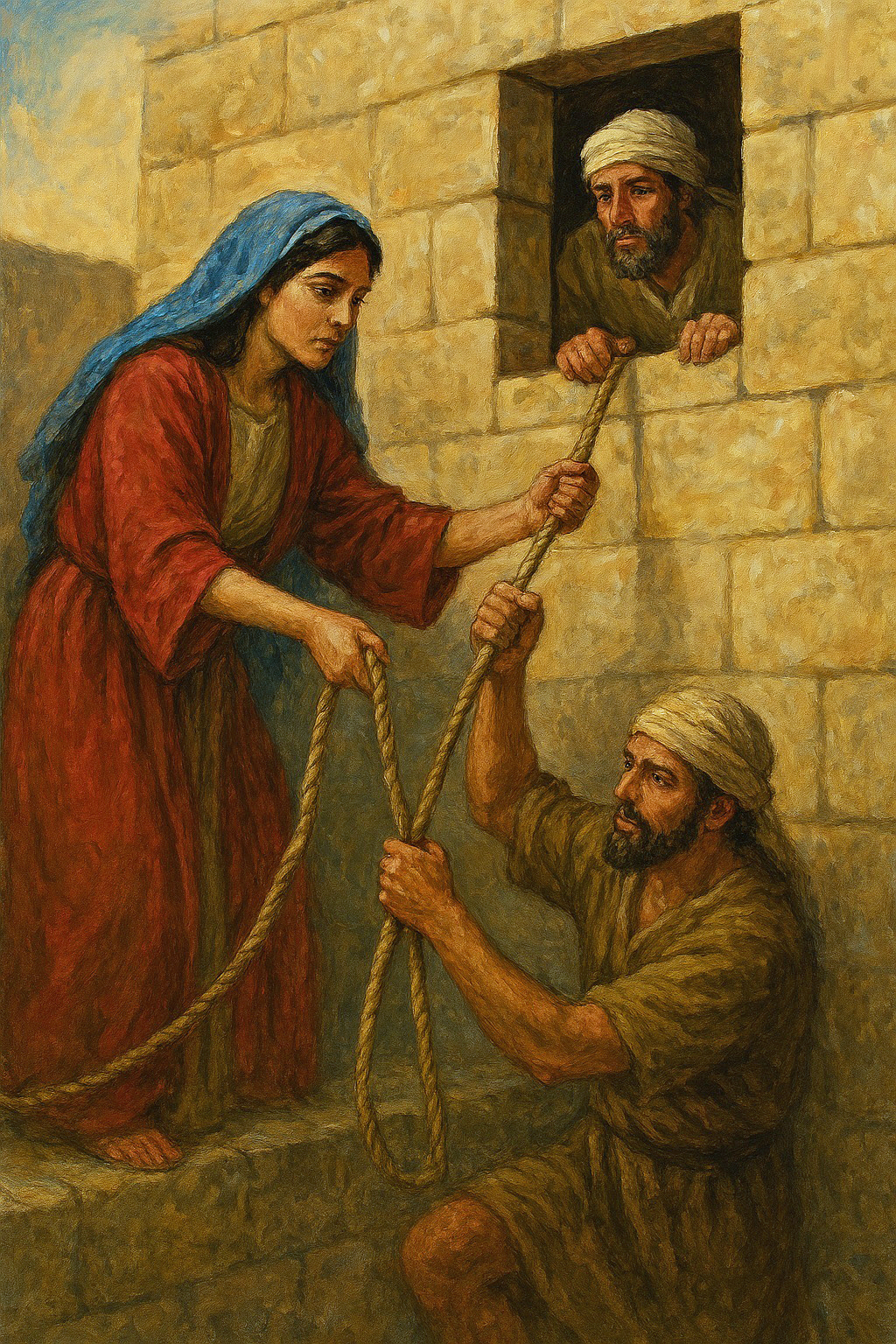 "By faith the
prostitute Rahab, because she welcomed the spies, was not killed with those who
were disobedient." Hebrews 11:31
"By faith the
prostitute Rahab, because she welcomed the spies, was not killed with those who
were disobedient." Hebrews 11:31
One
of the biggest difficulties we have in understanding God's character and our
own character in interaction with God is the tendency to focus on obedience
over faith. We continue to believe that we can chart a course that will allow
us to earn righteousness and salvation. We do this despite Paul's assertion in
his epistle to the Romans that we are all sinners. (Romans
3:12, 23) He allows no wiggle room here, and we are not only guilty of sin,
but of the vilest sins. He enumerated some of the worst sins at the end of
Romans, chapter one, and lest we look down on those who commit them, he adds at
the beginning of chapter two, "you who pass judgment do the same things." (Romans
2:1) We might be tempted to think that the Apostle Paul, emissary to the Gentiles
would exemplify obedience, but he says of himself, "For I know that good itself
does not dwell in me, that is, in my sinful nature. For I have the desire to do
what is good, but I cannot carry it out. For I do not do the good I want to do,
but the evil I do not want to do--this I keep on doing." (Romans
7:18-19) Paul tried to achieve perfection, bringing the matter to God. "Therefore,
in order to keep me from becoming conceited, I was given a thorn in my flesh, a
messenger of Satan, to torment me. Three times I pleaded with the Lord to take
it away from me. But he said to me, 'My grace is sufficient for you, for my
power is made perfect in weakness.'" (2
Corinthians 12:7-9) In that knowledge, Paul was able to proclaim, "Therefore,
there is now no condemnation for those who are in Christ Jesus, because through
Christ Jesus the law of the Spirit who gives life has set you free from the law
of sin and death." (Romans
8:1-2)
For
those who might be tempted to quibble over obedience to the law over faith in
Christ, we only need examine our Savior's teachings. For example, in the
Parable of the Sheep and the Goats (Matthew
25:31-46), the people are divided into two classes, the saved and the lost.
Based on obedience and veneration of God's law, we might expect we would find
Sabbath keepers, among the sheep, and murderers, adulterers, and thieves among
the goats. But none of those qualifications are mentioned by Jesus in the parable. Caring for the most
basic needs of others seems to be the key to the gates of heaven. How can this
be when it has been hammered into us for generations that Sabbath keepers are
the chosen and saved remnant? Even if that somehow plays into it, it calls into
question whether we really understand what the Sabbath is about. Is this
another one of those times where Jesus is saying, "you have heard it said, but...?"
But
this did not begin with Jesus. Plenty of examples are in the Old Testament. The
Canaanites were to be annihilated by the Israelites. "However, in the cities of
the nations the Lord your God is giving you as an inheritance, do not leave
alive anything that breathes. Completely destroy them--the Hittites, Amorites,
Canaanites, Perizzites, Hivites and Jebusites--as the Lord your God has
commanded you." (Deuteronomy
20:16-17) Obedience demands that all should be killed, but an early
exception is made for Rahab in Jericho because she helped the Israelite spies.
We might expect that she must be an ancient equivalent to a modern saint like
Mother Theresa, a chaste nun serving others while in perfect obedience to
dogma. Nothing would be further from the truth. Not only was Rahab one of the
Canaanites despised by Israel, but she was also one of the lowest and most
despised of those even among her own people. She sold herself sexually. She was
a prostitute. Considering the fuss made in churches today over those who dress
even remotely in an overtly sexual fashion, I doubt any of our modern Christians
would welcome her into their social circles. More likely, she would be at best
the subject of never-ending gossip, and at worst completely shunned by those
who tend to look down on publicans and such. (Luke
8:9-14)
Instead,
Rahab is not only saved from the death sentence passed on the Canaanites, but
she also even marries Salmon, a descendant of Judah, a prominent patriarch. She
and her husband have a child named Boaz, who also figures importantly in the line
of descendants who gave us Jesus. We sometimes joke about our own family trees
and find pirates or other rapscallions hiding in the boughs and among the
leaves. In contrast we might expect Jesus to come from the purest line of forebears,
but such is not the case. The patriarch, Judah, liked to visit prostitutes and
even had sex with his daughter-in-law, Tamar, thinking she was a prostitute
looking for customers. (Genesis
38) Rahab was not the first to be referred to as a prostitute in Christ's
lineage. And later, even Mary, the mother of Jesus, had to deal with spurious
allegations surrounding his birth. (Matthew
1:18-19)
If
those were not enough blots on Christ's lineage, next came the question of
Rahab's son, Boaz, who married Ruth, a Moabitess. While it is true that Moabites
were not among the inhabitants of Canaan commanded to be exterminated, they
were still banned. "No Ammonite or Moabite or any of their descendants may
enter the assembly of the Lord, not even in the tenth generation. For they did
not come to meet you with bread and water on your way when you came out of
Egypt, and they hired Balaam son of Beor from Pethor in Aram Naharaim to
pronounce a curse on you." (Deuteronomy
23:3-4) Not only was she allowed to marry Boaz, but only three generations
later, her descendant was not just one of the assembly of the Lord, he was
their ruler King David, and Jesus was often referred to as the Son of David.
But we are not done yet, for Jesus was descended from David and Bathsheba, a
woman taken by David in an adulterous affair and married into the royal line
after David had her husband murdered.
After
all of this, it seems strange that one of the primary accusations against Jesus
was that he associated with sinners, even eating with them. This was considered
evidence that he could not be the perfect Messiah that all were expecting. How
could God favor such a flawed individual with the conquering power to defeat
the Romans and usher in a messianic age for Jerusalem? People have funny ideas
about what are necessary qualifications to save us all from ourselves and bring
us to paradise. They tend to look for those who hate the same people they do
and are reluctant to point out the sins committed by their own crowd of
followers. In return, those followers grant a sycophantic pass for the sins of
those they would have lead them. It has been like this from the days of Nimrod
to the present. It is little wonder, therefore, that we can find no one without
sin for we all are hiding something that we would rather not have see the light
of day.
Strangely,
despite that, some among us go about proclaiming perfection is possible and
urge obedience to a dogmatic standard as evidence of that perfection. But it is
possible to observe the letter of the law and still miss the mark of
perfection. The wealthy young man assured Jesus that he faithfully observed all
the law, until Jesus revealed that the law is not the standard. The basis of
the law, love, is the standard. Once we understand that, we can see that no one
is without sin, for at times, we all have placed self over love. Most often, we
do this out of fear, fear that we will lose something if we relate to others from
love instead of a quid pro quo that ensures that we gain as much as we give if
not more.
One
thing Jesus was well versed in was the Old Testament. It was the scripture of
his day. And he understood that the harshness found there was because of the hardness
of people's hearts. He revered the prophets and quoted them as he tried to
steer people aright regarding this harshness. Interestingly, those prophets were
laden with sins just like the rest of us. God used them in mighty ways, and
their words continue to be powerful witnesses to us still. But Jonah fled from
the Lord. Elijah fled from Jezebel after the amazing Mount Carmel experience. Habakkuk
struggled with doubts over how God could allow evil to exist. Samuel was
faithful, but his children were so corrupt that the Israelites demanded a king
to lead them instead. Isaiah was a faithful prophet, but he told King Hezekiah
he was going to die. When Hezekiah prayed for healing God sent the prophet back
to tell the king that God had heard his prayer and he would live for fifteen
more years. However, those extra years allowed Hezekiah to father Manasseh, one
of the evilest kings to rule in Jerusalem, filling the city with blood from one
end to the other.
The
lesson we need to understand is from Tamar to Bathsheba, Rahab to Ruth, Jonah
to Elijah, God does not call us because we are perfect. He calls us because we go. Despite our flaws, he loves us enough to call us anyway.
And once we learn to love like he does, we will find ourselves
among the sheep and not the goats.