
Stephen
Terry, Director


The
Enemy Within
Commentary
for the November 8, 2025, Sabbath School Lesson
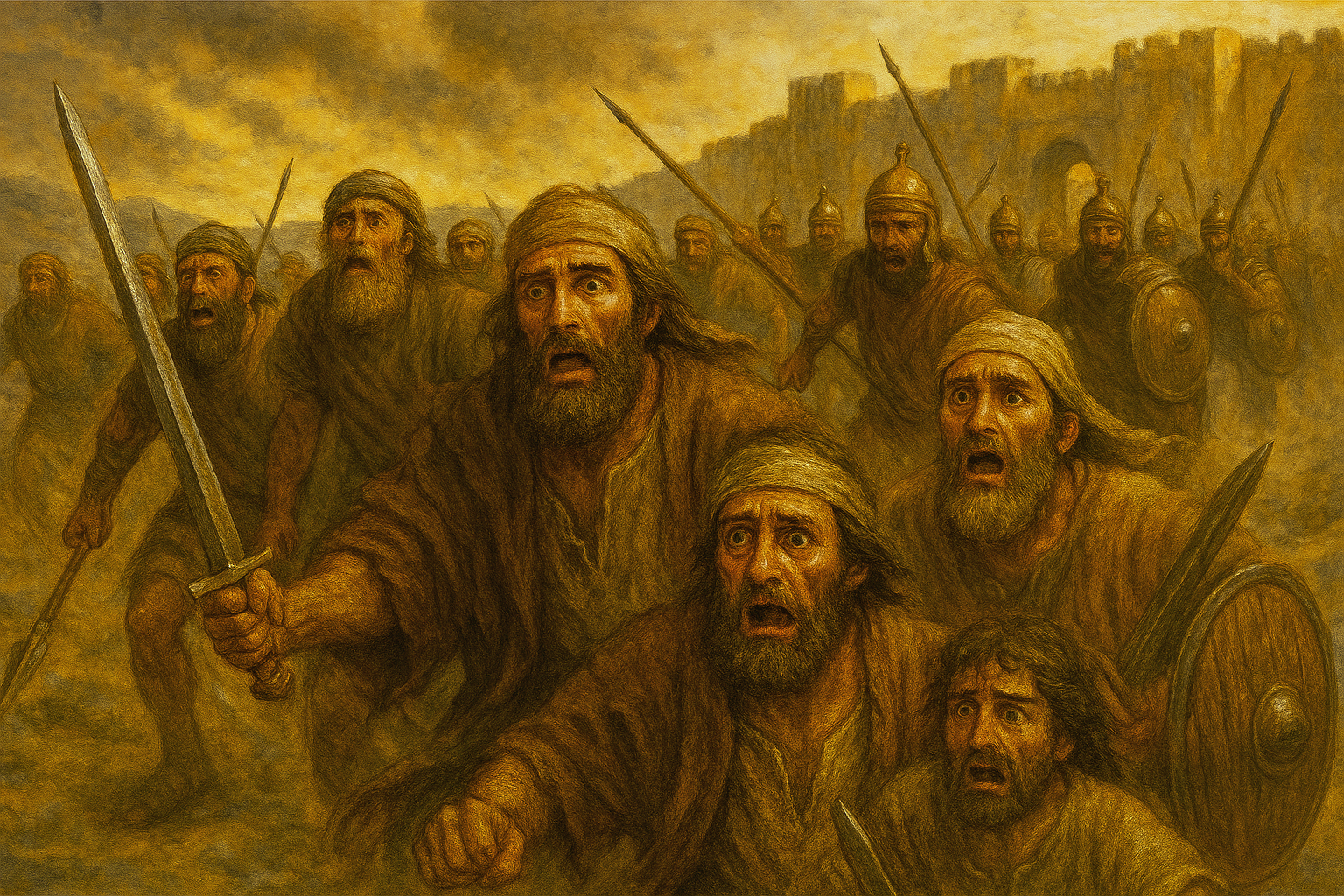 "When they returned to Joshua, they said, 'Not all
the army will have to go up against Ai. Send two or three thousand men to take
it and do not weary the whole army, for only a few people live there.' So about
three thousand went up; but they were routed by the men of Ai, who killed about
thirty-six of them. They chased the Israelites from the city gate as far as the
stone quarries and struck them down on the slopes. At this the hearts of the
people melted in fear and became like water." Joshua 7:3-5
"When they returned to Joshua, they said, 'Not all
the army will have to go up against Ai. Send two or three thousand men to take
it and do not weary the whole army, for only a few people live there.' So about
three thousand went up; but they were routed by the men of Ai, who killed about
thirty-six of them. They chased the Israelites from the city gate as far as the
stone quarries and struck them down on the slopes. At this the hearts of the
people melted in fear and became like water." Joshua 7:3-5
So
much of the biblical narrative carries themes of theodicy where dreadful things
happen to God's chosen people and those who oppose them seem to triumph at their
expense. One of the most familiar stories is that of Job who was faithful to
God and cared for his fellow man without wandering from the path of
righteousness. Yet, even Job was brought low with tragedy upon tragedy destroying
everything good from his life. Sitting in ashes miserably scraping boils from
his skin, he could not even find solace from his wife who urged him to end it
all by cursing God. But God was not done with Job, and his story continues to
resonate today for those who wonder why, despite faithful obedience, God's
people are subjected to untold suffering.
The
prophet Habakkuk questioned whether God even notices the suffering of his people.
Does he care? Will he rouse himself to intervene before everyone is destroyed?
Even Jesus echoed this same sentiment when he stated without intervention God's
people would not survive. (Matthew
24:21-22) God revealed to Habakkuk what he was doing to deal with the
situation, but the prophet was not pleased to see that others, more wicked than
the Israelites, were to be a foil against the evil that had arisen in Israel.
It was hard to take, and it left Habakkuk in silence before God's throne, saddened
at the evil to come but unable to gainsay its necessity. This may be the real
reason for the inexplicability of the dilemma of theodicy. When our faith fails
when we cannot fathom why a loving God would allow untold evil, we may be
subjects of God's mercy by being sheltered from what is to come in response to
all the evil. As a war veteran, I can vouch for the devastating mental trauma
that results from the things seen and done in warfare. If God did not shelter
us from the full extent of the conflict between good and evil, the Post
Traumatic Stress would be everywhere, and it would feed the trauma in an ever-widening
cycle of destruction and retribution. God would not have his people live like
this. We were created in his image (Genesis
1:27), and God is love. (1
John 4:8)
God's
intent was that we should never have to fight and kill at all. Through Moses,
he told the people, "Do not be afraid. Stand firm and you will see the
deliverance the Lord will bring you today. The Egyptians you see today you will
never see again. The Lord will fight for you; you need only to be still." (Exodus
14:13-14) He did not intend for them to fight and kill in Canaan either when he
promised them the land of the Canaanites. "I will send my terror ahead of you
and throw into confusion every nation you encounter. I will make all your
enemies turn their backs and run. I will send the hornet ahead of you to drive
the Hivites, Canaanites and Hittites out of your way. But I will not drive them
out in a single year, because the land would become desolate and the wild
animals too numerous for you." (Exodus 23:27-29)
It is
challenging to stand silent while waiting for God to act. Even mighty prophets
have failed to stand when challenged. Elijah stood on Mount Carmel and
presented a sacrifice that was consumed by fire from heaven before all the
people, challenging them to stand for God instead of the pagan idols of Jezebel
and her followers. But even after that great display of God's presence and
power, he ran and hid when that woman promised to take his life. (1
Kings 18:16-19:18)
King
David, who wrote in the 23rd Psalm about walking in "paths of righteousness"
and lying "beside still waters," nonetheless walked through valleys of great
darkness where he felt "the shadow of death." Because he shared this
experience, I have memorized it and found comfort in its verses when facing my
own shadows. But it does not end there. I continually read the Bible from cover
to cover because every time I read it, my circumstances differ, so it speaks to
me differently as well. And it has an added benefit, when high on a mast in a
storm far out at sea, a sailor is thankful for the rope rigging and depends
upon it for his life. The Bible is that rigging for the believer. But if the
sailor never ascends the ropes in clear weather, it will be doubly perilous to
climb the rigging without that experience when the storm hits, and the gales
would blow him from the yards and into the churning blackness of the sea. The
wise sailor not only learns when it is easiest to do so but builds a framework
of what does and does not work. His obedience to those principles is insurance
against the storm. The prophet Amos tells us that a time is coming when the
word of God will be difficult to find (Amos
8:11), all the more important then to seek it out now while we can.
When
the Israelites had opportunity four decades before to enter Canaan without the
massive loss of life, they had not submitted to that framework of obedience
that would have spared them and the Canaanites so much bloodshed. While the
Canaanites had lost their right to live in the land because of their
ever-growing evil. God's compassion would still have driven them with hornets
instead of what eventually took place. God's actions are tempered with mercy
and grace, and still, we fail to accept or appreciate them. The result is sorrow
for all, both God's people and their enemies. For us because we think that all
that is required is to know a few proof texts from the Bible and calling
ourselves Christian despite what our characters witness against us., and for
our enemies because, through our own unfaithfulness, we deny them the hope that
we claim to have, not realizing that destroying their hope also threatens our own.
The
Israelites, fresh from their victory against Jericho soon discovered they were
not the mighty host of God they thought themselves to be. The walls of Jericho
did not fall because the Israelites were so righteous it could not be
otherwise. They fell because the people of Jericho had come to trust in their
own wealth and power to overcome every challenge. They saw no need for
repentance from the misery they caused others. The walls they had come to rely
on to secure that wealth and control over the surrounding countryside came crashing
down revealing the nakedness of their world view and how little it could do to
save them from real danger. They perished, but the virus of greed and
corruption did not and it infected Israel through Achan and his family.
Knowing
the evil of what he had done, he hid plunder from Jericho in his tent despite
the ban on taking plunder. He never asked himself, "If the plunder could not
save the people of Jericho, why should it be able to save me and my family?" He
did not realize or accept the importance of obedience, and his impatience for
plunder got the best of him. While he paid with his life for that error, had he
only waited, with the next battle the Israelites were allowed to keep both livestock
and plunder. We get our own idea of what is needful or what is right and think
it is God's will, so we rush headlong to fulfill the imagined need. We even
contrive fanciful arguments as to why our impatient rooting about and ruining
things for everyone else is beneficial. The prophet Ezekiel wrote of those who
give so little care for others. "As for you, my flock, this is what the
Sovereign Lord says: I will judge between one sheep and another, and between
rams and goats. Is it not enough for you to feed on the good pasture? Must you
also trample the rest of your pasture with your feet? Is it not enough for you
to drink clear water? Must you also muddy the rest with your feet? Must my
flock feed on what you have trampled and drink what you have muddied with your
feet?" (Ezekiel 34:17-19)
Achan
was one of those who would trample on the blessings rightfully to be expected
by others to feed his own greed. His ilk has not died out despite his tragic
end. When God calls shepherds, it is not to reward their righteousness. They
have none. The only perfect shepherd was Jesus. He calls us to learn and grow
and to care for one another. We are called to provide
for others what we have provided for ourselves. If we instead choose
covetousness and greed as Achan did, we will find there will never be enough to
satisfy us as so many around us in this life give proof of. Even those who claim
God's ordination have sold themselves to grub for money as mendicants, forsaking
the high calling of the gospel and God's promise to care for all who are his.
As King David shared, "I was young and now I am old, yet I have never seen the
righteous forsaken or their children begging bread." (Psalm 37:25) God promises,
"Before they call I will answer; while they are still speaking I will hear." (Isaiah
65:24) "Put not your trust in princes, nor in the son of man, in whom there is
no help." (Psalm 146:3) "God is our refuge and strength, an ever-present help
in trouble." (Psalm 46:1)