
Stephen
Terry, Director


The
True Joshua
Commentary
for the December 6, 2025, Sabbath School Lesson
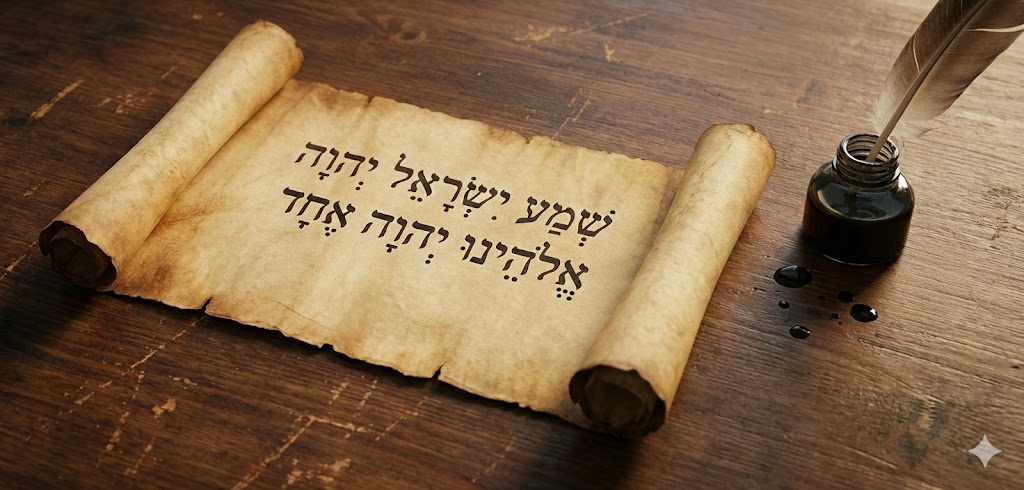 "Hear, O
Israel: The Lord our God, the Lord is one."
"Hear, O
Israel: The Lord our God, the Lord is one."
Deuteronomy 6:4
Great
splits exist today in Christianity over the importance of words and their
meanings. A recent conclave convened over words that split the Roman Catholic
Church from the Orthodox Church centuries ago over two different versions of
the Nicaean Creed. The version favored by the Catholics offered support for
their Trinitarian theology. Whereas, the Orthodox version, Homoousias, saw
Jesus as divine, it did not support the distinct compartmentalization of
Trinitarianism. While this may seem an inessential distinction, it was enough
to result in mutual bilateral excommunications. Therefore, it is significant
that the Pope, while reciting the Nicaean Creed at the conclave, recited the
Orthodox rather than the Catholic version. This was lauded as a step toward
healing a great rift that has gone on far too long.
We
have similar rifts of a more modern derivation that have unnecessarily split Christianity.
For instance, while I was in the Army stationed in Alaska during the 1970s, I
studied the Bible with others as they were willing, and one young man who
claimed to be of the Holiness Pentecostal denomination considered me to be a
heretic and refused to have anything to do with me. My sin? When baptizing, I
chose the formula in Matthew
28:19, "baptizing them in the name of the Father and of the Son and of the
Holy Spirit." He insisted that the only baptism God would recognize was baptizing
"in the name of Jesus" according to Acts
2:38. He maintained that "Jesus" is the name of the Father, Son, and Holy Spirit,
and one could not receive the Holy Spirit without that formula. This is an
interesting view, but it tends to result in reducing baptism to a magical rite only
possible with an essential incantation. It begs the question, if it is that
specific, what language must the incantation be recited in? Is it as
efficacious in Modern Chinese as it was in the koine Greek of the Book of Acts?
Another
encounter I had in Alaska was with a soldier who was a Jehovah's Witness. As modern
Arians who deny the divinity of Christ, they also have a fixation over names.
In all references to God, they use the word "Jehovah." In fact, in their
denominationally created translation of the Bible, it inserts "Jehovah" in
every such instance. There is no word "Jehovah" in the early texts of the
Bible. It is based on the Hebrew Tetragrammaton: יהוה. The Jews
considered this God's name and too holy to be uttered. You can see two
instances of this word written on the scroll in the picture accompanying this
commentary from Deuteronomy 6:4.
Hebrew
was originally written without vowels. The marks you see above and below the
lines on the scroll are vowels that were added later. They were written above
and below the text because the text was considered too holy to be directly
altered. There was a problem, however, concerning the name of God. If the
correct vowels were provided what would prevent someone from accidentally
uttering what was prohibited? The solution was to write instead the vowels for "Adonai"
which means "Lord." Translators of the Bible have respected this and often
translate the Tetragrammaton with the vowels from "Adonai" as "LORD" with all
capital letters indicating that is what they have done. While this shows
respect for rabbinic sensitivities and scholarship, the Jehovah's Witnesses do
not agree and instead created a novel word that combines the consonants from
the Tetragrammaton and the vowels from "Adonai" as "Jehovah." This has resulted
in them inserting the word "Jehovah" contrary to the biblical text in places like
the gospels. (i.e., "But as for you, young child, you will be called a prophet
of the Most High, for you will go ahead of Jehovah to prepare his ways." (Luke
1:76, New World Translation by the Jehovah's Witnesses)[i])
This, too, seems to turn the name into an incantation that, if uttered correctly,
will produce miraculous results. But the Bible is far more than a magic
spellbook of incantations. Viewing it as such can jeopardize one's relationship
to God as Simon the Sorcerer discovered. (Acts
8:17-20, Cf. Acts
19:13-20)
What then
is the truth about Joshua? He prefigures Jesus as a type of savior leading the
people into the Promised Land. His name, as did the name of Jesus, refers to
salvation for the people, not through the strength of the people, but through
God. Humanity has a long history of trying to save itself. Often religious
reasons are cited for such actions, but people are poor enforcers of what we
imagine to be God's will because 1) we often have little understanding of God's
will, confusing the use of force with compassion and empathy. This was
sometimes the case in the Vietnam War and the My Lai Massacre in particular, we
tend to believe that the only way to save the village is to burn it to the
ground. 2) Patience is not our strong suit and allowing time for the Lord to
work in any given situation is challenging. We would rather rush in like fools
wielding instruments of evil to compel obedience than wait for God.
Nonetheless, often our only action should be to be still. (Exodus
14:14) And vengeance should not be our part lest we throw away our own
salvation. All vengeance belongs to God, who knows fully every aspect of every
situation.
God's
expectation for us is "Do not repay anyone evil for evil. Be careful to do what
is right in the eyes of everyone." (Romans 12:17) And his promise to us is, "Do
not take revenge, my dear friends, but leave room for God's wrath, for it is
written: 'It is mine to avenge; I will repay,' says the Lord." (Romans 12:19)
It took forty years of wandering in the wilderness for the Israelites to learn
to depend on God's timing and his leading through his chosen representative. For
us, it often takes a lifetime. We tend to get hung up on things like perfectionism,
formulaic incantations, and believing we need to build paradise here. Ironically,
the town of Paradise, California, leveled by wildfire, is illustrative that any
paradise we can build in this life is only fuel for the flames that will one
day consume all such vanity. Each of us knows our time on this earth is
woefully limited, but we act as though it is not and what we build or
accumulate will remain forever. We can build golden testaments to our power and
influence just as Nebuchadnezzar did. (Daniel
3) We can demand all people respect and bow down to what we have erected,
but in the end, the power is God's, and he will set up or tear down whomever he
will. (Daniel
4)
Despite
their delivery from slavery when God confronted Pharaoh and nearly destroyed
the kingdom of Egypt, the Israelites looked only upon their own meager strength
and lived in fear, unable to understand the power of God. They refused to trust
in God and go up into Canaan and possess the land as God had offered them. As a
result, that generation save Joshua and Caleb, died in the wilderness, and
their children went up to claim Canaan four decades later. Their parents could
not see things as they truly are. They could not place their faith in God,
preferring trusting in their own weakness instead, and receiving the result of
such misplaced trust. How many there are that do the same today? Their fear of
what might happen if they start trusting in God overshadows their ability to
see the freedom that exists beyond the cross. Like Pilgrim in John Bunyan's "Pilgrim's
Progress," we go forward in life struggling with a load we were never meant to
carry. With that load we find ourselves stuck, trying to muck our way through
the Slough of Despond. Just like those who could not envision going forth into
Canaan, our inability to see anything but our burdens keep us from making any significant
progress on the narrow path heavenward.
We
admire Joshua for his faithfulness and his stalwart spirit, but Joshua had
nothing that was not available to us. God is fully willing to lead us forward.
But instead, we sit by the phone wondering why God never calls us or even if he
exists, while failing to recognize that it is we ourselves who have cut the
phone line. God has our phone number, but when he calls it says the line is
disconnected. If we are ready to talk to God once again, then we need to patch up
that line with the electrical tape of prayer and "be still" as we await his
response. He will call. Ever since Eden when humanity ran and hid from him, he
has missed us greatly. When I consider the millions and millions of dead made
so at our hands over the centuries since we walked away from God, we need him and
what he can teach us about compassion and empathy more than we realize.