
Stephen
Terry, Director


Ultimate
Loyalty: Worship in a War Zone
Commentary
for the November 15, 2025, Sabbath School Lesson
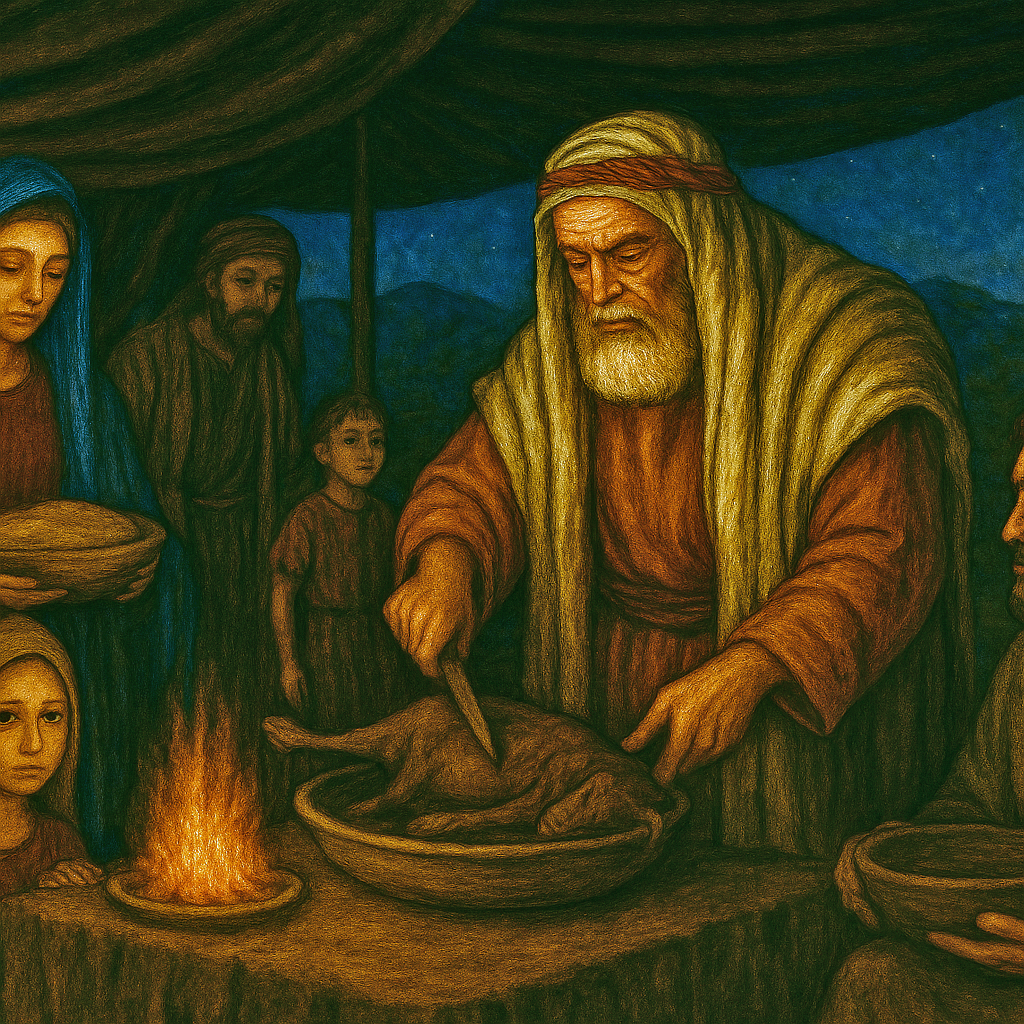 "On the tenth
day of the first month the people went up from the Jordan and camped at Gilgal
on the eastern border of Jericho."
"On the tenth
day of the first month the people went up from the Jordan and camped at Gilgal
on the eastern border of Jericho."
"On the evening of the fourteenth day of the month,
while camped at Gilgal on the plains of Jericho, the Israelites celebrated the
Passover."
Joshua 4:19 & 5:10
After
God divided the waters of the Jordan river, allowing the Israelites to walk
across the riverbed, it seems inane from a military perspective what they did
next. At Gilgal with their first objective in the conquest of Canaan, Jericho,
next door, they conducted a mass circumcision of all the males who had not been circumcised while wandering in the wilderness. While
the procedure is quick, it is not painless, and adults can take anywhere from
two to six weeks to fully heal. If the Canaanites had chosen to attack them, they
would have been able to muster little resistance and could have been driven
back into the Jordan. Arguments have been made that they would have been ready
to fight and defend themselves after only three days. But that was not the case
with Shechem, his father Hamor, and their entire town. Three days after being
circumcised they were unable to defend themselves against only two of Jacob's sons,
Simeon and Levi, who killed them because Shechem had raped their sister, Dinah.
God
seems to have protected his people during this time. After reports of the
Israelites crossing the Jordan on foot circulated among the Canaanites, they
were afraid to attack a people who had such a powerful God preparing the way
for them. They had been following Israel's progress ever since Egypt, according
to Rahab, the Canaanite prostitute who helped the Israelite spies. She told
them, "I know that the Lord has given you this land and that a great fear of
you has fallen on us, so that all who live in this country are melting in fear
because of you. We have heard how the Lord dried up the water of the Red Sea
for you when you came out of Egypt, and what you did to Sihon and Og, the two
kings of the Amorites east of the Jordan, whom you completely destroyed. When
we heard of it, our hearts melted in fear and everyone's courage failed because
of you, for the Lord your God is God in heaven above and on the earth below." (Joshua
2:9-11) Witnesses testified that God was fighting for Israel, and they were
coming for the Canaanites. This was according to God's promise through Moses on
the shore of the Red Sea. "The Lord will fight for you; you need only to be
still." (Exodus 14:14)
The
Israelites had four decades of wandering the wilderness to drive this lesson home.
It was the recognition of how vital God's presence was to them that led them to
submit to the mass circumcision. They had come to believe that whatever God
demanded was necessary for victory. Even four days later, despite the pain,
they rose up to celebrate the first Passover in Canaan. God did not allow harm
to come to them during the Passover in Egypt. He would not allow it here in
Gilgal either. They celebrated faithfully on the fourteenth day of the first
month. This was a high point of their conquest of Canaan, and the walls of
Jericho collapsed before them later as evidence of their continuing favor. But
as high points often do, they descended into a low and dark valley afterwards.
Achan plundered Jericho despite God's command not to and dozens of his fellow
Israelites died when attempting to take Ai as a result. The covenant with God
had been allowed to lapse in the wilderness and the sign of that covenant,
circumcision, was not imposed. But with the reinstatement of circumcision came reinstatement
of the covenant.
How
sad that soon after its reinstatement, one man and his family turned their back
on God for material gain. It is even sadder that a Canaanite prostitute had a
better understanding of God, than one among those who considered themselves God's
chosen sons of Abraham. Achan and his household died for their betrayal. It may
seem harsh to punish the entire family, but he could not have hidden everything
in his tent without the family being complicit in the deceit. While tragic,
after their death, they felt no further pain, but the families of those who
died because of Achan's betrayal would never forget the loved ones they lost
because of that perfidy. The record of that betrayal has come through the
centuries that we might learn from that lesson.
In
contrast, the Canaanite prostitute, Rahab, married into Israel, marrying
Salmon. From that union came Boaz, who married Ruth, a Moabitess. Eventually,
through Jesse, came King David. Jesus, the Messiah, came as prophesied from
that Davidic heritage. All eventually happened because a Canaanite prostitute
had a more faithful relationship with God than did a family God, through Moses,
had rescued from Egyptian slavery.
Could
it have been knowledge of this heritage that led Jesus to share the "Parable of
the Two Sons?"
"What
do you think? There was a man who had two sons. He went to the first and said,
'Son, go and work today in the vineyard.'
'I
will not,' he answered, but later he changed his mind and went.
Then
the father went to the other son and said the same thing. He answered, 'I will,
sir,' but he did not go.
Which
of the two did what his father wanted?"
"The
first," they answered.
"Jesus
said to them, 'Truly I tell you, the tax collectors and the prostitutes are
entering the kingdom of God ahead of you.'"
(Matthew
21:28-31)
When
we consider the hostility that exists between the people who call themselves
Christian today and those they consider sinners, it is apparent we are failing
to understand the depth of God's love for all. We would cast those we deem
sinners from God's presence in a misguided attempt to purify the church,
driving away those whom God is most earnestly calling and who are most eager to
respond to that call. They are intimately acquainted with sin and its
detrimental effects, including the hopelessness, depression, and despondency it
induces. The slightest light of a caring heart would draw them from darkness
toward that light. Unfortunately, that light is seldom found
in churches where people are continually watched that
they might be caught in a sin that would allow the
church to cast them out. This is how the Pharisees treated Jesus, trying to
trick him into blasphemy so that they could prove he was not really speaking
for God and could safely be disposed of as a heretic.
We deceive ourselves if we believe that Pharisees are no longer around..
God
has told us that he takes no delight in the death of the sinner. (Ezekiel
33:11) If that is the case, why do we, who claim to be his followers, take
such delight in driving them away? If we do not think this is what we are
doing, then why are they "entering the kingdom of God ahead of us?" It is
because they have learned that loving the banned thing is no answer to their
need. It only brings emptiness to their being. Those pathways no longer have
the allure for them that they once had. They are like the prodigal who thought a
hedonistic lifestyle would bring him happiness and spent his inheritance
pursuing it. When realization dawned, he was ready to come home to the lifestyle
he once spurned even to the point of being only a servant in his family home.
Glad to have regained his lost son, the father welcomed him home with joy. But his
brother was not happy to see him. Not having seen the folly of what the world
offers us, he was jealous of his brother's experiences and refused to even
enter the house to welcome him. He is like the church member who would drive
out the repentant sinner because that sinner had not suffered enough to earn the
right to enter God's kingdom.
Jesus
told of a Pharisee visiting the temple while a tax collector was also praying
there. He prayed to thank God that he was not like the sinners, or worse, like
the tax collector. But the tax collector recognizing his own sins requested God's
mercy and did not compare himself to others he deemed less worthy. In relating
this story, Jesus tells us that it was the tax collector, not the Pharisee, who
found grace before God. (Luke
18:9-14) The tax collector, unlike the Pharisee, believed God loved him,
not because of who he is, but because of who God is, and he claimed the promise
of that love.
Every
moment we spend focusing on the sins of others is a moment lost where we could have
been loving God and loving others as the Bible has often told us to do. God
modeled that love to us throughout its pages. He created us in his loving
image. (Genesis
1:27) He revealed it through the incarnation of Jesus to help us find our
way home. "For God so loved the world that he gave his one and only Son, that
whoever believes in him shall not perish but have eternal life. For God did not
send his Son into the world to condemn the world, but to save the world through
him." (John 3:16-17) Would we trade such deep love for tawdry material goods as
Achan did? What a poor bargain that would be.