
Stephen
Terry, Director


New
Testament Prophets
Commentary
for the October 24, 2026, Sabbath School Lesson
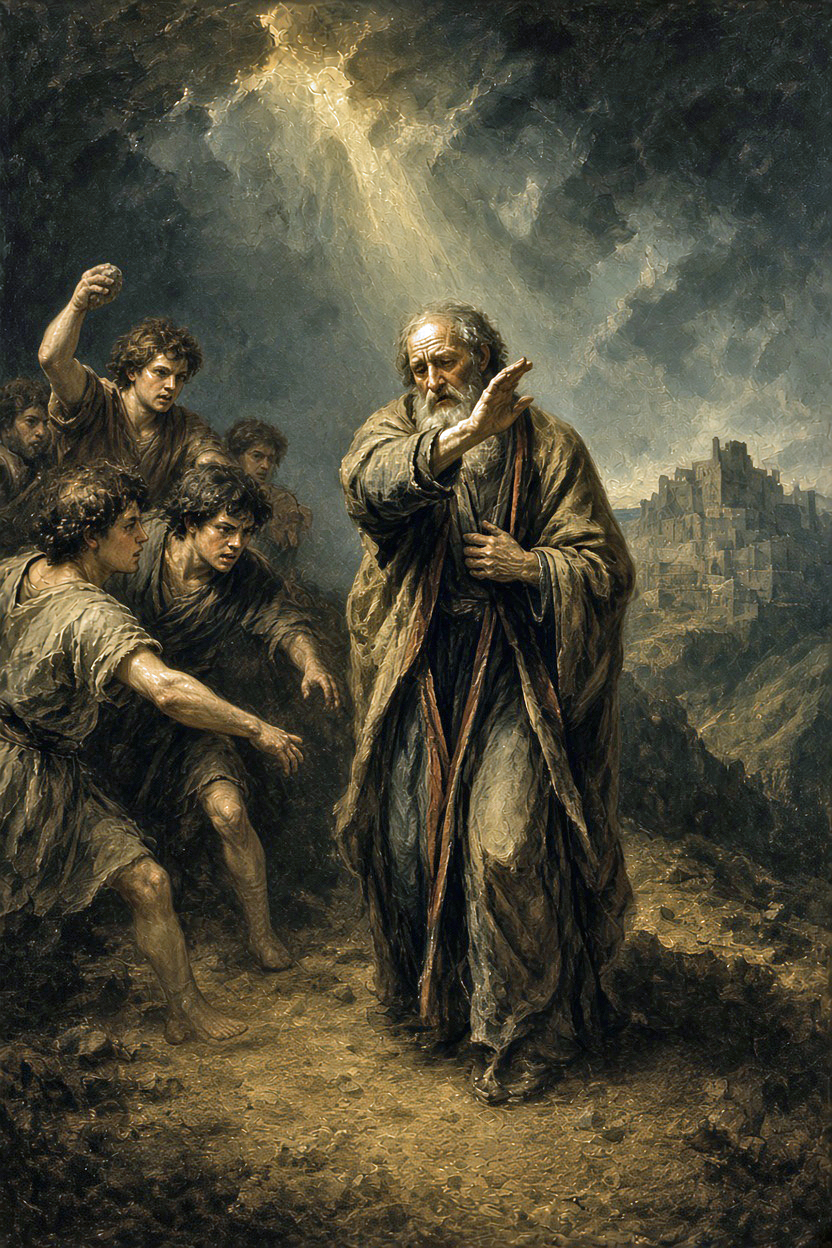 "In
fact, everyone who wants to live a godly life in Christ Jesus will be
persecuted, while evildoers and impostors will go from bad to worse, deceiving
and being deceived." 2 Timothy 3:12-13
Still
Waters Ministry, here in Washington State in the United States is a global
ministry and as such we interact with over 160,000 visitors to our website and
Facebook pages annually. Among those we interact with are thousands of those
who call themselves, apostles, prophets, bishops, pastors, priests, and various
other titles associated with the many Christian denominations that all
simultaneously claim to be the one true church. Usually, they make this claim
based on a limited number of proof texts they have ferreted from the Bible, traditional
church interpretations of such texts, or the inspired writings or utterances of
some long dead religious personality. They may also point to the millions who
follow the same creed as proof of God's endorsement of their titles.
They
cling to such titles despite the intent of Jesus when he said, "But you are not
to be called 'Rabbi,' for you have one Teacher, and you are all brothers. And
do not call anyone on earth 'father,' for you have one Father, and he is in
heaven. Nor are you to be called instructors, for you have one Instructor, the
Messiah." (Matthew 23:8-10) We are neither to seek honorifics from others nor
to bestow them on one another. This is because it supplants the authority of
God in our lives by implying we need another intercessor than Christ, and it
becomes an ongoing temptation to covet such titles and the imagined power,
influence, and respect that comes with them.
Jesus intended his followers to
show their connection to God by allowing the Holy Spirit to replicate his
humble, compassionate character in their lives. Seeking and bearing titles that
imply a special relationship to God is antithetical to that and misleads others
into seeing that as essential to the Christian experience and to seeking such
titles for themselves. John the Baptist lived a life that refuted all of that
and Jesus pointed him out as an example.
"As John's disciples were
leaving, Jesus began to speak to the crowd about John: 'What did you go out
into the wilderness to see? A reed swayed by the wind? If not, what did you go
out to see? A man dressed in fine clothes? No, those who wear fine clothes are
in kings' palaces. Then what did you go out to see? A prophet? Yes, I tell you,
and more than a prophet. This is the one about whom it is written:
'I will send my messenger ahead
of you,
who will prepare your way before you.'
"Truly
I tell you, among those born of women there has not risen anyone greater than
John the Baptist; yet whoever is least in the kingdom of heaven is greater than
he. From the days of John the Baptist until now, the kingdom of heaven has been
subjected to violence, and violent people have been raiding it. For all the
Prophets and the Law prophesied until John. And if you are willing to accept
it, he is the Elijah who was to come. Whoever has ears, let them hear." (Matthew
11:7-15)
John was the greatest of the
prophets hitherto his day. Greater than Moses, Elijah, Elisha, Isaiah,
Jeremiah, Ezekiel, or any other prophet. Yet, he claimed no title. He wore no
clerical garb like the priests at the temple in Jerusalem. He led no synagogue.
And as Jesus proclaimed the heritage of even God's greatest representatives was
violence and death, even at the hands of those who bore the very titles John
eschewed. So too for anyone who would emulate God's character in this world, as
Paul wrote in his second letter to Timothy as quoted at the beginning of this
commentary, succinctly "everyone who wants to live a godly life in Christ Jesus
will be persecuted."
Much of that persecution will even come from those purportedly serving God.
Again, Jesus warned of this as well. "They will put you out of the synagogue;
in fact, the time is coming when anyone who kills you will think they are
offering a service to God." (John 16:2) Despite all of that, amazingly, God
does not give up on us and continues to call those willing to call our fellow
human beings back to him, despite the risk. "I am sending you prophets and
sages and teachers. Some of them you will kill and crucify; others you will
flog in your synagogues and pursue from town to town." (Matthew 23:34)
There is a word that has special
significance here. It is "synagogue." This is where local people gathered for
worship under the guidance of a rabbi in lieu of traveling to the temple. Note
that the followers of Jesus, those seeking to emulate God's character in their lives
are persecuted even within and by their local church. That Jesus repeats this
only adds emphasis, and we should take it to heart. How many have spent decades
in the bosom of their local church thanking God for the special blessing of the
feeling of security that provides, not realizing that is about as far from the
life of the persecuted follower of Jesus as we could get.
People realized there was something
missing in all that in Jesus' day. That is why despite the hardships involved
they went out into the wilderness to hear what John the Baptist had to say
rather than listening to a homily by the local rabbi. It is why they were
willing to starve in the wilderness to hear Jesus. That willingness to suffer
to draw near to God allowed them to experience the miracles that multiplied
loaves and fishes. (Mark
6:30-44 & 8:1-10)
The person with a religious title, a roof over their head, an income, and flock
of followers has much less need of miracles and may, because of the path they
have chosen, experience far less of God's active, miraculous presence as a
result. But the one who discovers that those titles and all that security can function
as a barrier to God's freely flowing grace and learns to rely solely on God's
providence and compassion will open channels of blessing and salvation
otherwise overlooked.
I am not speaking of Prosperity
Theology here. Prosperity preachers love the adulation of their followers and
channel that adulation into an ever-growing stream of income and wealth believing
that such wealth is God's endorsement of their ministry. But Jesus had a
warning there also.
"And he told them this parable:
'The ground of a certain rich man yielded an abundant harvest. He thought to
himself, "What shall I do? I have no place to store my crops."
"Then he said, 'This is what
I'll do. I will tear down my barns and build bigger ones, and there I will
store my surplus grain. And I'll say to myself, 'You have plenty of grain laid
up for many years. Take life easy; eat, drink and be merry.'"
"But God said to him, 'You fool!
This very night your life will be demanded from you. Then who will get what you
have prepared for yourself?'
"This is how it will be with
whoever stores up things for themselves but is not rich toward God." (Luke
12:16-21)
As
if all of this were not enough, John the Baptist's life should give us a clue
as to how to identify a prophet in the New Testament and through all the centuries
since. His life was one of little that we would call wealth and power. But the
few words recorded about him in the New Testament reveal he found peace and fulfillment
in heralding the Messiah by the banks of the Jordan and the Sea of Galilee
where the water for baptism was accompanied by the beautiful scenes of nature.
Ending up in Herod's dungeon must have been horrible for one so accustomed to
the beauty of Creation. To be taken from that beauty and thrust into a dark
hole created by one human being to abuse others must have been horrible. And
then to be cruelly murdered without ever seeing those shores again is heart breaking.
But this is what those who have chosen not to surrender their hearts to God
would have for all of those who would give themselves completely to God. They
feel they have great power in this world, power so great that they can even
call for the death of the Messiah. What then is it for them to slay his lowly
followers?
Sadly,
the church has abetted much of this persecution through the millennia. Through the
early centuries after Jesus' ascension, they expected him to return soon and
relied on the Holy Spirit, given at Pentecost, to guide them in preparing for that
return. They cared for one another and those with means shared with those
without and all were blessed though no one was focused on accumulating wealth
for themselves. Those that were focused on wealth like Ananias and Sapphira (Acts
5:1-11), or Simon the Sorcerer (Acts
8:9-24) were dealt with harshly as being out of character for Christians.
But as Jesus' coming was delayed and the centuries rolled by, the body of
Christ, the fellowship that grew into the Christian church, transitioned into
an earthly kingdom instead of maintaining their focus on heaven and the second
coming of Jesus. Rather than continuing their early love and compassion for one
another, some took on religious titles and assumed authority over the rest, and
those in similar positions of authority began to war against one another, as
with Athanasius and Arius at the Council of Nicaea early in the fourth century,
seeking unquestioned authority over God's flock.
Eventually
the power of Rome won out, not surprisingly since the secular Roman Empire
ruled much of the known world already. That beast became so tempting to ride
that no pope could refuse it. The church has been enamored of such secular
authority ever since. But this is not the spirit of the prophets. Nor should it
be ours. Every time we take on a religious title as a sign of our authority
over others, every time we appeal to secular authorities to assert the church s
power over others in matters pertaining to faith, every time we exert authority
rather than compassion and grace, the Roman beast within hardens our hearts against
the whispers of the Holy Spirit. But every time we keep the commandments to
love God with all our heart and our neighbor as ourselves (Revelation
12:17), the Spirit that inspired John the Baptist and all other prophets can
inspire us and open the door to our hearts that God might give us a heart like
his, filled with love, compassion, and grace. (Revelation
19:10 & Ezekiel
36:26)